ASM-SMT-Technical Conditions of Order and Deliveries (TCOD).pdf - 第28页
28 www.asm-smt.com 9.6.1. General requirem ents Labeling method: Adhesive label, print, engraving, laser marking, stamping, etching, eroding, other methods as agreed with ASM AS. • Permanent attachment to support materia…
27 www.asm-smt.com
For Germany, this shall particularly include the packaging legislation and possibly also the waste legislation. Particular
attention shall be paid to aspects of the avoidance of excess packaging material and its reuse or recycling, respectively.
Reusable packaging shall be preferred.
For the definition of the packaging, the cooperation with packaging specialists is recommended.
The packaging is made in packing units according to the specifications of ASM AS. Painted and electroplated parts shall
be packaged so that mutual damage is excluded (except bulk goods).
9.5.2. Applicable specifications, guidelines and standards
These regulations, guidelines and standards only represent a foundation of instructions. In special cases, the additional
instructions contained in these documents shall be observed.
ISO 21067-1 Packaging — Vocabulary — Part 1: General terms
ISO 21067-2 Packaging — Vocabulary — Part 2; Packaging and the environment terms
ISO 780 Packaging – Distribution packaging – Graphical symbols for handling and storage of
packages
ISO 4180 Packaging -- Complete, filled transport packages -- General rules for the compilation
of performance test schedules
IEC 61340-5-1 Ed. 2.0 b:2016▹ Electrostatics - Part 5-1: Protection of electronic devices from electrostatic
phenomena - General requirements
9.5.3. First article inspection on packaging
The inspection of the packaging is part of the first article inspection of the ordered item of goods.
The packaging must be adequately implemented in compliance with the fragility characteristics.
The supplier shall conduct the test of the requirements for the packaging in compliance with the packaging standards
(e.g. fall test, climatic test, shock test, pressure test etc.) or furnish evidence of compliance by means of material
certificates in the first article inspection report.
The Supplier should discuss with ASM AS Source Team on packaging alignment.
Final visual inspection of the packaging and functional test of the packaged good.
Evidence on ROHS compliance if required.
9.6. Product labelling
The labeling of components and assemblies ensures their identification and traceability.
These definitions for labeling are considered the standard definitions. The technical documentation will usually contain
references to these definitions. The location of the labeling and the maximum available space for the labeling are also
specified in the technical documentation.
Should other labels and requirements apply for specific products than those specified here, the corresponding definitions
will be contained in the product-specific documentation.
28 www.asm-smt.com
9.6.1. General requirements
Labeling method: Adhesive label, print, engraving, laser marking, stamping, etching, eroding, other methods as agreed
with ASM AS.
• Permanent attachment to support material
• Abrasion resistance of the labeling
• Functional impairments must be excluded.
• Maximum resistance against solvents and contamination
• Temperature resistance in the range of -20°C to +7 0°C
• Non-conductive labels on electric assemblies
• Labeling should be visible in the installed condition, if possible
• Labeling should be legible even after surface treatment
• Font: Helvetica or Arial; other fonts to be agreed with ASM AS
• Character size: 1.5mm minimum (5 pts)
• Single line spacing
• Centered orientation.
9.6.2. Requirements for label markings
Acryl ate butyl adhesive for labels, PNS adhesive type and adhesive strength class T according to DIN 30646
The label size on the packaging should be not more than 90 x 60 mm.
The label size on the modules should be not more than 40 x 30 mm
Label background color: white
Font color: black
9.6.3. Labelling design
9.6.3.1. Individual parts, functional assemblies and purchased assemblies
These include manufactured parts and assemblies as well as purchased assemblies that need to be labeled to achieve a
clear identification and traceability.
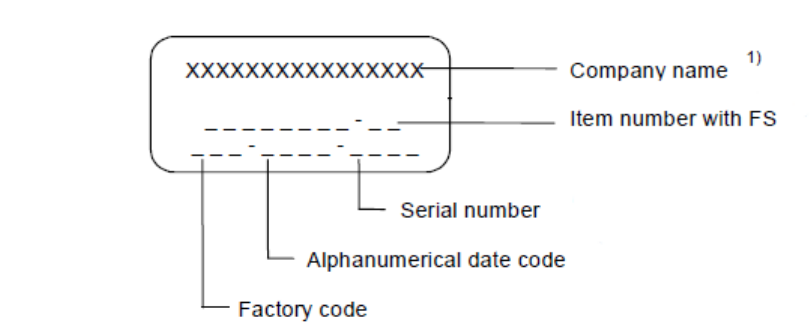
Fully designed labeling layout
2)
3)
4)
5)
29 www.asm-smt.com
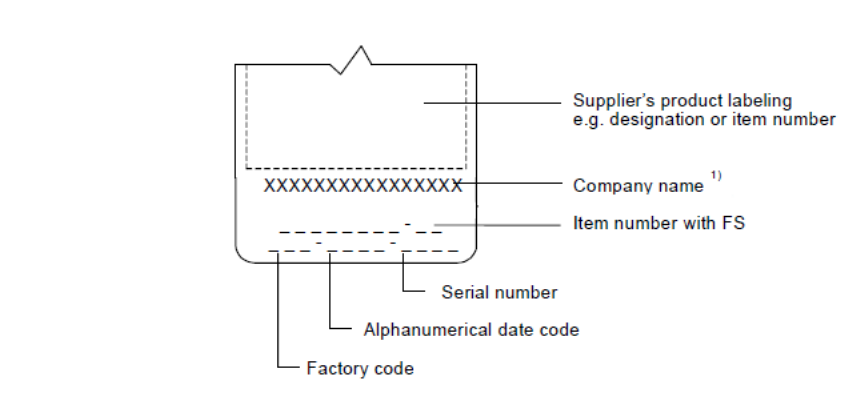
- ad 1): Company name “ASM AS” .
- ad 2): The part number with FS (functional version) is specified in the manufacturing documentation.
- ad 3): The serial number must be specified if unique traceability is required.
- ad 4): The alphanumerical date code is defined in Subsection 9.6.4.
- ad 5): The factory code is specified by Purchasing.
-
Alternative designs:
In the case of insufficient space, the labeling may have a two-line or two-part (two separate labels / fields) design.
The required labeling may be integrated with the supplier’s product labeling (see example):
Layout with smallest space conditions
With smallest space conditions at least the marking of the production plant is necessary.
The characteristic for the production plant is communicated by ASM AS purchasing.
If more space should be available, it is to be indicated additionally in the labeling depending upon available place:
- the Series/counting number, if clear parts-related traceability is necessary the Letter/number key date is
defined in section 9.6.4.
With further available place:
- the article number with FS (function conditions), which is to be taken out of the documents.
9.6.3.2. Labelling using 2D barcode
For reasons of traceability, a labeling using 2D barcode can be required as an alternative to the standard labeling. In
such cases, the manufacturing documentation will contain the note: “Product labeling using 2D barcode according to
TBL”.
Permissible labeling types are thermal transfer printing, laser printing or direct inkjet printing.
The design of the entire labeling using 2D barcode shall be submitted to the
customer on First articles for verification.
2)
3)
4)
5)