High-speed-solder-ball-shear-and-pull-tests.pdf - 第8页
package substrate surface finish showed a more rapid degradation with thermal aging than tho se with an ENIG finish [12-16]. (a) Brittle fracture surface of solder joint (b) Brittle fracture surface of the matching pad o…
half-sine pulse, was selected for all drop testing in this
evaluation [11]. Choosing this drop condition was necessarily
a compromise; too severe and relative assessment of various
constructions and aging exposures would be difficult, and too
gentle could introduce potentially significant solder joint
cyclic fatigue effects.
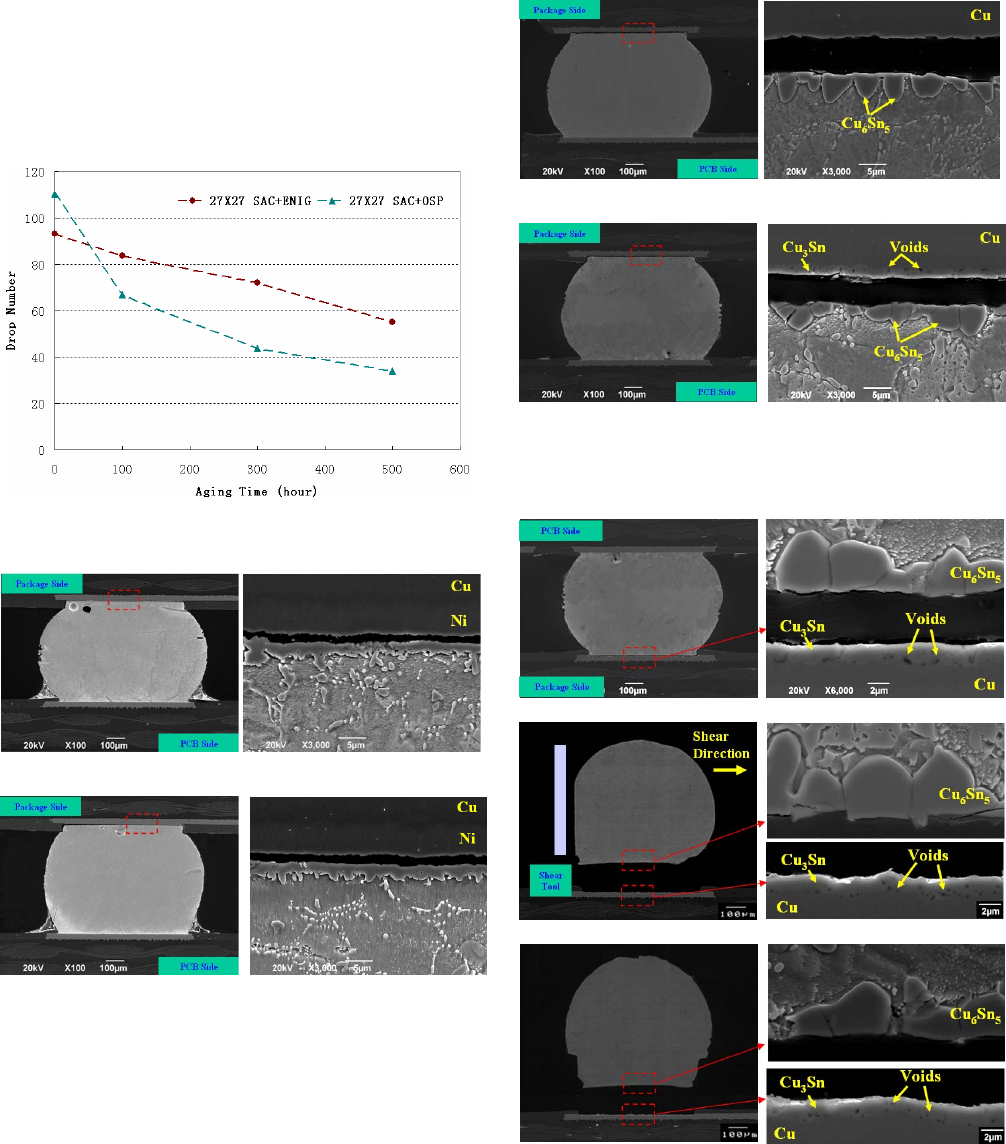
Figure 14. Board level drop lifetime with thermal aging of
SAC405 on different pad finishes
(a) 0 hour aging (b) Close-up view at location
indicated by rectangle in (a)
(c) 500 hours aging (d) Close-up view at location
indicated by rectangle in (c)
Figure 15. IMC interfacial fracture during drop test with
and without 500 hours aging (SAC405 + ENIG)
BLDT test boards were fabricated with both non-solder-
mask-defined (NSMD) and solder-mask-defined (SMD) pad
geometries. In both cases, the solder-wetted pad diameter was
0.684 mm. Although NSMD is more typical of actual
production circuit boards, SMD has the advantage for this
correlation study that the BLDT fracture locations are more
likely to occur at the package side; this is significant because
solder ball shear/pull testing can only evaluate the package
side fractures as the component is unattached to a PCB. This
paper only reports results for the SMD board configuration.
(a) 0 hour aging (b) Close-up view at location
indicated by rectangle in (a)
(c) 500 hours aging (d) Close-up view at location
indicated by rectangle in (c)
Figure 16. IMC interfacial fracture during drop test with
and without 500 hours aging (SAC405 + OSP)
(a) IMC failure during drop test
(b) IMC fracture failure during HS ball shear (500 mm/s)
(b) IMC fracture failure during HS ball pull (50mm/s)
Figure 17. Cross-sectional comparison of failure fracture
during drop test, HS ball shear/pull tests (OSP, 500 hours)
An extremely abbreviated summary of the drop testing
results is shown in Figure 14, identifying the mean value (8
assemblies per data point) of the drops-to-failure for the test
board assemblies. Repeating observations recorded in earlier
work, the drop fracture strength of devices with an OSP
1510 2007 Electronic Components and Technology Conference
package substrate surface finish showed a more rapid
degradation with thermal aging than those with an ENIG
finish [12-16].
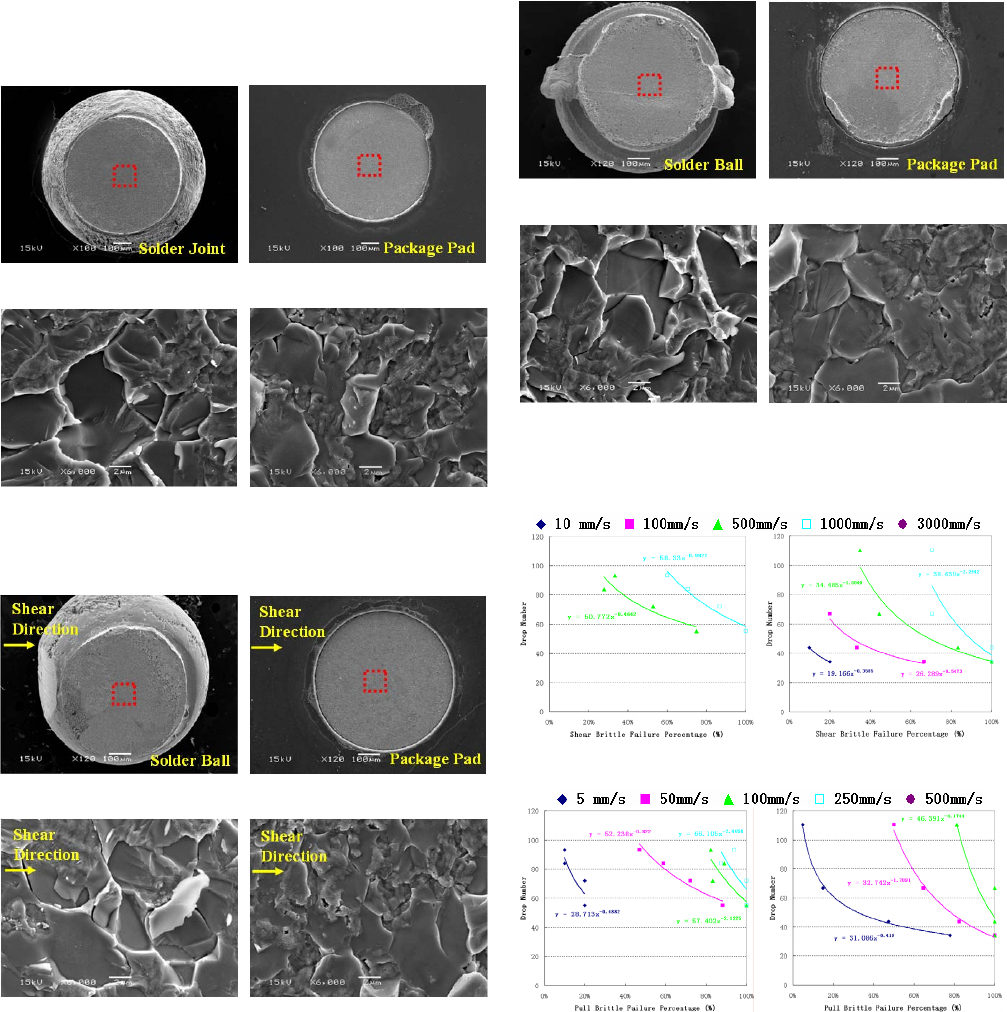
(a) Brittle fracture surface of
solder joint
(b) Brittle fracture surface of
the matching pad of (a)
(c) Close-up view at location
indicated by rectangle in (a)
(d) Close-up view at location
indicated by rectangle in (b)
Figure 18. Brittle fracture surface after drop test
(SAC405 + OSP, 500 hours aging)
(a) Brittle fracture surface of
sheared ball
(b) Brittle fracture surface of
the matching pad of (a)
(c) Close-up view at location
indicated by rectangle in (a)
(d) Close-up view at location
indicated by rectangle in (b)
Figure 19. Brittle fracture surface after high-speed ball
shear test (SAC405 + OSP, 500 hours aging, 500 mm/s)
3.5 Correlations between BLDT and High Speed Ball
Shear/Pull Tests
Previous evaluations of high-speed solder ball shear and
pull testing have observed brittle fractures that appeared
similar to the brittle fracture mode observed in BLDT
assemblies, but little definitive cross-sectional evidence has
been provided. Partly this has been due to the difficulty of
such studies, both in terms of retrieval of individual sheared
or pulled balls and matching them to their corresponding pad,
and the subsequent cross-sectional work.
(a) Brittle fracture surface of
pulled ball
(b) Brittle fracture surface of
the matching pad of (a)
(c) Close-up view at location
indicated by rectangle in (a)
(d) Close-up view at location
indicated by rectangle in (b)
Figure 20. Brittle fracture surface after high-speed ball pull
test (SAC405 + OSP, 500 hours aging, 50 mm/s)
(a) Ball shear (ENIG) (b) Ball shear (OSP)
(c) Ball pull (ENIG) (d) Ball pull (OSP)
Figure 21. Correlation of drops-to-failure and brittle failure
percentage of ball shear and pull tests at different test
speeds.
Notes: (i) All failures in drop test are brittle fractures.
(ii) The curves disappear if the brittle failure percentage
(ball shear and pull) at different aging time rises to 100%,
e.g. 3000 mm/s for ball shear and 500 mm/s for ball pull.
In this paper, painstaking effort has resulted in the
definitive images shown in Figures 15 to 20. From the failure
analysis of drop test specimens as shown in Figures 15 and
16, the brittle failure on the ENIG was induced between the
IMC and the Ni layers. For the OSP specimens without aging
(with two times reflow), the brittle failure was found between
1511 2007 Electronic Components and Technology Conference
Cu
6
Sn
5
IMC and Cu layers. The brittle failure of the OSP
specimens after thermal aging occurred between the Cu
6
Sn
5
and Cu
3
Sn IMC phases.
From the comparison of Figures 15 to 17 (cross-section)
and 18 to 20 (fracture surface), it is clear that brittle fracture
interfaces from drop testing show a striking similarity with
those from high-speed ball shear and pull tests. These figures
provide clear evidence of a close resemblance between the
brittle fracture modes of BLDT and high-speed solder ball
shear and pull.
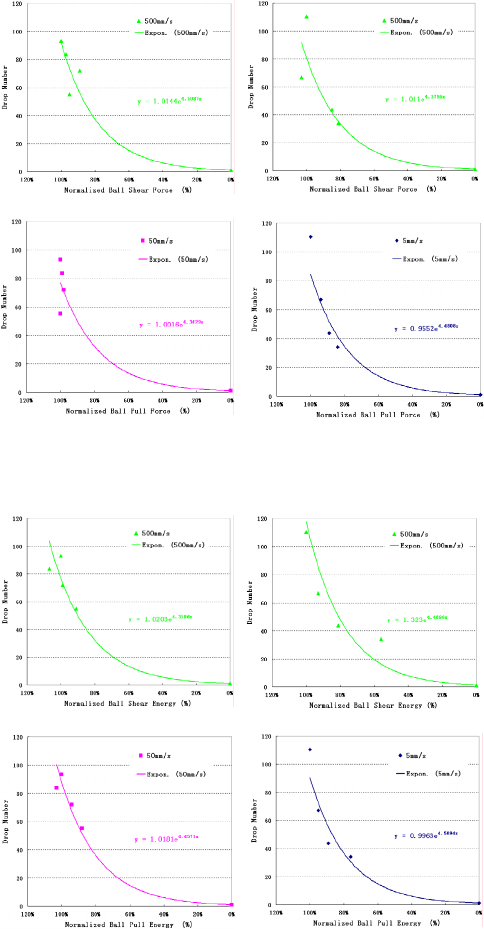
(a) Ball shear (ENIG) (b) Ball shear (OSP)
(c) Ball pull (ENIG) (d) Ball pull (OSP)
Figure 22. Correlation of drops-to-failure and normalized
ball shear and pull force with the optimal testing speed
(a) Ball shear (ENIG) (b) Ball shear (OSP)
(c) Ball pull (ENIG) (d) Ball pull (OSP)
Figure 23. Correlation of drops-to-failure and normalized
ball shear and pull energy with the optimal testing speed
Due to their complexity and requisite length of explanation,
it is not possible in this brief paper to elaborate on the various
mathematical correlations relating the solder ball shear/pull
and drop test results. Nonetheless, an innovative approach is
graphically summarized in Figures 21-23. Figure 21 relates
the brittle fracture percentages from shear and pull solder ball
testing to the drops-to-failure for the specific packages and
drop test conditions used in this study. Briefly, this plot is
achieved by plotting the drops-to-failure number for each
time point against the equivalent data from shear or pull
testing, followed by power law curve fitting. It should be
noted that each curve in Figure 21 corresponds to one solder
ball shear or pull test speed. These curves can be employed to
estimate the “drops-to-failure” number from the brittle
fracture percentage obtained in either the ball shear or pull
test with a specific test speed. For demonstration purpose, the
5 mm/s ball pull test curve in Figure 21(d) is used as an
example. If 60% of brittle fracture percentage is observed
during this kind of test, then people can draw a vertical line at
60% on the horizontal axis and going upwards. When the
vertical line hits the designated curve, people can turn left and
find its corresponding vertical coordinate (or just plug 60%
into the fitting function), which is 39. This value is the
estimated “drops-to-failure” number for the same type of
specimens subject to the mechanical drop test with the
conditions used in the present study. In other words, the
curves in Figure 21 may provide people with certain
“prediction” capability to estimate the drop test results from
the high-speed ball shear or pull test data.
Figure 22 details the exponential relationship between
normalized solder ball shear/pull force and drops-to-failure
for the brittle failure mode data points only. The shear and
pull data come from the optimal speeds for each time point.
Figure 23 shows similar graphical summaries for the solder
ball shear/pull energy. These graphs highlight that a moderate
shift in brittle fracture rate, fracture energy or force for high-
speed solder ball shear/pull testing can have a significant
impact on the predicted drop testing lifetime. It is suggested
that a manufacturer might establish solder ball shear/pull
failure mode, fracture energy or force acceptance criteria for a
particular product based upon a similar analysis.
Future papers will further evaluate the various relationships
between drops-to-failure, failure mode, force and fracture
energy, drawing upon the much larger database generated in
the full study (only a subset of the results are included in the
Figures 21-23 correlations due to limitations on paper length).
4. Conclusions
1) Solder ball shear and ball pull tests produced a high
incidence of brittle fracture with increasing test speed,
independent of pad finish or aging time.
2) The IMC on packages with an OSP pad grew faster than
on devices with ENIG plating, and samples with OSP
pads generated more brittle solder joint failures in ball
shear/pull tests after thermal aging.
3) Solder ball pull testing (compared with shear) generated a
higher percentage of brittle failures at all test speeds.
4) Compared to the specimens with ENIG pad finish, the
ball shear/pull strength and fracture energy of specimens
with OSP decreased more rapidly with aging time. This
phenomenon most likely relates to the thicker Cu-Sn
1512 2007 Electronic Components and Technology Conference