IPC-CC-830B.pdf - 第15页
If and when a conformal coating manufacturer recom- mends a primer for use with a conformal coating (as a sys- tem), the primer shall be used in conjunction with the con- formal coating material during qualification testi…
in the individual test method, shall be made at temperature
of 15 to 35°C [59 to 95°F], air pressure of 650 to 800 mil-
limeters mercury [0.86 to 1.05 bar], and a maximum rela-
tive humidity of 75%. Whenever the test conditions must
be closely controlled in order to obtain reproducible results
for referee purposes, temperature, relative humidity and
atmospheric pressure conditions of 25 ± 3°C [77 ± 5.4°F],
40 to 60% RH, and 650 to 800 millimeters mercury [0.86
to 1.05 bar], shall be specified.
4.5.2 Permissible Temperature Variation in Environ-
mental Chambers
When chambers are used, specimens
under test shall be located only within the working area
defined as follows:
a. Reference temperature variation within working area:
The controls for the chambers shall be capable of main-
taining the temperature of any single reference point
within the working area within ± 2°C [± 3.6°F].
b. Spatial temperature variation within working area:
Chambers shall be so constructed that, at any given
time, the temperature of any point within the working
area shall not deviate more than 3°C [5.4°F] from the
reference point, except for the immediate vicinity of
specimens generating heat.
4.5.3 Reference Conditions Reference conditions as a
base for calculations shall be 25°C [77°F] for temperature,
760 millimeters mercury [1.01 bar] of air pressure, and a
relative humidity of 50%.
4.6 Inspection Routine Inspections shall be performed
in accordance with testing requirements defined in 3.2
thereof. Test specimens shall be prepared in accordance
with 4.7 and subjected to the procedure of test methods
listed in Table 3-1.
4.7 Inspection Sampling
4.7.1 Test Vehicles
Test vehicle to be used shall be in
accordance to specific test method as outline in Table 4-1.
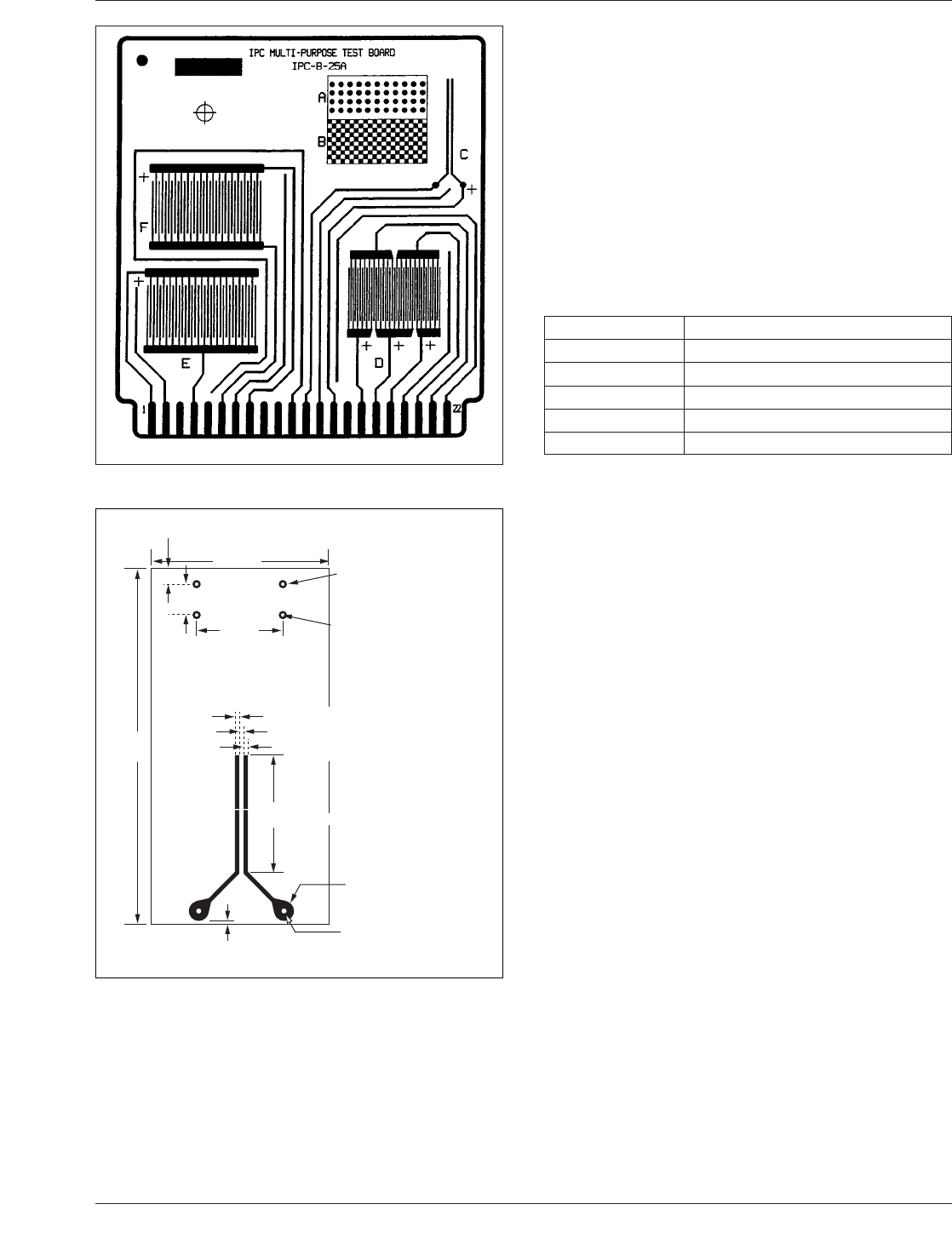
A IPC-B-25A Standard Test Board is illustrated in Figure
4-1. Test pattern to be used shall be as specified in test
method.
Test assemblies for temperature and humidity aging test
shall be made with the base material in accordance with
IPC-4101/21, IPC-4101/24, IPC-4101/25 or IPC-4101/26,
with tin plated or solder coated 17 µm copper ‘‘Y’’ shape
conductor, as illustrated in Figure 4-2. Test assemblies
shall contain two resistors, one with marking ink and one
with color code bars.
Glass plates to be used shall be standard laboratory glass
plates of 50 mm x 50 mm [1.97 in x 1.97 in] minimum
size.
Test strips for flammability testing shall be 13 mm [0.512
in] wide by 130 mm [5.118] long in accordance with UL
94 specification.
Tin panels shall be prepared in accordance with FED-STD-
141, Method 2012.
4.7.2 Sample Size The minimum number of test speci-
mens shall be as outlined in Table 4-1, or it shall be of
sufficient quantity to achieve statistical confidence required
by agreement between customer and supplier.
4.7.3 Preparation Prior to Coating The prepared test
vehicles shall be cleaned, handled and stored so that, at the
time of priming and/or coating, they meet the cleanliness
requirements of IPC-6012 (see 6.3 and 6.4).
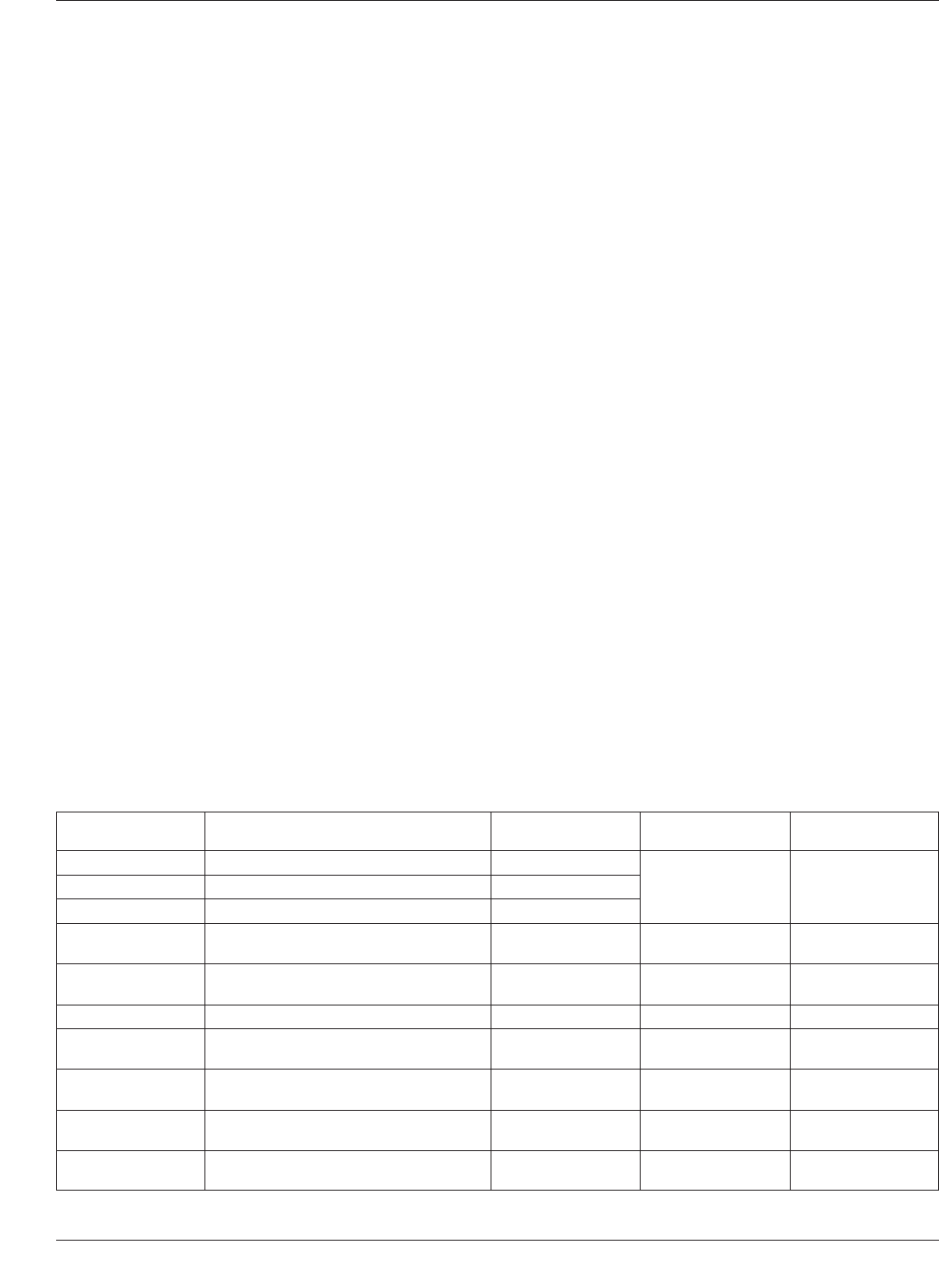
Table 4-1 Test Vehicles and Sample Sizes
Paragraph Test to Run Test Method Test Vehicle
Number of
Specimen
3.5.2 Appearance Visual
Glass Plate*
4 coated,
1 uncoated
3.5.3 Fluorescence Visual under UV
4.7.4 Thickness ASTM-D-1005
3.5.4 Fungus Resistance IPC-TM-650
2.6.1.1
Glass Plate 4 coated
3.5.5 Flexibility IPC-TM-650
2.4.5.1
Tin Panel 4 coated
3.5.6 Flammability UL 94 HB UL 94 Test Strip 20 coated
3.6.1 Dielectric Withstanding Voltage IPC-TM-650
2.5.7.1
IPC-B-25A Test
Board
5 coated
3.7.1 Moisture and Insulation Resistance IPC-TM-650
2.6.3.4
IPC-B-25A Test
Board
4 coated,
1 uncoated
3.7.2 Thermal Shock IPC-TM-650
2.6.7.1
IPC-B-25A Test
Board
5 coated
3.7.3 Temperature and Humidity Aging
(Hydrolytic Stability)
IPC-TM-650
2.6.11.1
‘‘Y’’ shape test
assembly
5 coated
(1 as control)
* Same specimens are used for these inspections.
IPC-CC-830B August 2002
6
Copyright Association Connecting Electronics Industries
Provided by IHS under license with IPC
Not for Resale
No reproduction or networking permitted without license from IHS
--```-`-`,,`,,`,`,,`---
If and when a conformal coating manufacturer recom-
mends a primer for use with a conformal coating (as a sys-
tem), the primer shall be used in conjunction with the con-
formal coating material during qualification testing.
4.7.4 Coating The conformal coating shall be applied to
the test vehicles over the patterns and/or assemblies and
cured for the time and temperature recommended by the
manufacturer. Thickness shall be measured in accordance
with ASTM-D-1005 or by micrometer or indicator accurate
to 12.5 ± 2.5 µm [0.5 ± 0.1 mil]. For Type XY, the thick-
ness may be measured optically. A glass plate may be used
for referee in conformal coating thickness measurement.
For the purpose of qualification, qualification retention and
quality conformance inspection, the cured conformal coat-
ing on the test vehicle shall have a thickness as specified
in Table 4-2. For actual thickness requirements of applied
and cured conformal coating on a printed wiring assembly
product, refer to J-STD-001 or IPC-2221.
4.8 Failures One or more failures shall be cause for
repeating the failed test after the failure mode has been
determined and corrected. If the corrective action results in
a product change per 4.4, qualification of the changed
product shall be verified.
4.9 Inspection Reporting
4.9.1 Qualification Reporting
Because samples, equip-
ment, procedures and conditions may vary between loca-
tions or test systems, complete and precise reporting of
sample preparation, test details and verifying data is
required. Results of inspection shall be summarized in a
qualification inspection report, with classification attained
clearly indicated. An example of the format is shown in
Appendix A.
4.9.2 Qualification Retention Reporting Complete and
precise reporting of sample preparation, test details and
verifying data is required for qualification retention inspec-
tion. Results shall be compared with the original qualifica-
tion inspection results and reported accordingly. Results of
inspection shall be summarized in a qualification retention
inspection report. An example of the format is shown in
Appendix B.
4.9.3 Quality Conformance Reporting Results from the
quality conformance inspection shall be compared with the
original qualification inspection results and previous qual-
ity conformance inspection results. Results of inspection
shall be summarized in a quality conformance inspection
report. An example of the format is shown in Appendix C.
5 PREPARATION FOR DELIVERY
5.1 Containers
Containers for packaging shall be in
accordance with good commercial practices. Containers
IPC-830b-4-1
Figure 4-1 IPC-B-25A
IPC-830b-4-2
Figure 4-2 Test Coupon with ‘‘Y’’ Shape Pattern
75 mm
[2.95 in]
4.7 mm
[0.185 in]
38 mm
[1.50 in]
19 mm
[0.748 in]
6.30 mm [0.2480 in]
2.3 ± 0.13 mm DIA
[0.0906 ± 0.00513 in DIA]
Hole 0.75 ± 0.08 mm DIA
[0.0295 ± 0.0031 in DIA]
0.75 mm [0.0295 in MIN]
0.75 mm ± 0.08 mm [0.0295 in ± 0.0031 in MIN]
0.75 mm [0.0295 in MIN]
3.2 mm
[0.126 in]
25 ± 1.5 mm
[0.984 ± 0.0591 in MIN]
3.8 ± 0.13 mm DIA
[0.150 ± 0.00512 in DIA]
HOLE 1.3 ± 0.08 mm DIA
[0.051 ± 0.0031 in DIA]
Table 4-2 Thickness Requirements on Test Vehicle
Type of Coating Thickness
AR 25-75 µm [0.98-2.95 mil]
UR 25-75 µm [0.98-2.95 mil]
ER 25-75 µm [0.98-2.95 mil]
SR 50-200 µm [1.97-7.87 mil]
XY 12.5-50 µm [0.49-1.97 mil]
August 2002 IPC-CC-830B
7
Copyright Association Connecting Electronics Industries
Provided by IHS under license with IPC
Not for Resale
No reproduction or networking permitted without license from IHS
--```-`-`,,`,,`,`,,`---

shall be of a corrosion resistant material that will not react,
deteriorate or affect the quality of the conformal coating
product being packaged. When a conformal coating prod-
uct consist of more than one component, each component
shall be individually furnished in sufficient quantities nec-
essary to react with the other and total amount to be that
specified in the purchase order.
5.2 Packaging Preservation, packing and marking shall
be in accordance with MIL-STD-1188.
5.3 Marking The following markings are required:
a. Manufacturer’s part number
b. Manufacturer’s lot or batch number
c. Name of manufacturer
d. Date of manufacture
e. Expiration date
f. Precautionary handling
6 NOTES
6.1 Order Data
It is recommended that the following
information be specified in procurement documents:
a. Title, number and date of this standard; type (see 1.3.1)
and class (see 1.3.2) of material contained in the pack-
age
b. Solvent compatibility information
c. Special packing instructions if required
d. Size of containers
e. Quantity of material required
f. Other special instructions
6.2 Formulation Change It is important that the proper-
ties of conformal coating material remain consistent
throughout the life of the product. Small changes in the
composition of the material may have dramatic effects
upon certain properties (such as flammability, adhesions,
etc.) and hence behaviors of the product during the appli-
cation process and in end use environment. Compatibility
of conformal coating with associated materials can often be
a sensitive issue. Therefore, it is important that formulation
consistency be maintained and users be informed when any
change has been made.
6.3 Conditioning It is recommended that the test boards
be baked at 121°C [249.8°F] for minimum one hour, but no
more than four hours, prior to coating. It is also suggested
that the environment in which the conformal coating is
applied should be clean. Monitoring of relative humidity,
temperature and particle counts ensures a better-coated
assembly.
6.4 Cleanliness It is of paramount importance that the
test vehicle be thoroughly cleaned prior to conformal coat-
ing application. A ‘‘dirty’’ test vehicle will decrease values
for dielectric withstanding voltage, insulation resistance,
and will adversely impact adhesion. An unclean test
vehicle cannot yield an accurate evaluation of the confor-
mal coating material.
6.5 Adhesion The level of adhesion between conformal
coatings and substrates varies greatly. Among the factors
which influence adhesion are soldering procedures, primer
and/or coating application, curing process, chemistry of
conformal coating, solder mask, flux and cleaning agent (if
any).
Some applications require high-level adhesion; others
desire easy removal of conformal coating from the coate-
dassembly. The key to the determination of adhesion
requirement is an agreement between manufacturer/
assembler or assembler/user of conformal coating, sup-
ported by adequate understanding of subsequent manufac-
turing processes and end use environments.
The adhesion test used shall be agreed upon the
manufacturer/assembler or assembler/user of conformal
coating. A standard paint type tape test may be used for
some coated printed wiring assemblies. Alternate methods,
such as temperature and/or humidity cycling etc., may be
employed. The applicability of test result shall be deter-
mined by the user.
6.6 Solvent Compatibility The compatibility of a confor-
mal coating product with solvents may be evaluated to
avoid potential degradation of conformal coating and
coated printed wiring assemblies in subsequent manufac-
turing processes or end use environments.
Described below is a recommended procedure for the
evaluation of solvent compatibility of a conformal coating
product.
a. Immerse a coated specimen in the solvent at 25 ± 5°C
[77 ± 9°F] for two minutes.
b. Remove the coated specimen from solvent, air dried for
10 minutes at ambient laboratory conditions.
c. Oven bake the coated specimen for 30 minutes at 65 ±
3°C [147 ± 5.4°F].
d. Cool to room temperature.
e. Examine coated specimen for evidence of surface tack,
blistering, dilation and color change.
6.7 Identification of Solvent Sensitive Conformal Coat-
ings
It is recommended that solvent sensitive conformal
coating be identified on the coated printed wiring assem-
blies by using labels, bar codes, color-coding, etc. This will
provide useful cautionary information for subsequent
manufacturing processes and/or end use applications,
which might otherwise incur solvent incompatibility.
IPC-CC-830B August 2002
8
Copyright Association Connecting Electronics Industries
Provided by IHS under license with IPC
Not for Resale
No reproduction or networking permitted without license from IHS
--```-`-`,,`,,`,`,,`---