SECS GEM Manual.pdf - 第48页
GEM Manual for DEK Printers Capabilities Issue 1.6 January 22, 2018 Page 48 of 171 4.10 Limits Monitoring The DEK printer is capable of monitoring limits on selected status variables and discrete variables. These variabl…
GEM Manual for DEK Printers Capabilities
Issue 1.6 January 22, 2018 Page 47 of 171
Scenarios:
Host requests that the equipment time is set:
Comments Host Equipment Comments
Set time TIME = Host time S2F31 -->
Adjust equipment to host time offset.
<-- S2F32 Acknowledge new time.
Host requests equipment current time:
Comments Host Equipment Comments
Time request S2F17 -->
<-- S2F18 Value TIME = host offset time sent.
GEM Manual for DEK Printers Capabilities
Issue 1.6 January 22, 2018 Page 48 of 171
4.10 Limits Monitoring
The DEK printer is capable of monitoring limits on selected status variables and discrete variables.
These variables are identified in section 5.5. The printer provides seven configurable limits that may
be applied to each variable. When one of these limits is crossed a collection event is generated. The
event can be used to alert the host that the variable has crossed a limit.
4.10.1 Definitions
Limit - Used in this section to represent the set of variable limit attributes that completely describe a
variable monitoring "barrier." The attributes include VID, Units, UPPERDB, LOWERDB,
LIMITMAX, and LIMITMIN. In some contexts it may be interpreted more narrowly as the
combination of UPPERDB and LOWERDB.
LIMITIDn - Refers to the identifier of a specific limit (as defined by UPPERDB and LOWERDB)
among the set of limits for a monitored equipment variable. LIMITIDs are consecutively numbered,
beginning at one through the number of limits possible (seven minimum).
Monitoring Zone - A subset of the possible range of values for a variable of interest to the host. A
single limit divides the range into two zones. Multiple limits may be combined to divide the range
even further.
Zone Transition - The movement of a variable value from one monitoring zone to another. This
transition is a collection event and has a corresponding CEID.
Deadband - An overlap of two zones implemented to prevent constant zone transitions by a variable
sitting on or near a limit (i.e. "chattering").
UPPERDB - A variable limit attribute that defines the upper boundary of the deadband of a limit. The
value applies to a single limit (LIMITID) for a specified VID. Thus, UPPERDB and LOWERDB as a
pair define a limit.
LOWERDB - A variable limit attribute that defines the lower boundary of the deadband of a limit.
The value applies to a single limit (LIMITID) for a specified VID. Thus, UPPERDB and LOWERDB
as a pair define a limit.
UPPER ZONE - The range of values lying above a limit.
LOWER ZONE - The range of values lying below a limit.
LIMITMAX - The maximum value for any limits of a specific equipment variable. This value is set
by the equipment manufacturer and typically coincides with the maximum value allowed for the
monitored variable.
GEM Manual for DEK Printers Capabilities
Issue 1.6 January 22, 2018 Page 49 of 171
4.10.2 Monitoring Limit Characteristics
A limit is defined by a set of attributes that include the variable (VID) to which the limit corresponds,
the units of that variable, the maximum and minimum possible values of the limit (LIMITMAX and
LIMITMIN) and the specific borders of the limit (UPPERDB and LOWERDB).
There is a limitation to the values of UPPERDB and LOWERDB which may be stated as:
LIMITMAX>UPPERDB>LOWERDB>LIMITMIN
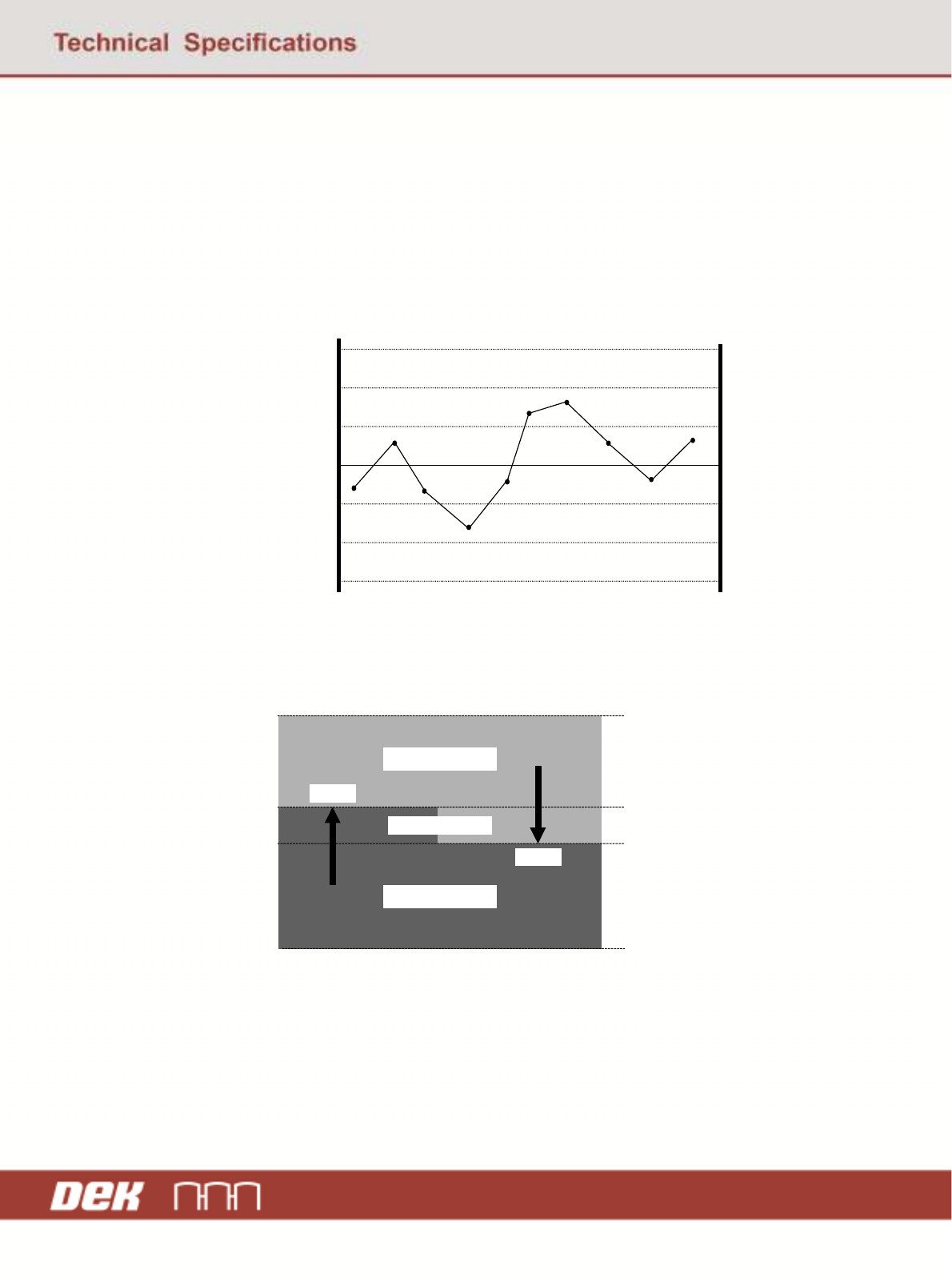
Example of how Limits can be applied to monitor a variable:
Limit 1
Limit 2
Limit 3
Limit 4
Limit 5
Limit 6
Limit 7
Nominal
Upper Spec. Limit
Lower Spec. Limit
Upper Control Limit
Lower Control Limit
Minimum Limit
Maximum Limit
A limit divides the possible range of variable values into two parts, the upper zone and the lower zone.
At any time, the monitored variable is considered to be in one and only one of these zones. However,
as these two zones have an area of overlap. This is called the deadband.
UPPER ZONE
LOWER ZONE
DEAD BAND
Event
Event
LIMITMAX
LIMITMIN
UPPERDB
LOWERDB