IPC-CM-770D-1996.pdf - 第120页
IPC-CM-770 Januaty 1996 3. Bond Force R I 6. Second Search 9. Ball is Reformed Torch 1. Home Wire of Wire Ball on End n 4. Tip Withdrawn 7. Wedge Bonding Operation o1 ,ce 8. Alt. Tail Pulling !. Search i. Work Moved Towa…
January 1996 IPC-CM-770
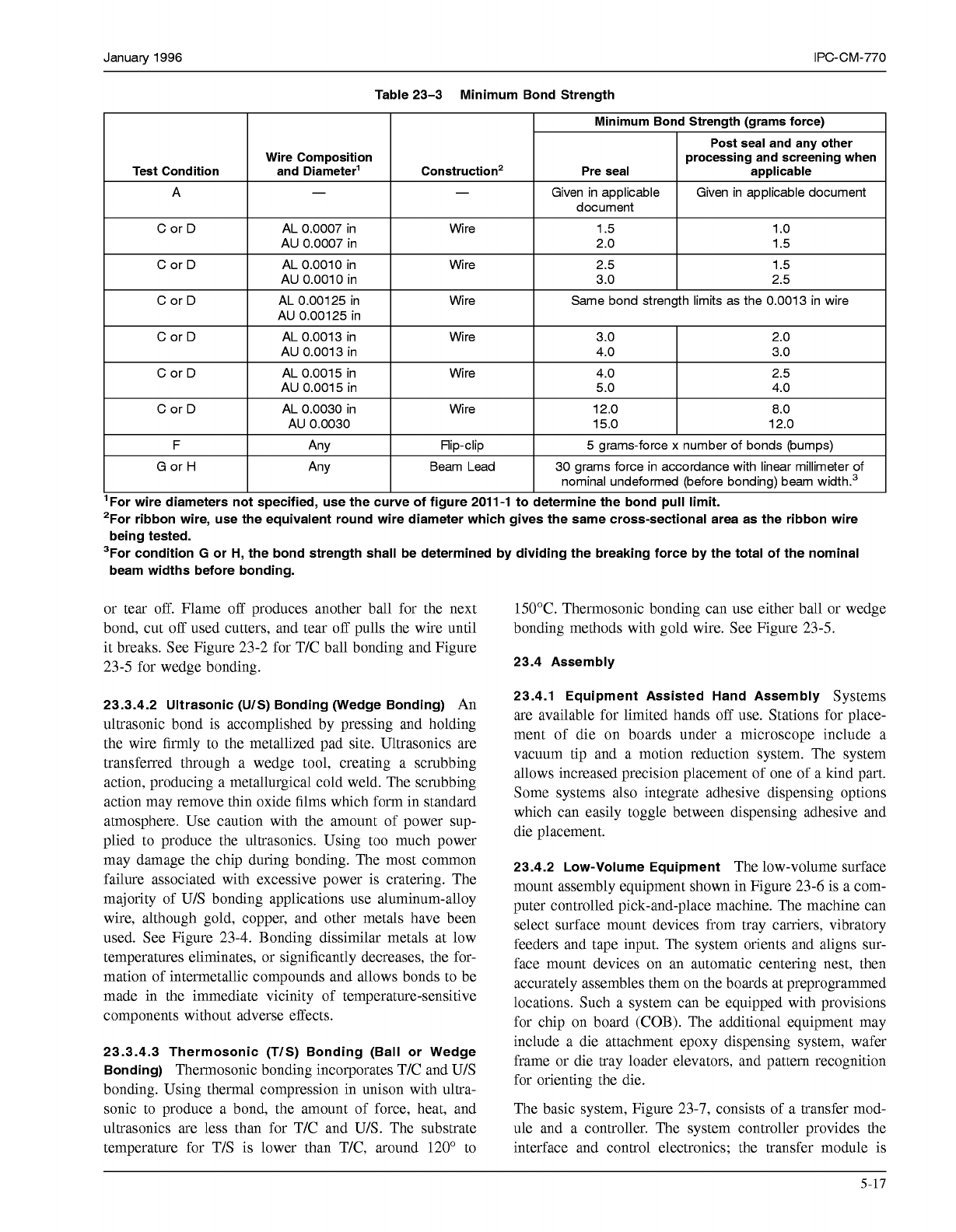
Table 23-3 Minimum Bond Strength
Wire Composition rocessing and screening when
AU 0.0007 in
AU 0.0013 in
F
5
grams-force
x
number of bonds (bumps)
Flip-clip
Any
G
or
H
30 grams force in accordance with linear millimeter of Beam Lead
Any
nominal undeformed (before bonding) beam width.3
'For wire diameters not specified, use the curve of figure 2011-1 to determine the bond pull limit.
2For ribbon wire, use the equivalent round wire diameter which gives the same cross-sectional area as the ribbon wire
3For condition
G
or H, the bond strength shall be determined by dividing the breaking force by the total of the nominal
being tested.
beam widths before bonding.
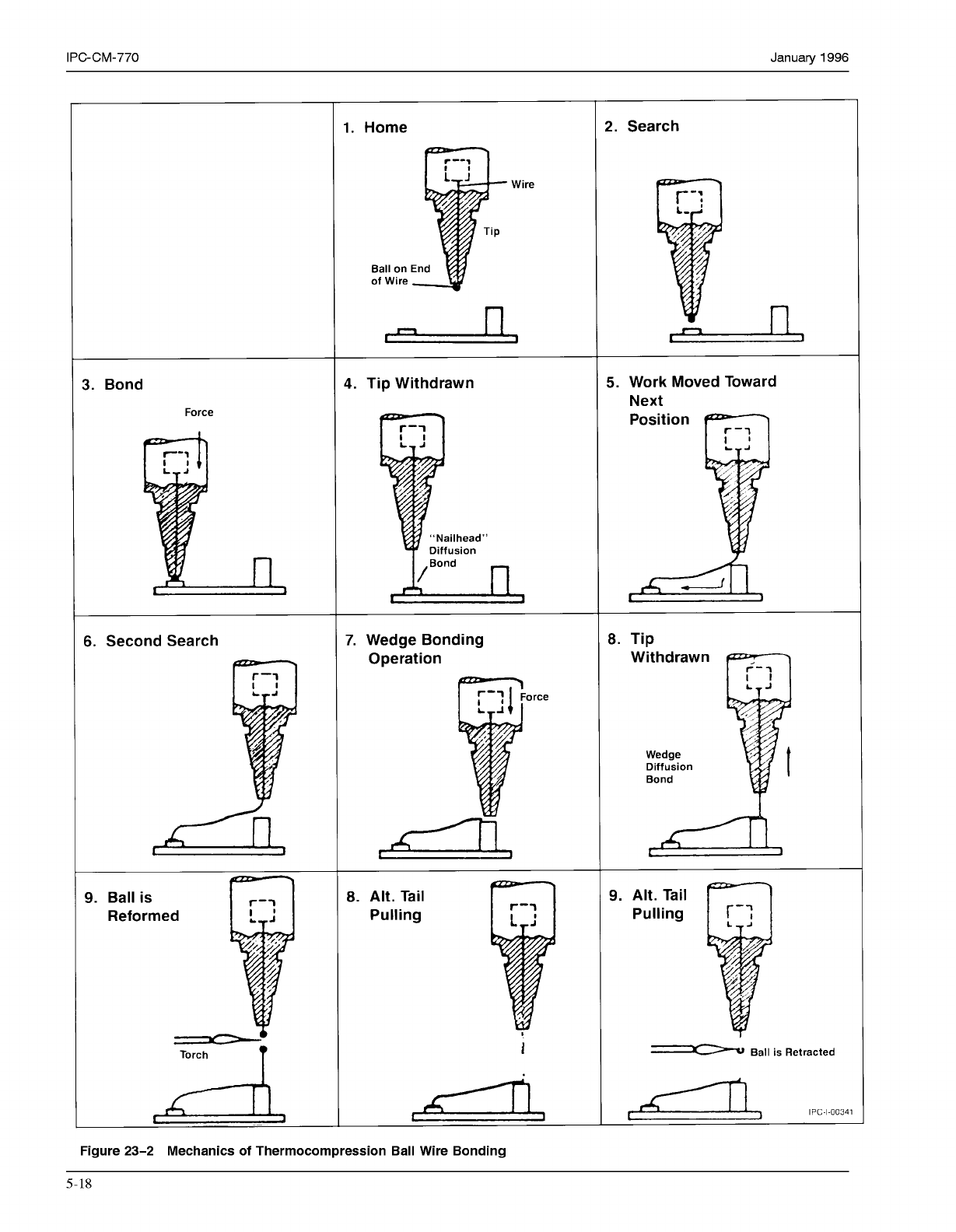
or tear off. Flame off produces another ball for the next
bond, cut off used cutters, and tear off pulls the wire until
it breaks. See Figure 23-2 for T/C ball bonding and Figure
23-5 for wedge bonding.
23.3.4.2 Ultrasonic
(UIS)
Bonding (Wedge Bonding)
An
ultrasonic bond is accomplished by pressing and holding
the wire firmly to the metallized pad site. Ultrasonics are
transferred through a wedge tool, creating a scrubbing
action, producing a metallurgical cold weld. The scrubbing
action may remove thin oxide films which form in standard
atmosphere. Use caution with the amount of power sup-
plied to produce the ultrasonics. Using too much power
may damage the chip during bonding. The most common
failure associated with excessive power is cratering. The
majority of U/S bonding applications use aluminum-alloy
wire, although gold, copper, and other metals have been
used. See Figure 23-4. Bonding dissimilar metals at low
temperatures eliminates, or significantly decreases, the for-
mation of intermetallic compounds and allows bonds to be
made in the immediate vicinity of temperature-sensitive
components without adverse effects.
23.3.4.3 Thermosonic (TIS) Bonding (Ball or Wedge
Bonding)
Thermosonic bonding incorporates T/C and U/S
bonding. Using thermal compression in unison with ultra-
sonic to produce a bond, the amount of force, heat, and
ultrasonics are less than for T/C and U/S. The substrate
temperature for T/S is lower than T/C, around 120" to
150°C. Thermosonic bonding can use either ball or wedge
bonding methods with gold wire. See Figure 23-5.
23.4 Assembly
23.4.1 Equipment Assisted Hand Assembly
Systems
are available for limited hands off use. Stations for place-
ment of die on boards under a microscope include a
vacuum tip and a motion reduction system. The system
allows increased precision placement of one of a kind part.
Some systems also integrate adhesive dispensing options
which can easily toggle between dispensing adhesive and
die placement.
23.4.2 Low-Volume Equipment
The low-volume surface
mount assembly equipment shown in Figure 23-6 is a com-
puter controlled pick-and-place machine. The machine can
select surface mount devices from tray carriers, vibratory
feeders and tape input. The system orients and aligns sur-
face mount devices on an automatic centering nest, then
accurately assembles them on the boards at preprogrammed
locations. Such a system can be equipped with provisions
for chip on board (COB). The additional equipment may
include a die attachment epoxy dispensing system, wafer
frame or die tray loader elevators, and pattern recognition
for orienting the die.
The basic system, Figure 23-7, consists of a transfer mod-
ule and a controller. The system controller provides the
interface and control electronics; the transfer module is
5-17
COPYRIGHT Association Connecting Electronics Industries
Licensed by Information Handling Services
COPYRIGHT Association Connecting Electronics Industries
Licensed by Information Handling Services
IPC-CM-770
Januaty
1996
3.
Bond
Force
R
I
6.
Second Search
9.
Ball is
Reformed
Torch
1.
Home
Wire
of
Wire
Ball on End
n
4.
Tip Withdrawn
7.
Wedge Bonding
Operation
o1
,ce
8.
Alt. Tail
Pulling
!.
Search
i.
Work Moved Toward
Next
Position
B.
Tip
Withdrawn
m
Wedge
Diffusion
Bond
9.
Alt. Tail
Pulling
Ball
is
Retracted
d
IPC-1-00341
Figure
23-2
Mechanics
of
Thermocompression
Ball
Wire
Bonding
5-18
COPYRIGHT Association Connecting Electronics Industries
Licensed by Information Handling Services
COPYRIGHT Association Connecting Electronics Industries
Licensed by Information Handling Services
January
1996
IPC-CM-770
0.1
mm
[0.004
inch]
TYP
TYP TYP
,0.025
mm
[0.001
inch]
ball
IPC-1-00340
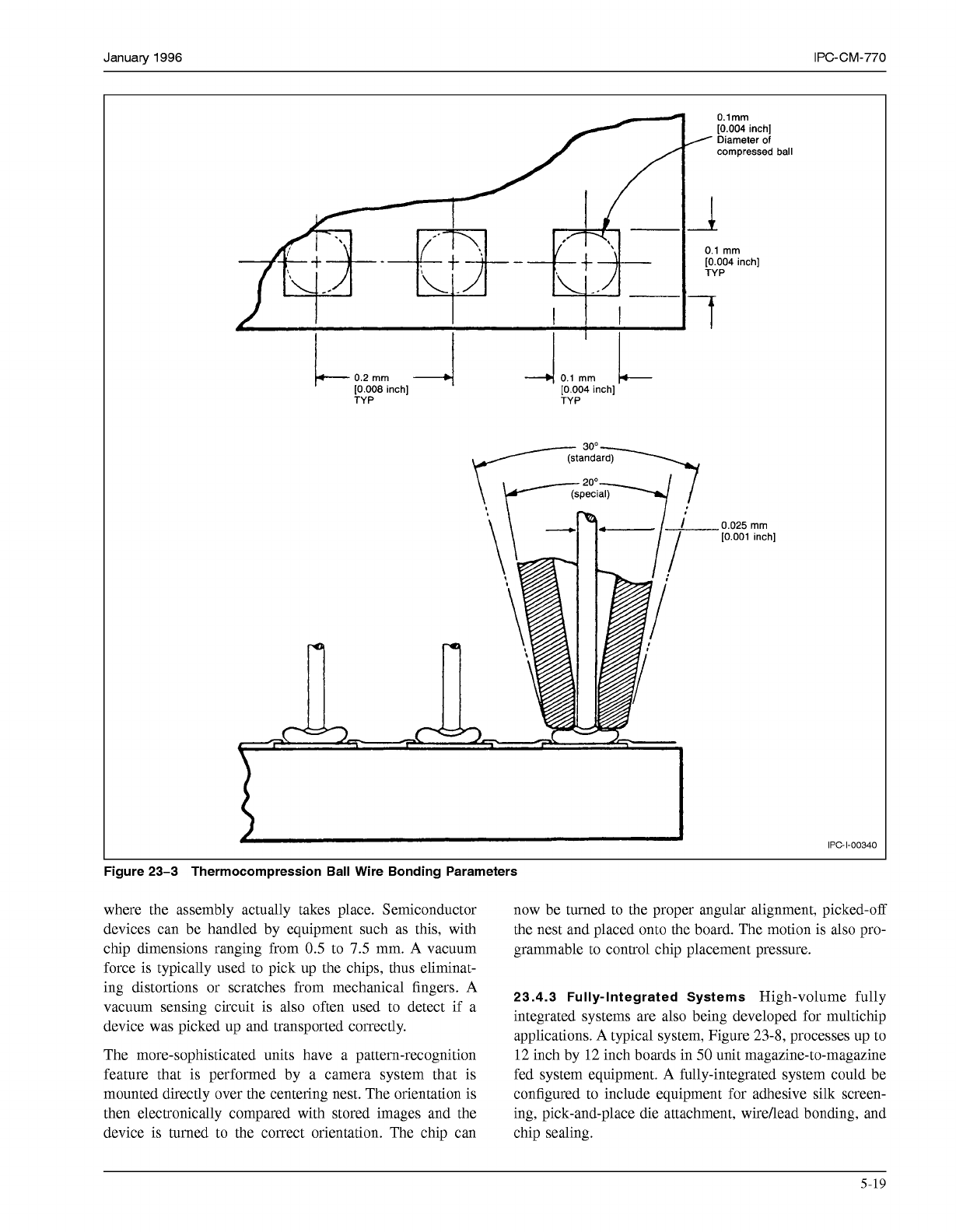
Figure 23-3 Thermocompression Ball Wire Bonding Parameters
where the assembly actually takes place. Semiconductor now be turned to the proper angular alignment, picked-off
devices can be handled by equipment such as this, with the nest and placed onto the board. The motion is also pro-
chip dimensions ranging from
0.5
to
7.5
mm.
A
vacuum grammable to control chip placement pressure.
force is typically used to pick up the chips, thus eliminat-
ing distortions or scratches from mechanical fingers.
A
vacuum sensing circuit is also often used to detect if a
23.4.3 Fully-Integrated Systems
High-volume fully
device was picked up and transported correctly.
integrated systems are also being developed for multichip
applications.
A
typical system, Figure
23-8,
processes up to
The more-sophisticated units have a pattern-recognition
12
inch by
12
inch boards in
50
unit magazine-to-magazine
feature that is performed by a camera system that is fed system equipment.
A
fully-integrated system could be
mounted directly over the centering nest. The orientation is configured to include equipment for adhesive silk screen-
then electronically compared with stored images and the ing, pick-and-place die attachment, wireAead bonding, and
device is turned to the correct orientation. The chip can chip sealing.
5-19
COPYRIGHT Association Connecting Electronics Industries
Licensed by Information Handling Services
COPYRIGHT Association Connecting Electronics Industries
Licensed by Information Handling Services