DuraBlue II Customer Product Manual.pdf - 第76页
Clear/Reset key Heater key Operation 4-14 Part 1126931_01 2018 Nordson Corporation F4 Fault When the melter detects an F4 fault: 1. The ready LED turns off and the red fault LED turns on. 2. All of the component key LE…
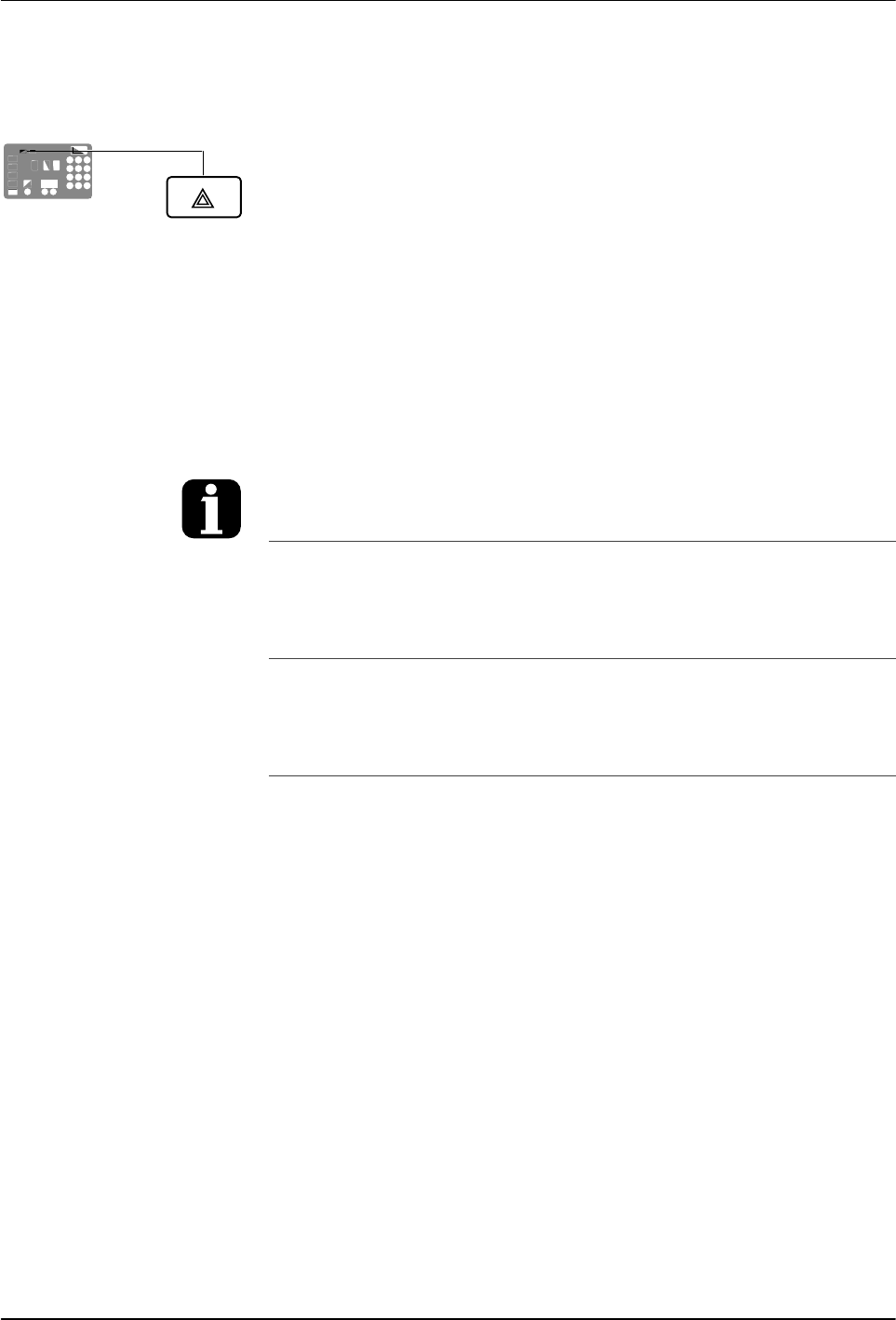
Fault LED (red)
Operation
4-13
Part 1126931_01
2018 Nordson Corporation
4. The left display indicates, as follows, the component that has, or is,
failing.
If the LED on the tank key is on, the left display will indicate either 1
for the tank or 2 for the pump.
If the LED on the hose or applicator key is on, the left display will
indicate the number of the affected hose or applicator.
5. If the fault condition still exists at the end of the two‐minute monitoring
period, the ready LED will turn off, the red fault LED will turn on, the
heaters turn off, and the melter records the fault in the fault log. Refer to
Monitor Melter Faults in this section.
To be able to put the melter back into operation, the fault must be remedied
and the melter reset (reset key). Refer to Section 6, Troubleshooting, for
information about diagnosing and correcting fault conditions. Also refer to
Returning the Melter to Factory Settings.
To view the temperature of a heated component
when an F2 or F3 fault exists, simultaneously
press and hold both of the right‐display scroll
keys.
You can temporarily dismiss an F1fault (RTD)
and return to the automatic scan mode by
pressing the Clear/Reset key. The heaters will,
however, remain off. If the fault condition still
exists two minutes after pressing the clear/reset
key, the fault LED will turn back on.
When an F1 fault code appears, you can
determine whether the fault was caused by an
open or a shorted RTD by simultaneously
pressing both of the right‐display scroll keys. If
the right display indicates OP, the RTD is open, if
it indicates SH, the RTD has shorted.
If, for any reason, a component reaches 235 C
(458 F), an immediate F3 fault will occur (no
two‐minute monitoring period).
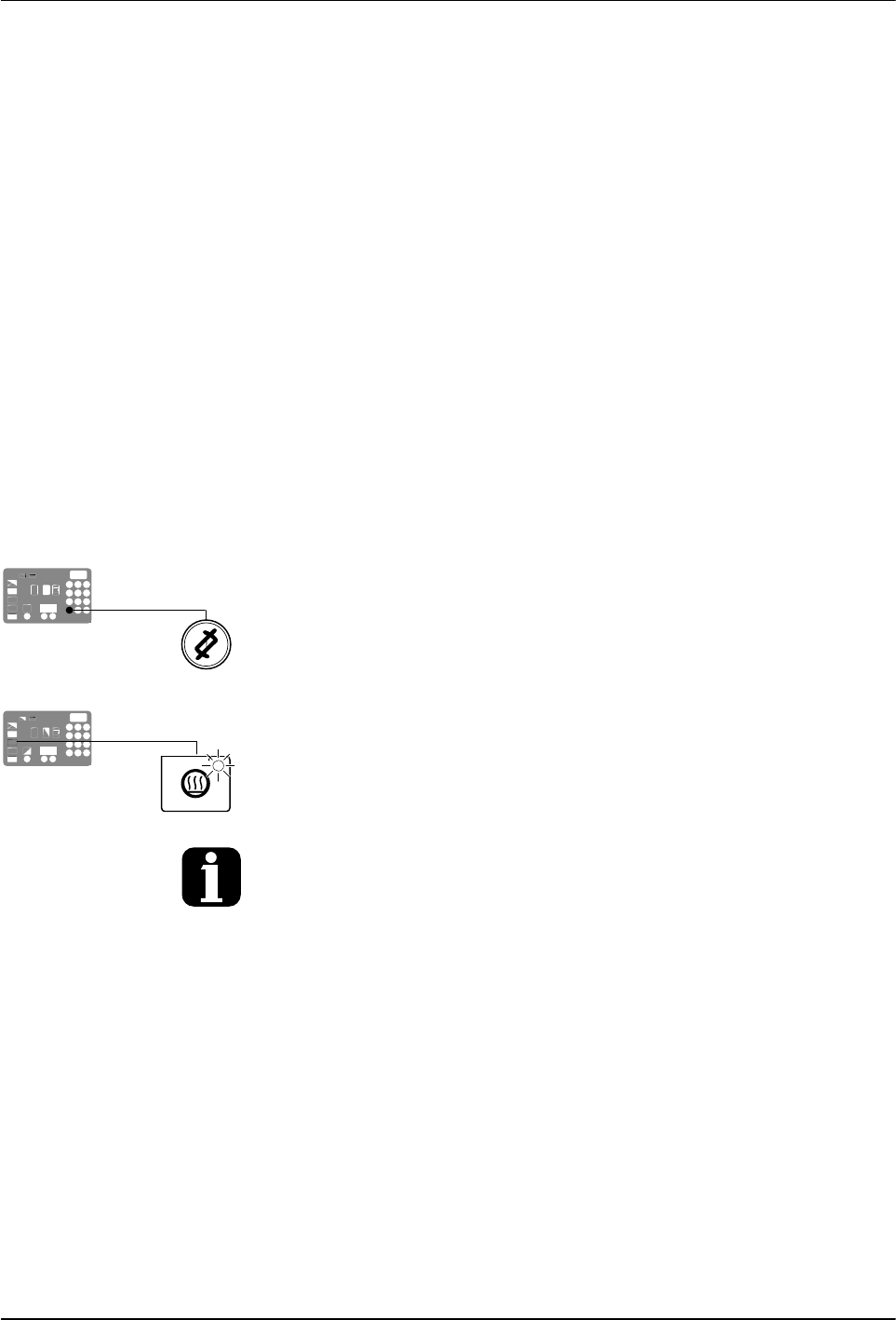
Clear/Reset key
Heater key
Operation
4-14
Part 1126931_01
2018 Nordson Corporation
F4 Fault
When the melter detects an F4 fault:
1. The ready LED turns off and the red fault LED turns on.
2. All of the component key LEDs (tank, hose, and applicator) turn off.
3. The right display indicates F4.
4. The left display indicates a sub‐code. Sub‐codes classify the fault as
being fatal or nonfatal. The affect on the melter of each of these two
classes of F4 faults is:
Fatal—The fault LED turns on and stays on and the melter stops
functioning completely.
Nonfatal—The fault LED turns on for five seconds, but the heaters and
pump continue to operate normally. Nonfatal faults affect the internal
clock.
5. The melter records the fault in the fault log. Refer to Monitor Melter Faults
in this section.
Resetting the melter
1. Diagnose and correct the fault condition. Refer to Section 6,
Troubleshooting, for information about diagnosing and correcting fault
conditions.
2. Return the melter to the automatic scan mode by pressing the Setup key
twice.
3. Press the Clear/Reset key.
4. Press the Heater key to turn on the heaters.
If F4 appears in the right display when you press the clock key, the internal clock function
has failed.
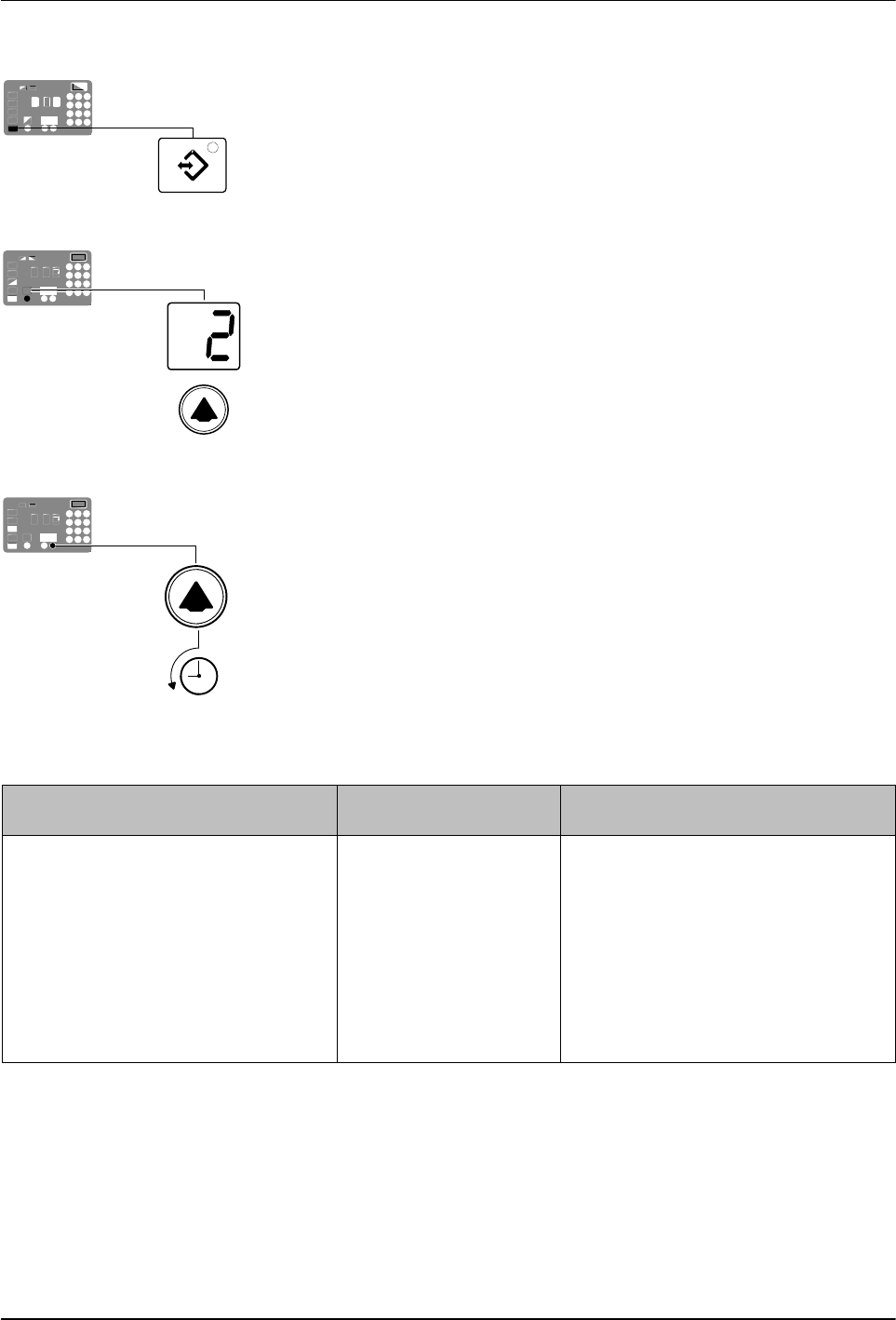
Setup Key
Left display and scroll key
Scrolling through the fault log
Operation
4-15
Part 1126931_01
2018 Nordson Corporation
Reviewing the Fault Log
1. Press and hold the Setup key.
The automatic scan stops and operating Parameter 1 appears in the
left display.
2. Scroll the left display to Parameter 2 (the fault log).
The right display indicates the last fault that occurred as follows:
If the last fault was an F1, F2, or F3 fault, then the LED on the affected
component key turns yellow.
If the last fault to occur was an F4 fault, then the LEDs on all of
the component keys turn off.
The right display indicates the log entry for the last fault to
occur. Table 4‐2 provides the meaning of each digit in the log
entry. Following the table are two example fault log entries.
3. Press the right‐display scroll key to review each of the remaining nine log
entries. Each press of the scroll key displays a progressively older log
entry.
NOTE: The fault log only stores the last ten faults. After ten faults
occur, the existing log entries are overwritten, beginning with the oldest
entry, by the eleventh and following log entries.
4. Press the Setup key to return to the automatic scan mode.
Table 4‐2 Fault Log
First Digit Second and Third
Digits
Fourth Digit
Component:
‐ F
Type of fault:
1 = Tank or hose/applicator 1 0 = Unused log entry
2 = Pump or hose/applicator 2 1 = RTD (open or short)
3 = Hose 3 or applicator 3 2 = Component under temperature
4 = Hose 4 or applicator 4 3 = Component over temperature
5 = Hose 5 or applicator 5
4 = Processor or electrical failure
6 = Hose 6 or applicator 6