ANSI ESD-S20.20-2021-EN.pdf - 第21页
ANSI/ESD S20. 20- 2021 13 Table 5. ESD Susc eptibility Test Refere nces fo r Devices ESD Model ESD Standards and Methods for Suscept ibility Testing of Devices HBM ANSI/ESDA/JEDEC J S- 001 MIL -STD-883-3 Method 3015 MIL …

ANSI/ESD S20.20-2021
12
(This annex is not part of ESD Association Standard ANSI/ESD S20.20-2021)
ANNEX B (INFORMATIVE) – ESD SENSITIVITY TESTING
Assessing the ESD sensitivity of parts, assemblies, and equipment and the required protection
levels is an important element of an ESD control program. A common method for establishing ESD
sensitivity limits is to use HBM and CDM to characterize electronic items. The selection of specific
ESD control procedures or materials is at the discretion of the ESD control program plan preparer.
It should be based on risk assessment and the established ESD sensitivities of parts, assemblies,
and equipment. All devices should be considered sensitive to HBM and CDM.
Technical literature and failure analysis data exist that indicate ESD failures are due to a complex
series of interrelated effects. Some of the factors that influence ESD sensitivity include the ESD
current and energy envelope, the rise time of the ESD event, device design, fabrication technology,
and device package style. Energy sensitive devices are typically damaged by currents across a
circuit element or a protection element causing thermal damage. Voltage sensitive devices are
typically damaged when the breakdown voltage across a dielectric, for example, the gate oxide, is
exceeded. ESD sensitivity testing of devices, whether performed using HBM or CDM, provides
ESD sensitivity levels for comparing one device to another using defined parameters. The ESD
sensitivity of the device (defined in volts), as determined by using any of the defined models, may
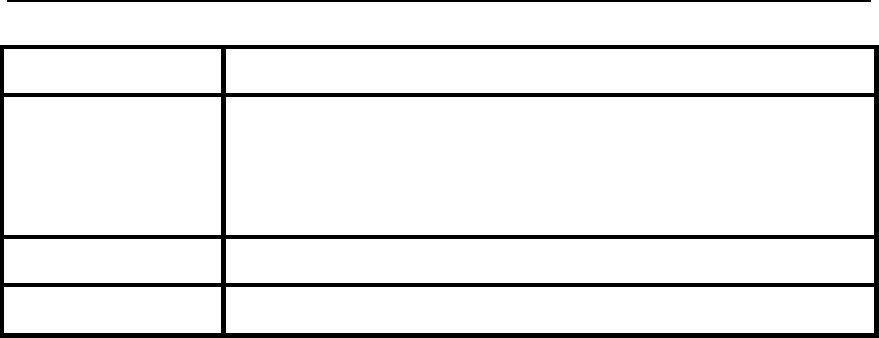
not be the actual failure voltage level in the manufacturing process or user environment. Table 5
provides a reference for various standards and test methods for ESD sensitivity testing.
1. Human Body Model Sensitivity
A source of ESD damage is the charged human body, as modeled by HBM standards. This testing
model represents the discharge from the fingertip of a standing individual delivered to the
conductive contact of the device, for example, a conductive lead or a ball that is on a different
potential on at least one other conductive contact. It is modeled by a 100-pF capacitor discharged
through a switching component and 1500-ohm series resistor into the device under test (DUT).
HBM ESD sensitivity of devices may be determined by testing the device using one of the
referenced test methods.
2. Charged Device Model Sensitivity
A source of damage for CDM is the rapid discharge from a charged device to a conductive object.
The ESD event is device-dependent, but its location relative to ground can influence the failure
level in the real world. This test model assumes the device itself has become charged, and rapid
discharge occurs when the charged device's conductive leads contact a conductive surface, which
is at a lower potential. The entire CDM event can take place in less than 2.0 ns. Although very short
in duration, current levels can reach several tens of amperes during discharge. CDM ESD
sensitivity of devices may be determined by testing the device using the referenced test method.
3. Machine Model (Historical Information Only)
The MM was originally thought to describe a rapid transfer of energy to the conductive leads of the
device from an isolated charged conductor with at least one lead of the device grounded. The
equipment designed did not simulate the intended discharge event. Isolated charged conductor
discharges to devices that are not grounded can also be characterized by the CDM event. MM is
no longer required for device qualification as it does not give any additional information to the HBM
and CDM data. Nevertheless, the control of discharges from charged conductors in the
manufacturing environment is still a key element in the ESD control program. For more information
on MM, see JEDEC JEP172A: Discontinuing Use of the Machine Model for Device ESD
Qualification.
ANSI/ESD S20.20-2021
13
Table 5. ESD Susceptibility Test References for Devices
ESD Model
ESD Standards and Methods for Susceptibility Testing of Devices
HBM
ANSI/ESDA/JEDEC JS-001
MIL-STD-883-3 Method 3015
MIL-STD-750 Method 1020
MIL-PRF-19500
MIL-PRF-38534
MIL-PRF-38535
CDM
ANSI/ESDA/JEDEC JS-002
MM
(For Information Only)
ESD SP5.2

ANSI/ESD S20.20-2021
14
(This annex is not part of ESD Association Standard ANSI/ESD S20.20-2021)
ANNEX C (INFORMATIVE) – TAILORING
Tailoring allows users of ANSI/ESD S20.20 to deviate from or exclude a requirement of the
standard if the user can provide justification and technical rationale for the deviation or exclusion.
Tailoring statements must be documented but are typically added to an organization's ESD control
program plan and include the requirement(s) of ANSI/ESD S20.20 that are excluded or modified
as well as the technical justification or rationale for the change.
The use of tailoring statements by an organization to deviate from or exclude a requirement from
ANSI/ESD S20.20 in an ESD control program plan is often misunderstood by both the organization
and those trying to determine compliance with the standard. This most often evolves from a
misunderstanding of what is or is not a requirement within the standard. In the tailoring examples
provided below, the affected requirement within ANSI/ESD S20.20 includes the word 'shall' or
'mandatory". Tailoring statements derived by the organization to address where and how the
program deviates from ANSI/ESD S20.20 requirements (see Section 6.3) must include the
requirement within the standard that is affected and the technical rationale for the exclusion or
deviation from the requirement.
Examples of Acceptable Tailoring Statements and Rationale
Example 1
Tailoring Statement: This ESD control program plan does not include personnel grounding.
ANSI/ESD S20.20 Requirement Affected: Section 8.2, first sentence: "All personnel shall be
bonded or electrically connected to the selected grounding/equipotential bonding system when
handling ESDS items."
Technical Rationale for Exclusion: The organization utilizes a fully automated manufacturing
process with no human interaction or handling of ESDS items.
Example 2
Tailoring Statement: The upper point to ground limit for worksurfaces used within cleanroom
EPAs is less than 1.0 x 10
10
ohms instead of 1.0 x 10
9
ohms as required for product qualification
and compliance verification.
ANSI/ESD S20.20 Requirement Affected: Table 3, product qualification and compliance
verification 'point to groundable point' and 'point to ground' maximum resistance limit of
1.0 x 10
9
ohms as tested using ANSI/ESD STM4.1 and ESD TR53, respectively. Also, in
Sections 7.3 (product qualification plan) and 7.4 (compliance verification plan), the required test
limits provided in Tables 2, 3, and 4 shall be met.
Technical Rationale for Deviation: The organization has a cleanliness requirement for multiple
cleanrooms where ESDS items are handled. The worksurface materials meeting cleanliness
requirements within these cleanrooms have resistance (point to ground) values that exceed
1.0 x 10
9
ohms but are less than 1.0 x 10
10
ohms. By ensuring these worksurfaces and personnel
are properly grounded, the organization believes all ESDS items and personnel are at the same
electrical potential. The manufacturing process in the cleanrooms where these worksurfaces are
used is controlled, and yield rates for the end products produced have been acceptable since the
initial installation.
Example 3
Tailoring Statement: The pulsed DC ceiling-mounted room ionization system utilized in this EPA
will have Offset Voltage (Peak): -250 volts < Voffset < 250 volts.
ANSI/ESD S20.20 Requirement Affected: Table 3, Product Qualification and Compliance
Verification Ionization Offset Voltage(Peak): -35 volts < Voffset < 35 volts.