0771445_7708_Mar2018_077144500.pdf - 第15页
Model 7708 M ultiplexer M odule Instructions for use w ith DAQ6510 077144500 / April 2018 15 Performance verification procedures The following procedures desc ribe how to check one channel (CH1) or one ch annel pair (CH …
Model 7708 Multiplexer Module Instructions for use with DAQ6510
14 077144500 / April 2018
Calculating resistance reading limits
Resistance reading limits must be recalculated based on the actual calibration resistance values supplied by
the equipment manufacturer. Calculations are performed in the same manner as shown in the previous
example, except that you should use the actual calibration resistance values instead of the nominal values
when performing your calculations.
For example, assume that you are testing the 10 kΩ range using an actual 10.03 kΩ calibration resistance
value. Using DAQ6510 one-year 10 kΩ range accuracy of ± (75 ppm of reading + 6 ppm of range), the
calculated reading limits are:
Reading limits = 10.03 kΩ ± [(10.03 kΩ 75 ppm) + (10 kΩ 6 ppm)]
Reading limits = 10.02929 kΩ to 10.03081 kΩ
Recommended test equipment
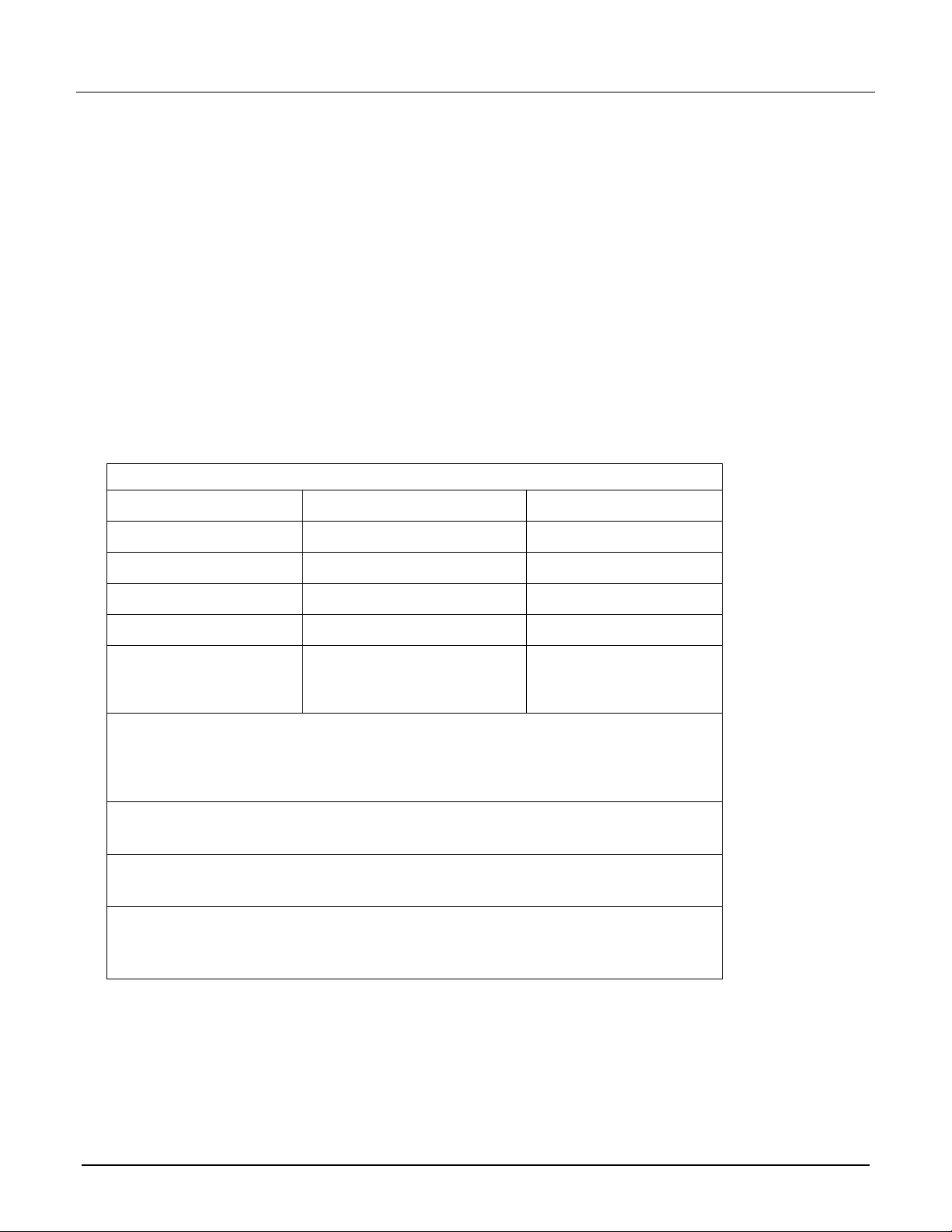
The table below summarizes recommended verification equipment. You can use alternate equipment if that
equipment has specifications that meet or exceed those listed below. Be aware that calibrator uncertainty adds
to the uncertainty of each measurement.
Fluke 5700A Calibrator:
DC voltage
AC voltage (1 kHz, 50 kHz)
Resistance
100 mV: ±14 ppm
100 mV: ±200 ppm
100 Ω: ±17 ppm
1.0 V: ±7 ppm
1.0 V: ±82 ppm
1 kΩ: ±12 ppm
10 V: ±5 ppm
10 V: ±82 ppm
10 kΩ: ±11 ppm
100 V: ±7 ppm
100 V: ±90 ppm
100 kΩ: ±13 ppm
1000 V: ±9 ppm
700 V: ±85 ppm
1 MΩ: ±18 ppm
10 MΩ: ±37 ppm
100 MΩ: ±120 ppm
Fluke 5725A Amplifier
AC Voltage, 50 kHz: 700 V, ±375 ppm
The Fluke 5725A amplifier is necessary only if you need to verify the 750 VAC range at 50 kHz.
Verification at 220 V and 50 kHz using the 5700A calibrator is adequate for most applications.
Keithley 3930A or 3940 Frequency Synthesizer
1 V
RMS
, 10 V
RMS
, 1 kHz, ±5 ppm, steady state and burst modulation
General Radio 1433-T Precision Decade Resistance Box
10 Ω to 400 Ω, ±0.02%
Miscellaneous equipment
Double banana plug to double banana plug shielded cables (two)
BNC to double banana plug shielded cable
Model 7708 Multiplexer Module Instructions for use with DAQ6510
077144500 / April 2018 15
Performance verification procedures
The following procedures describe how to check one channel (CH1) or one channel pair (CH1 and
CH11) of the module. To check other channels or channel pairs, modify the procedures by
connecting the verification equipment to the appropriate channel or channel pair.
When performing the verification procedures:
▪ Make sure that the equipment is properly warmed up and connected to the correct input terminals.
▪ Make sure that the TERMINALS switch is set to REAR.
▪ Do not use autoranging for any verification tests. Autorange hysteresis may cause the DAQ6510 to be on
an incorrect range. For each test signal, you must manually set the correct range for the DAQ6510.
▪ Make sure the calibrator output is enabled before you verify each measurement.
▪ Always let the source signal settle before taking a reading.
The verification limits stated in this section have been calculated using only the DAQ6510 one-year accuracy
specifications, and they do not include test equipment uncertainty. If a particular measurement falls slightly
outside the allowable range, recalculate new limits based on both DAQ6510 specifications and pertinent
calibration equipment specifications.
Do not attempt to perform this procedure unless qualified to do so. Failure to recognize and
observe normal safety precautions could result in personal injury or death.
The maximum common-mode voltage (the voltage between any module terminal and chassis
ground) is 300 VDC or 300 V
RMS
. Exceeding this value may cause a breakdown in insulation,
creating a shock hazard.
Model 7708 Multiplexer Module Instructions for use with DAQ6510
16 077144500 / April 2018
Verifying DC voltage
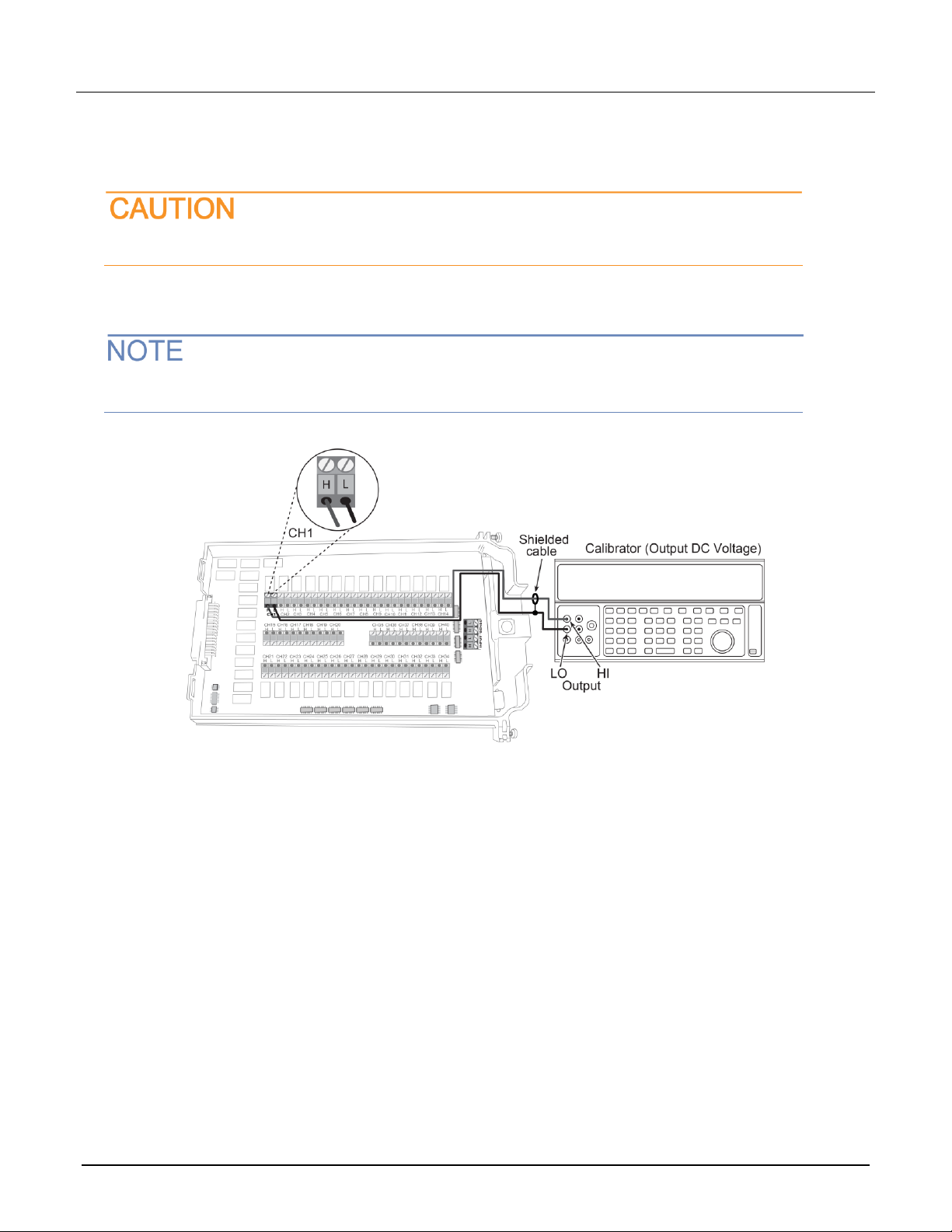
To check DC voltage accuracy, apply accurate voltages from the DC voltage calibrator to the input terminals of
the module and verify that the displayed readings fall within specified limits.
Do not exceed 300 VDC between plug-in module INPUT H and L terminals or between any
adjacent channels. Failure to observe this precaution can cause instrument damage.
To verify DC voltage accuracy:
1. Connect the CH1 H and L INPUT terminals to the DC voltage calibrator as shown in the next figure.
Use shielded, low-thermal connections when testing the 100 mV and 1 V ranges to avoid errors
caused by noise or thermal effects. Connect the shield to the output LO terminal of the calibrator.
2. Install the module in Slot 1 of the DAQ6510.
3. Turn on the power.
4. Allow the instrument to warm up for one hour.
5. Make sure that the front-panel TERMINALS switch is set to REAR.
6. On the front panel of the instrument, select the FUNCTION key and then select DC Voltage.
7. On the Home screen, swipe to the CHANNEL swipe screen.
8. Close channel 101.
9. Set the range to 100 mV.
10. Set the calibrator output to 0.00000 mV DC.
11. Allow the reading to settle.
12. Swipe to the Settings screen.
13. Enable Rel.
14. For the calibrator, source positive, negative, and full-scale voltages, see the ranges listed in the table
below. For each voltage setting, make sure that the reading is within stated limits.
15. Return to the CHANNEL swipe screen and open Channel 1.