0771445_7708_Mar2018_077144500.pdf - 第20页
Model 7708 M ultiplexer M odule I nstructions for use with DAQ6510 20 077144500 / April 2018 Ω Range Nominal resistance Nominal reading limits (1 year, 18°C to 28°C) Recalculated limits** 1 Ω* 1 Ω 0.999715 mΩ to 1.000285…
Model 7708 Multiplexer Module Instructions for use with DAQ6510
077144500 / April 2018 19
Verifying resistance
Check resistance by connecting accurate resistance values to the module and verifying that its resistance
readings are within the specified limits.
Do not apply more than 300 VDC between the module INPUT or SENSE H and L terminal
or between any adjacent channels. Failure to observe this precaution can cause
instrument damage.
To verify resistance accuracy:
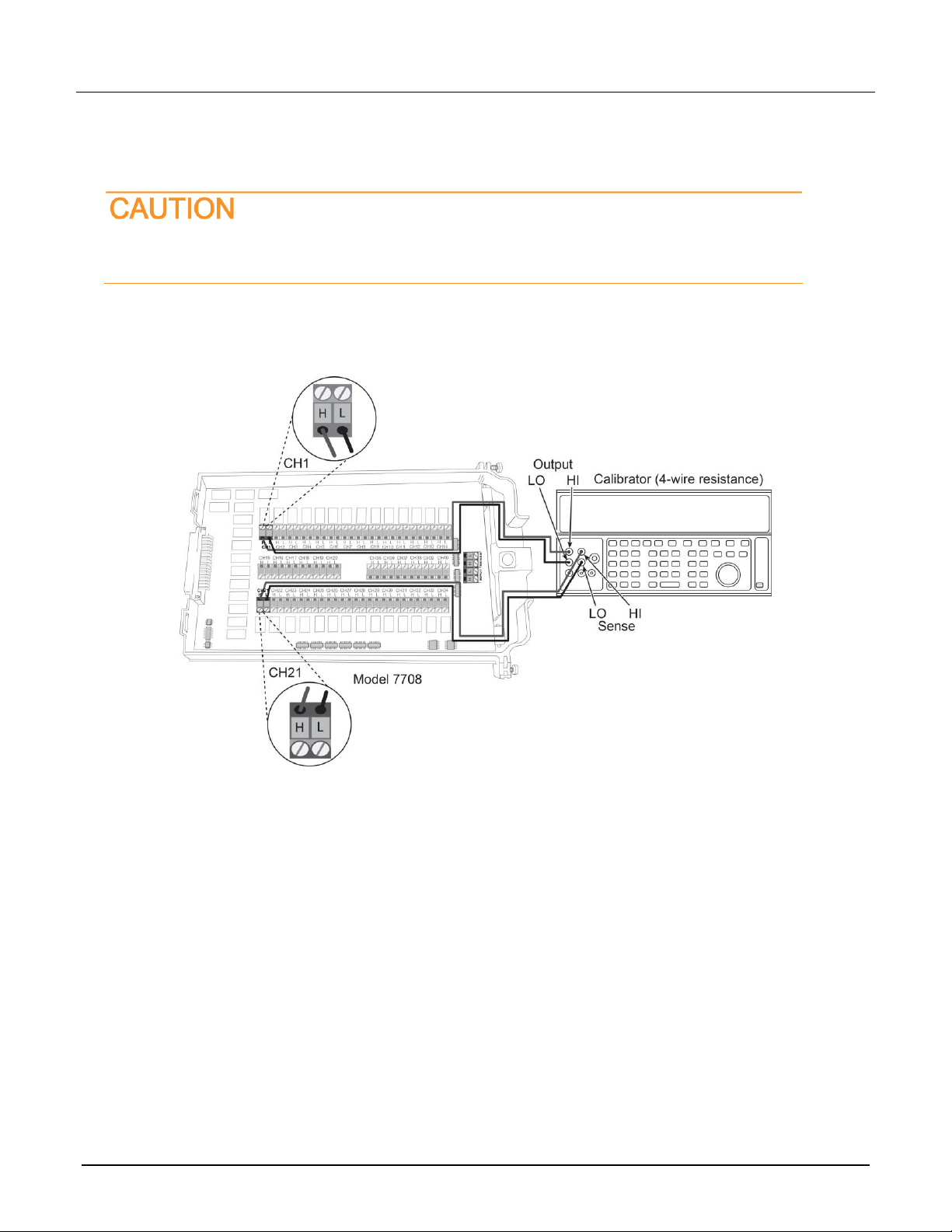
1. Using shielded Teflon or equivalent cables in a 4-wire configuration, connect the 7700 CH1 H and L INPUT
terminals and CH11 H and L SENSE terminals to the calibrator as shown in the next figure.
2. Install the module in Slot 1 of the DAQ6510.
3. Turn on the power.
4. Allow the instrument to warm up for one hour.
5. Make sure that the front-panel TERMINALS switch is set to REAR.
6. Set the calibrator for 4-wire resistance with external sense on.
7. On the front panel of the instrument, select the FUNCTION key and then select 4W Resistance.
8. On the Home screen, swipe to the CHANNEL swipe screen.
9. Set the range to 100 Ω range.
10. Swipe to the Settings screen.
11. Enable the Filter.
12. For the 100 Ω range, select the MENU key, select Channel Settings, and set Offset Compensation to On.
13. Recalculate reading limits based on actual calibrator resistance values.
14. Source the nominal full-scale resistance values for the 100 Ω to10 MΩ ranges listed in the table below.
Verify that the readings are within calculated limits.
Model 7708 Multiplexer Module Instructions for use with DAQ6510
20 077144500 / April 2018
Ω Range
Nominal
resistance
Nominal reading limits
(1 year, 18°C to 28°C)
Recalculated limits**
1 Ω*
1 Ω
0.999715 mΩ to
1.000285 Ω
__________ to __________ Ω
10 Ω
10 Ω
9.99895 mΩ to 10.00105 Ω
__________ to __________ Ω
100 Ω*
100 Ω
99.9895 Ω to 100.0105 Ω
__________ to __________ Ω
1 kΩ
1 kΩ
0.999929 Ω to 1.000081 kΩ
__________ to __________ kΩ
10 kΩ
10 kΩ
9.99929 Ω to 10.00081 kΩ
__________ to __________ kΩ
100 kΩ
100 kΩ
99.9905 Ω to 100.0095 kΩ
__________ to __________ kΩ
1 MΩ
1 MΩ
0.999894 Ω to
1.000106 MΩ
__________ to __________ MΩ
10 MΩ
10 MΩ
9.99590 Ω to 10.00410 MΩ
__________ to __________ MΩ
100 MΩ
100 MΩ
99.7970 Ω to 100.2030 MΩ
__________ to __________ MΩ
* Enable offset compensation for the 100 Ω range.
** Calculate limits based on actual calibration resistance values and DAQ6510 one-year
resistance accuracy specifications. See Calculating resistance reading limits (on page 14) for
more information.
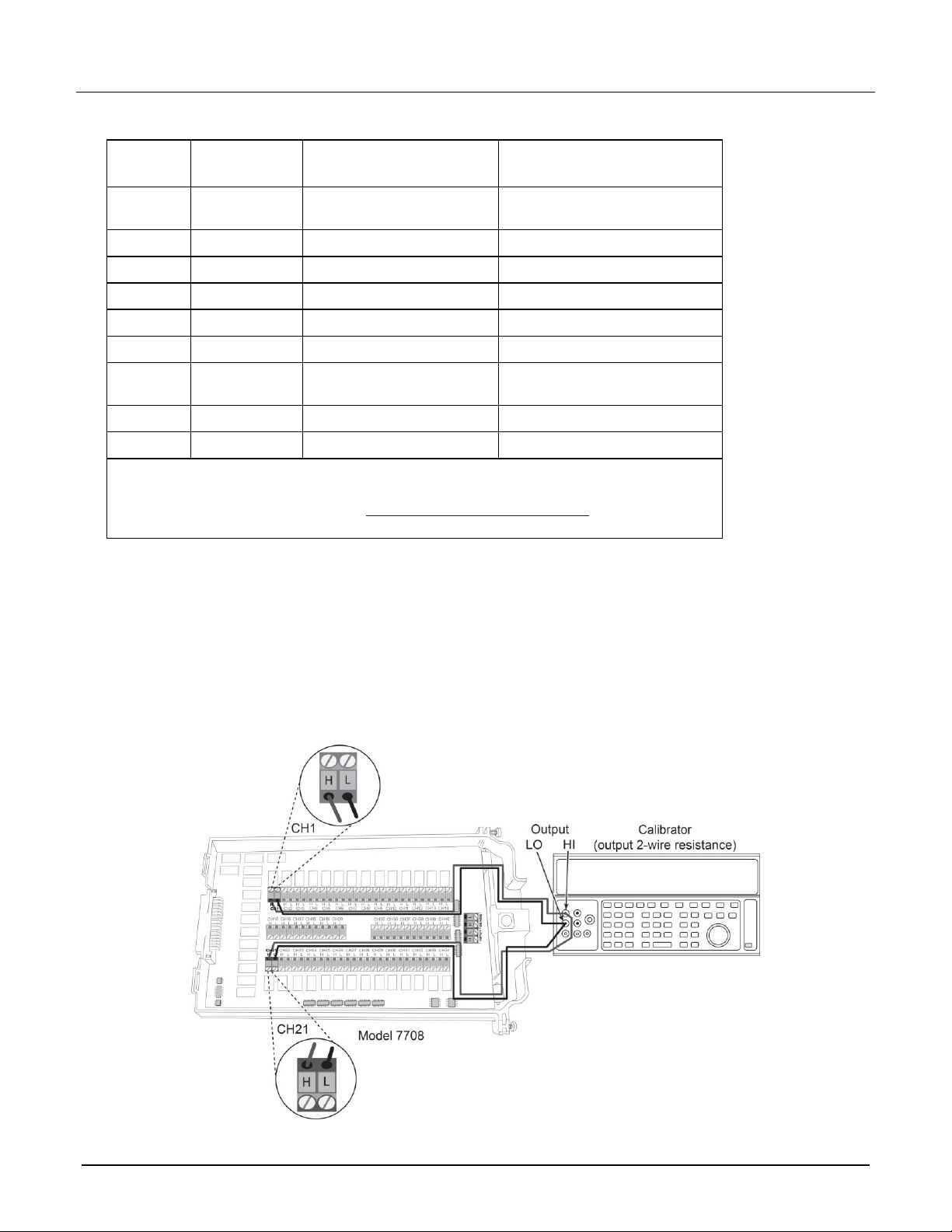
1. Connect the CH1 and CH11 terminals of the module to the calibrator as shown in the next figure.
2. Disable external sense on the calibrator.
3. Set the range of the DAQ6510 to 100 MΩ range.
4. Source a nominal 100 MΩ resistance value. Verify that the reading is within calculated limits for the
100 MΩ range.
5. Return to the CHANNEL swipe screen and open Channel 1.
Model 7708 Multiplexer Module Instructions for use with DAQ6510
077144500 / April 2018 21
Verifying temperature
Thermocouple, thermistor, and RTD temperature readings are derived from DC volts and resistance
measurements, respectively. For that reason, it is not necessary to independently verify the accuracy of
temperature measurements. If the DC volts and resistance functions meet or exceed specifications,
temperature function accuracy is automatically verified.
You can verify temperature accuracy using the following procedures.
Thermocouple temperature
This setup and reading limits table below does not include errors from ice point, thermocouple wire, and
connections. HI and LO connections from the calibrator and 7700 must be electrically isolated from each other.
To verify the thermocouple temperature:
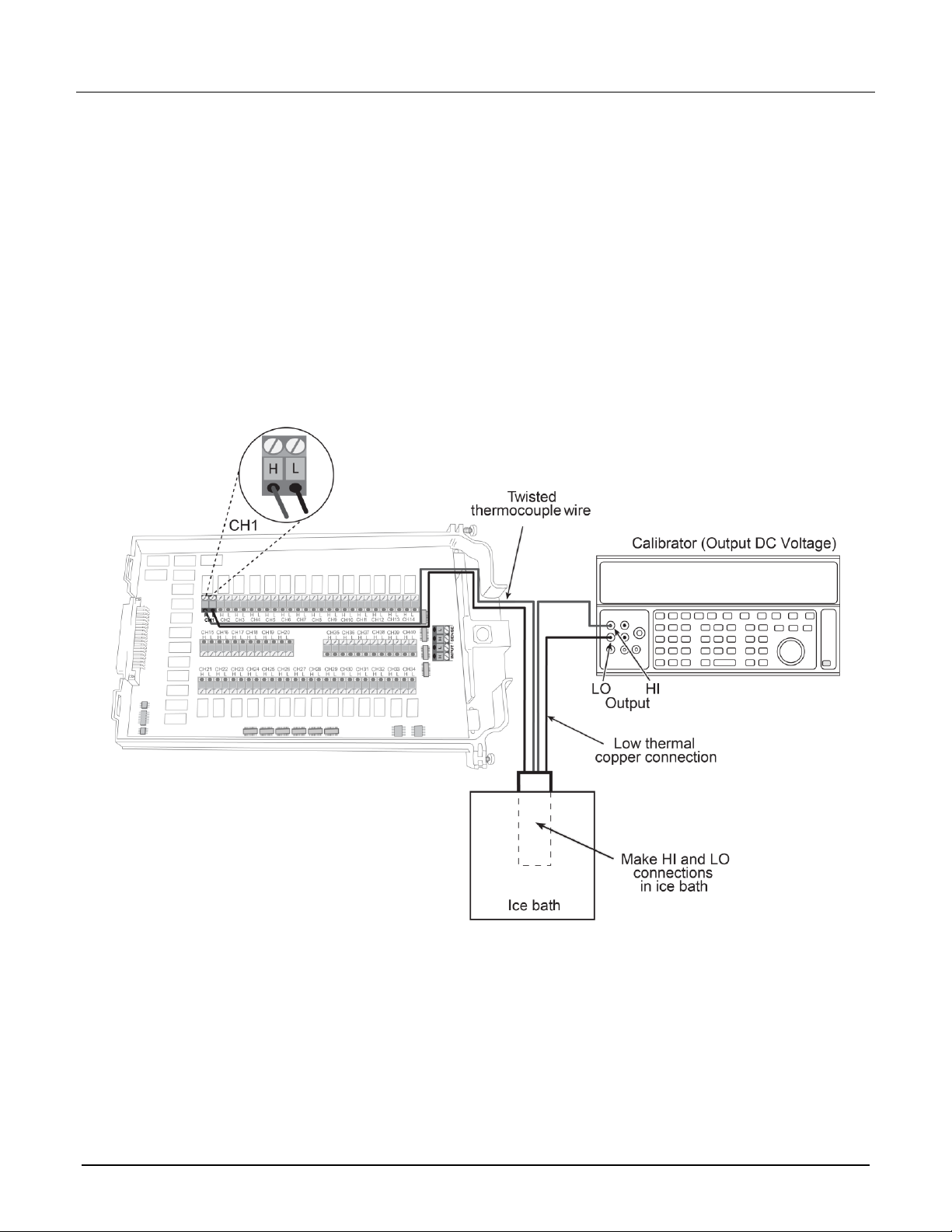
1. Connect the DC voltage calibrator output terminals and ice point reference to the CH1 H and L INPUT
terminals of the module using low-thermal shielded connections, as shown in the next figure.