Nordson-EFD-7017705-Component-Selection-Guide-Brochure.pdf - 第29页
www.nordsonefd.com info@nordsonefd.com 800-556-3484 Sales and service of Nordson EFD dispensing systems are available worldwide. 29 PP — Polypropylene Tip (pp 18–19) TLC — PTFE-lined Tip (pp 20-21) Tip Recommendations Fl…

www.nordsonefd.com info@nordsonefd.com 800-556-3484 Sales and service of Nordson EFD dispensing systems are available worldwide. www.nordsonefd.com info@nordsonefd.com 800-556-3484 Sales and service of Nordson EFD dispensing systems are available worldwide.
28
TT — Tapered Tip (pp 14–15)
GP — General Purpose Tip (pp 16-17)
Tip Recommendations
Examples:
• For tiny dots of low viscosity fluids, use a very small
diameter tip.
• If the fluid is reactive to metal, use a plastic tip.
• To avoid scratching or puncturing the surface,
use a flexible plastic tip.
If you have any questions, please ask.
We have many years of experience with all kinds of fluids.
l Recommended
m Satisfactory
x Not Recommended
Application TT GP PP TLC
Very low viscosity
fluids ............................
x
l
l
l
Particle-filled
pastes ..........................
l
l
m
x
Solvent bonding ............ x
l l l
Depositing in
recesses .......................
m
l
l
m
To spread a fluid ...........
l m l m
Fast-curing glues ..........
l m l l
Light-sensitive
adhesives .....................
l
m
m
m
To avoid scratching
or puncturing ................
l
m
l
l
Micro-deposits* .............. x
l m l
* Ceramic MicroDot tips and precision nozzles are the ideal
tip choice for micro-deposits.

www.nordsonefd.com info@nordsonefd.com 800-556-3484 Sales and service of Nordson EFD dispensing systems are available worldwide.
29
PP — Polypropylene Tip (pp 18–19)
TLC — PTFE-lined Tip (pp 20-21)
Tip Recommendations
Fluid/paste TT GP PP TLC
Adhesives .....................
l l l l
Anaerobics ....................
l m l m
Brazing Pastes ..............
l l m
x
Conformal
Coating .........................
l m m
x
Cyanoacrylates ..............
l m l l
Dampening
Fluids ...........................
l l l
x
Electrolytes ...................
l l m
x
Epoxies .........................
l l l
x
Gel Cyanoacrylates ........
l m l m
Greases ........................
l l l
x
Fluid/paste TT GP PP TLC
Heat Sink
Compounds ...................
l
l
m
x
Inks ..............................
m l l m
Oils ...............................
m l l m
Paints ...........................
m l l
x
RTVs .............................
l m m
x
Silicones .......................
l m m
x
Slurries .........................
l m m
x
Solder Creams ..............
l l m
x
Solder Masks ................
l l m
x
Solvents ........................ x
l l l
UV-cure Adhesives ........
l m m m
Application TT GP PP TLC
Very low viscosity
fluids ............................
x
l
l
l
Particle-filled
pastes ..........................
l
l
m
x
Solvent bonding ............ x
l l l
Depositing in
recesses .......................
m
l
l
m
To spread a fluid ...........
l m l m
Fast-curing glues ..........
l m l l
Light-sensitive
adhesives .....................
l
m
m
m
To avoid scratching
or puncturing ................
l
m
l
l
Micro-deposits* .............. x
l m l
www.nordsonefd.com info@nordsonefd.com 800-556-3484 Sales and service of Nordson EFD dispensing systems are available worldwide. www.nordsonefd.com info@nordsonefd.com 800-556-3484 Sales and service of Nordson EFD dispensing systems are available worldwide.
30
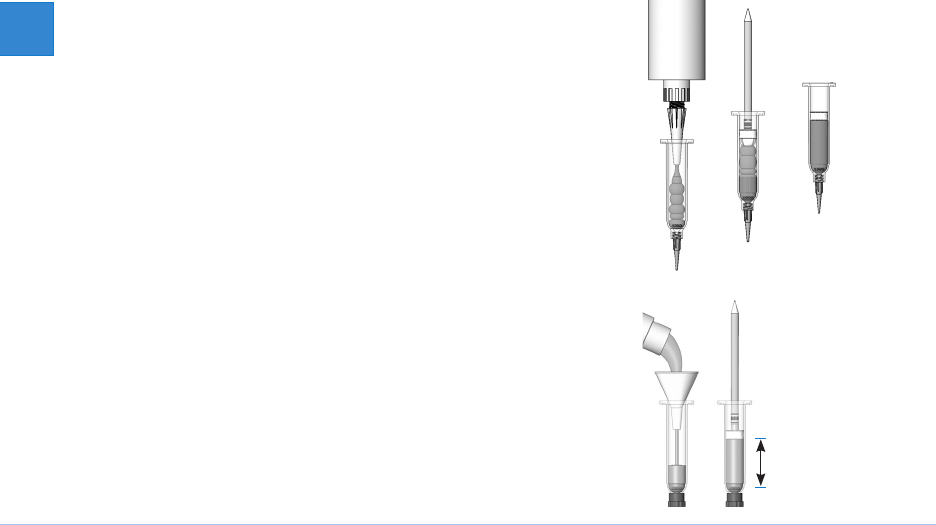
Filling Syringe Barrels
If your fluid is thick or non-leveling, you can spoon it into the barrel with a spatula.
Or, if the fluid comes packed in a 1/10 gallon cartridge, try loading the barrel with a
caulking gun. Then press in the SmoothFlow piston to move the fluid to the bottom
of the barrel and to remove trapped air.
If the fluid you are dispensing is pourable, take the barrel, twist on the tip cap, and
pour in your fluid. Insert the SmoothFlow piston. Carefully press the piston down
until it contacts the fluid. The barrel is now ready for use.
Note: The correct fill is a maximum 2/3 of the barrel capacity.
(Volume measurements for EFD barrels are at the 2/3 full level.)
Do not completely fill barrels.
Fill procedure
for thick fluids.
Fill procedure for
pourable fluids.
2/3 Maximum
fill