Seagate_IronWolf_Pro_SATA_Product_Manual_24-20-16-12TB_206815300B.pdf - 第16页
Seagate IronWolf Pro SAT A Pro duct Manua l, Rev B 16 www.seagate.com 2.6.4.1 Shock Figur e 2 Dri v e orientation 2.6.4.2 V ibration Linear random operating vibration The d r ive will operat e wi th out non-rec overable …
Seagate IronWolf Pro SATA Product Manual, Rev B 15
www.seagate.com
2.6 Environmental limits
Temperature and humidity values experienced by the drive must be such that condensation does not occur on any
drive part. Altitude and atmospheric pressure specifications are referenced to a standard day at 58.7°F (14.8°C).
NOTE To maintain optimal performance, drives should be run at nominal drive
temperatures and humidity. See Section 2.9 Reliability for rated MTBF device
operating condition requirements.
2.6.1 Temperature
2.6.2 Humidity
The values below assume that no condensation on the drive occurs. Maximum wet bulb temperature is 84.2°F (29°C).
2.6.3 Effective Altitude
2.6.4 Shock and Vibration
Shock and vibration measurements specified in this document are made directly on the drive itself and applied in the
X, Y, and Z axis at the drive mounting point locations.
Table 11 - Temperature ranges (operating/non-operating)
Operating 41°F to 149°F (5°C to 65°C) temperature range with a maximum temperature gradient of 36°F (20°C) per
hour as reported by the drive.
The maximum allowable drive reported temperature is 140°F (60°C).
Airflow may be required to achieve consistent nominal drive temperature values (see Section 3.3 Drive
mounting). To confirm that the required cooling is provided for the electronics and HDA, place the drive
in its final mechanical configuration, and perform random write/read operations. After the
temperatures stabilize, monitor the current drive temperature using the SMART temperature attribute
194 or Device Statistics log 04h page 5.
Non-operating –40°F to 158°F (–40°C to 70°C) package ambient with a maximum gradient of 36°F (20°C) per hour. This
specification assumes that the drive is packaged in the shipping container designed by Seagate for use
with drive.
Table 12 - Relative humidity (operating/non-operating)
Operating 5% to 95% non-condensing relative humidity with a maximum gradient of 20% per hour.
Non-operating 5% to 95% non-condensing relative humidity with a maximum gradient of 20% per hour.
Table 13 - Effective altitude (sea level)
Operating –304.8m to 3048m (–1000 ft to 10,000 ft)
Non-operating –304.8m to 12,192m (–1000 ft to 40,000 ft)
Seagate IronWolf Pro SATA Product Manual, Rev B 16
www.seagate.com
2.6.4.1 Shock
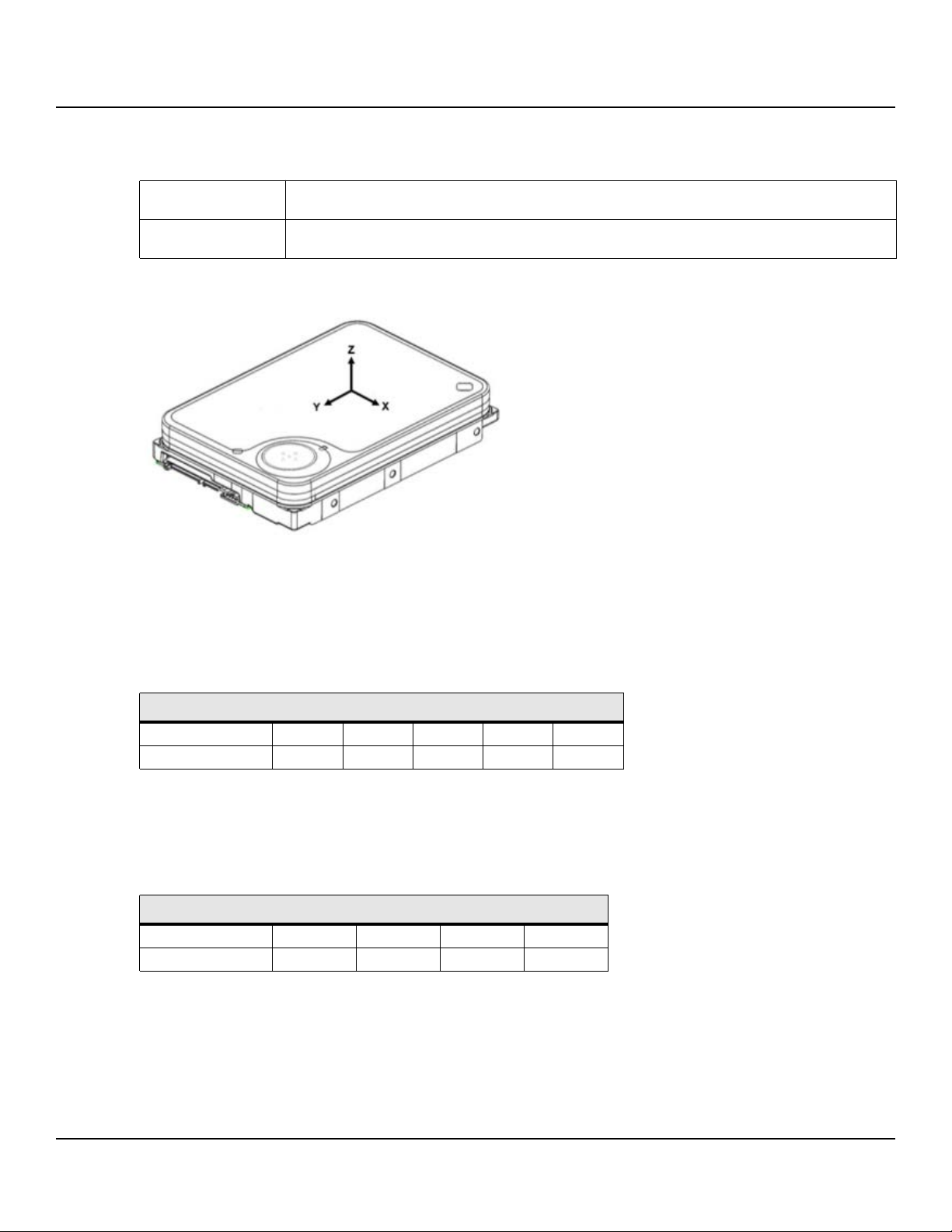
Figure 2 Drive orientation
2.6.4.2 Vibration
Linear random operating vibration
The drive will operate without non-recoverable errors while being subjected to the random power spectral density
noise specified below.
Random rotary operating vibration
The drive will exhibit greater than 90% throughput for sequential and random write operations while subjected to the
shaped random power spectral density noise specified below.
Table 14 - Shock
Operating
The drive will operate without error while subjected to intermittent shock pulses not exceeding 40 g
typical at a 2ms duration limited by Z-axis, shown in Figure 2, Drive orientation.
Non-operating
The drive will operate without non-recoverable errors after being subjected to shock pulses not
exceeding 200 g at a duration of 2ms.
Table 15 - Linear random operating vibration
PSD OF 5-500 Hz random noise at 0.70 Grms
Frequency (Hz) 5 20 200 250 500
G^2/Hz 0.00025 0.00210 0.00210 0.00020 0.00020
Table 16 - Random rotary operating vibration
PSD OF 20-1500 Hz at 12.5 rad/sec^2
Frequency (Hz) 20 200 800 1500
(rad/sec^2)^2/Hz 5.53E-02 5.53E-02 3.49E-01 6.14E-04
Seagate IronWolf Pro SATA Product Manual, Rev B 17
www.seagate.com
Linear random non-operating vibration
The drive will not incur physical damage or have non-recoverable errors after being subjected to the power spectral
density noise specified below.
2.7 Acoustics
Drive acoustics are measured as overall A-weighted acoustic sound power levels (no pure tones). All measurements
are consistent with ISO document 7779. Sound power measurements are taken under essentially free-field conditions
over a reflecting plane. For all tests, the drive is oriented with the cover facing upward.
NOTE For seek mode tests, the drive is placed in seek mode only. The number of seeks
per second is defined by the following equation:
(Number of seeks per second = 0.4 / (average latency + average access time))
* During periods of drive idle, some offline activity may occur according to the SMART specification, which may increase acoustic and power to
operational levels.
2.7.1 Test for Prominent Discrete Tones (PDTs)
Seagate follows the ECMA-74 standards for measurement and identification of PDTs. An exception to this process is
the use of the absolute threshold of hearing. Seagate uses this threshold curve (originated in ISO 389-7) to discern
tone audibility and to compensate for the inaudible components of sound prior to computation of tone ratios
according to Annex D of the ECMA-74 standards.
Table 17 - Linear random non-operating vibration
PSD Profile 2-500 Hz at 2.27 Grms
Frequency (Hz) 2 4 100 500
G^2/Hz 0.001 0.030 0.030 0.001
Table 18 - Fluid Dynamic Bearing (FDB) motor acoustics
Idle* Performance seek
All models
2.8 bels (typ)
3.0 bels (max)
3.2 bels (typ)
3.4 bels (max)