Specification_SIPLACE_F5_eng.pdf - 第26页
25 Description In the cluster technology each subpanel is assigned an ink spot. If this is present during the meas- urement via the PCB vision mod- ule, the corresponding subp anel is not populat ed. Natur ally it is als…
24
Description
Various fiducial mark shapes prove
to be optimal depending on the
condition of the surface.
In the case of bare copper sur-
faces with little oxidation, the sin-
gle cross is particularly recom-
mended because maximum
recognition reliability is achieved as
the result of the high information
content. Rectangle, square and
circle are less “informative”, but
save space, are rugged and can be
used even if oxidation is advanced.
In the case of tinned structures,
circle or square are recommended
because the ratio between fiducial
dimensions and presoldering thin-
ness is then particularly good.
Vision Sensor Technology:
PCB Position Recognition
Fiducial Mark Criteria
Determine 2 fiducials
Determine 3 fiducials
in addition
X-/Y-position, rotation angle, mean distortion
Shear, distortion in X- and Y-direction
Fiducial shapes
Freely definable via teaching, e.g.,
single cross, rectangle, square, circle
Fiducial surface:
Copper
Tin
Without oxidation and solder resist
Warp ≤ 1/10 of structure width, good
contrast with surroundings
Fiducial dimensions:
Single cross
Rectangle/square
Circle
Length and width: 0.9 - 2 mm
Stroke thickness: 0.3 - 1.0 mm
Edge length: 0.5 - 2 mm
Diameter: 0.5 - 2 mm
Fiducial surroundings
No clearance around the fiducial marks
necessary if there is no similar fiducial
structure within the search area
(5.7 x 5.7 mm).
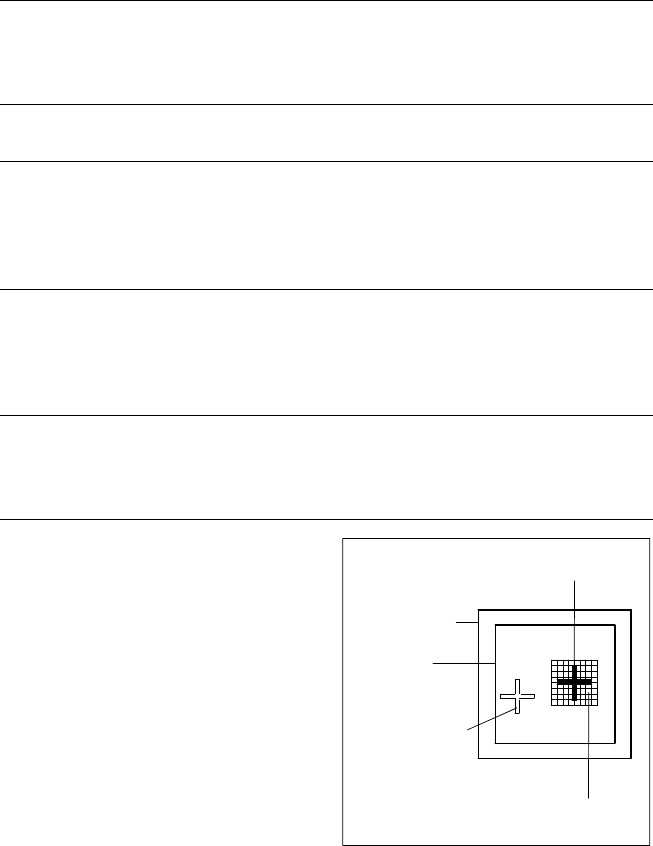
Reference Fiducial
PCB Camera
Field of View
Search
Fiducial to
be Located
Template
Window

25
Description
In the cluster technology each
subpanel is assigned an ink spot.
If this is present during the meas-
urement via the PCB vision mod-
ule, the corresponding subpanel is
not populated. Naturally it is also
possible to prevent the population
of the subpanel when the ink spot
is missing.
With this function it is possible to
prevent costs arising due to un-
necessary population of faulty
subpanels.
P
PP
Po
oo
os
ss
si
ii
it
tt
ti
ii
io
oo
on
n n
n R
RR
Re
ee
ec
cc
co
oo
og
gg
gn
nn
ni
ii
it
tt
ti
ii
io
oo
on
n n
n o
oo
of
f f
f F
FF
Fee
eeee
eed
dd
de
ee
er
rr
r
The pick-up position of the com-
ponent can be determined pre-
cisely with the aid of the position
recognition of the feeder. It is acti-
vated each time after a change of
feeder or component table. The
offset in position relative to the
stored ideal position is determined
on the basis of fiducials on the
feeder modules using the PCB vi-
sion module. This provides a very
high pick-up reliability even for the
very first component. This is par-
ticularly important with small com-
ponents.
Vision Sensor Technology:
Recognition of Faulty PCBs via Ink Spots
Position Recognition of Feeder
Ink Spot Criteria
Fiducial shapes
Single cross (recommended because
susceptibility to disruption lowest)
rectangle, square, circle, etc.
Masking material
Mat dark (light-absorbing)
Not recommended: white or shiny
Size or fiducial masking
Circular: Diameter ≥ 8.1 mm
Square: Edge length ≥ 5.7 mm
Fiducial recognition time
(travel > 100 mm)
Mark masked: 1.2 s
Mark not masked: 0.4 s

26
Description
The standard component vision
module is integrated directly into
the revolver head and images the
component in question. While the
component is cycling onward into
the next station of the revolver
head, the recorded image is being
evaluated by the central vision sys-
tem. The component is then cor-
rected by the appropriate angle in
this station on the basis of the po-
sition offsets determined.
Vision Sensor Technology:
Component Vision Module for the 6-Nozzle Revolver Head
Technical Data
Maximum component size 32 x 32 mm
Recognizable spectrum
of components
0603 to QFP 208 including BGA,
TSOP, QFP, PLCC, SO, SOJ, DRAM
Lead pitch
≥ 0.5 mm
Camera’s field of view 39 x 39 mm
Illumination
Front light
(2 freely programmable planes)