mi14061267.pdf - 第16页
Micromachines 2023 , 14 , 1267 16 of 17 viscosity will reduce the difficulty of injection, increase the droplet outlet velocity and droplet volume and impr ove the injection efficiency of the device, but the control accura…
Micromachines 2023, 14, 1267 15 of 17
device gradually decreases due to the entry of bubbles until the device almost fails. Based
on the above and experimental results, it can be seen that the nozzle-driven piezoelectric
micro-jet device proposed in this work has good stability and control accuracy compared
with the traditional piezoelectric micro-jet device.
Micromachines 2023, 14, x FOR PEER REVIEW 25 of 28
The nozzle-driven piezoelectric micro-jet device proposed in this work is not like the
traditional piezoelectric micro-jet device; due to the entry of bubbles, the stability of the
device will gradually decline as the work progresses. Once the bubbles are entrapped, the
air bubble grows via rectified diffusion and results in a malfunction [13]. In addition to
excellent stability, the piezoelectric micro-jet device proposed in this paper also has good
accuracy and ejection speed. The device has a maximum drop outlet velocity of 29.056 m/s
at a voltage amplitude of 200 V and a maximum drop accuracy of 13.864 nL at a nozzle
diameter of 0.2 mm. A piezoelectric micro-jet device with a pin joint designed by Deng et
al. is a typical traditional piezoelectric micro-jet device. Under the condition of an operat-
ing frequency of 100 HZ and voltage amplitude of 100 V, 1 Pa.s adhesive is sprayed, and
its maximum control accuracy can reach about 35 nL [24]. The piezoelectric micro-jet de-
vice proposed by Li et al. can obtain the injection speed of 4.7 m/s under the voltage am-
plitude of 130 V, and the control accuracy can reach 4.7 nL under the signal of a 50% duty
cycle [25]. In summary, compared with the traditional piezoelectric micro-jet device, the
nozzle-driven piezoelectric micro-jet device proposed in this work performs well in terms
of control accuracy and ejection speed, while in terms of stability, the nozzle-driven pie-
zoelectric micro-jet device is beer because it is not affected by bubbles.
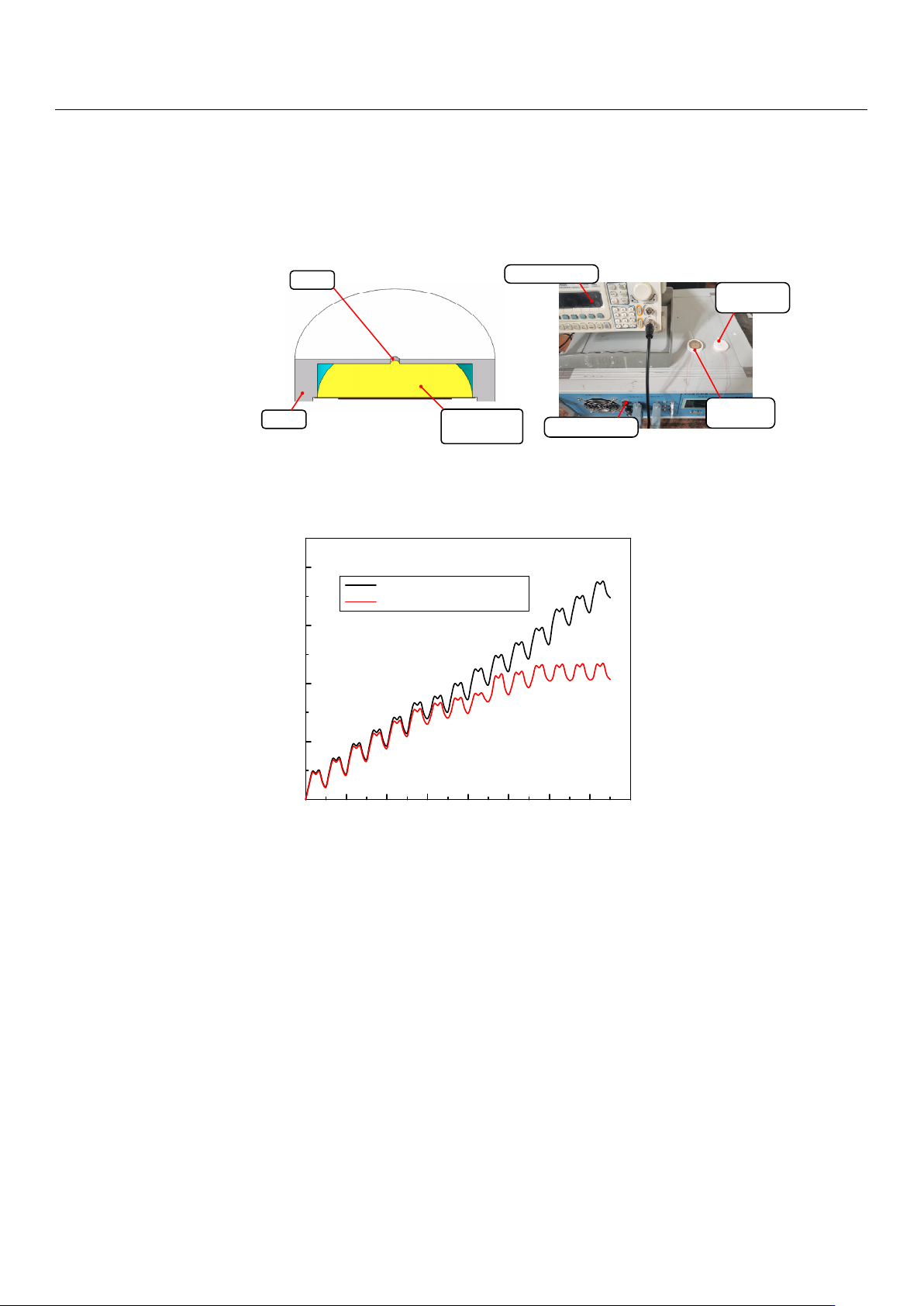
In order to prove the stability of the proposed nozzle-driven piezoelectric micro-jet
device, a traditional piezoelectric micro-jet device is fabricated in this work, and its inter-
nal structure is shown in Figure 24a. The cavity structure and experimental seings of the
two sets of experimental devices are the same, and the experimental system built is shown
in Figure 24b. The comparison experiment steps are as follows: under the seings of a
voltage amplitude of 100 V, signal frequency of 8090 Hz, nozzle diameter of 0.4 mm and
oil viscosity of 200 cs, the same continuous pulse signal is applied to the two sets of devices
through a signal generator and power amplifier, and the volume of droplets ejected by
the devices under multiple pulses is measured. The experimental results are shown in
Figure 25. The analysis shows that both sets of devices have good ejection conditions in
the initial few cycles, and both have high control accuracy. However, with the increase in
the total working time, the ejection performance of the traditional piezoelectric micro-jet
device gradually decreases due to the entry of bubbles until the device almost fails. Based
on the above and experimental results, it can be seen that the nozzle-driven piezoelectric
micro-jet device proposed in this work has good stability and control accuracy compared
with the traditional piezoelectric micro-jet device.
Cavity
Piezoelectric
vibrator
Nozzle
Signal generator
Power amplifier
Traditional
device
Proposed
device
ab
Figure 24. The internal structure of the traditional piezoelectric micro-jet device and the comparison
experimental system: (a) The internal structure of the traditional piezoelectric micro-jet device; (b)
the comparison experimental system.
Figure 24.
The internal structure of the traditional piezoelectric micro-jet device and the comparison
experimental system: (
a
) The internal structure of the traditional piezoelectric micro-jet device; (
b
) the
comparison experimental system.
Micromachines 2023, 14, x FOR PEER REVIEW 26 of 28
0T 2T 4T 6T 8T 10T 12T 14T 16T
0
50
100
150
200
Droplet volume (nL)
Time
The proposed device
The traditional device
Figure 25. The experimental results of the comparison experiment.
5. Conclusions
In this work, a piezoelectric micro-jet device is proposed. Its unique nozzle driving
mode makes the device have many outstanding advantages that traditional piezoelectric
micro-jet devices do not have: (1) The external nozzle is different from the traditional cav-
ity vibration type, which avoids the problem that the bubble enters the cavity and reduces
the injection performance. (2) The external nozzle makes the structure of the device more
compact, and the cavity cannot consider the assembly of the vibrator and the problem of
an outlet wire. (3) The external nozzle has strong interchangeability, which can be re-
placed and repaired from time to time without remanufacturing and assembling the de-
vice.
Based on the brief description of the structure of the device and the process of micro-
jet, ANSYS two-phase, two-way fluid–structure coupling analysis is carried out, and the
mechanism of the piezoelectric micro-jet is elaborated upon in detail. On the basis of de-
termining the optimal working frequency, the influence of voltage amplitude, input signal
frequency, nozzle diameter and oil viscosity on the injection performance of the proposed
device is studied, and a set of control methods is proposed based on this. A small range
of frequency adjustment has lile influence on the injection performance. Increasing the
voltage amplitude, decreasing the nozzle diameter and decreasing the oil viscosity will
reduce the difficulty of injection, increase the droplet outlet velocity and droplet volume
and improve the injection efficiency of the device, but the control accuracy of the droplet
will decrease. In addition, when the oil viscosity is greater than 100 Pa.s, it has lile influ-
ence on the volume of droplets, namely, the control accuracy, while the influence on the
difficulty of injection and the outlet velocity of droplets still exists. This work proved the
correctness of the piezoelectric micro-jet mechanism and the feasibility of the proposed
nozzle-driven piezoelectric micro-jet device through experiments and carried out the in-
jection performance test experiment, which mainly investigated the effects of voltage am-
plitude, signal frequency, oil viscosity and nozzle diameter on the droplet outlet velocity
and droplet volume. The experimental results showed that the piezoelectric micro-jet de-
vice has a maximum droplet outlet velocity of 29.056 m/s and a maximum droplet volume
of 86.45 nL at a voltage amplitude of 200 V, while the device can achieve a maximum
droplet accuracy of 13.864 nL at a nozzle diameter of 0.2 mm. From the above mentioned,
it can be seen that the device combines high precision and high efficiency excellently. The
experimental results coincide with the ANSYS simulation results, which confirms the cor-
rectness of the simulation experiment. Finally, a comparation experiment is carried out in
this work, and the stability and superiority of the proposed device are verified by the ex-
periment with the traditional piezoelectric micro-jet device.
Figure 25. The experimental results of the comparison experiment.
5. Conclusions
In this work, a piezoelectric micro-jet device is proposed. Its unique nozzle driving
mode makes the device have many outstanding advantages that traditional piezoelectric
micro-jet devices do not have: (1) The external nozzle is different from the traditional cavity
vibration type, which avoids the problem that the bubble enters the cavity and reduces
the injection performance. (2) The external nozzle makes the structure of the device more
compact, and the cavity cannot consider the assembly of the vibrator and the problem of
an outlet wire. (3) The external nozzle has strong interchangeability, which can be replaced
and repaired from time to time without remanufacturing and assembling the device.
Based on the brief description of the structure of the device and the process of micro-
jet, ANSYS two-phase, two-way fluid–structure coupling analysis is carried out, and the
mechanism of the piezoelectric micro-jet is elaborated upon in detail. On the basis of
determining the optimal working frequency, the influence of voltage amplitude, input
signal frequency, nozzle diameter and oil viscosity on the injection performance of the
proposed device is studied, and a set of control methods is proposed based on this. A
small range of frequency adjustment has little influence on the injection performance.
Increasing the voltage amplitude, decreasing the nozzle diameter and decreasing the oil

Micromachines 2023, 14, 1267 16 of 17
viscosity will reduce the difficulty of injection, increase the droplet outlet velocity and
droplet volume and improve the injection efficiency of the device, but the control accuracy
of the droplet will decrease. In addition, when the oil viscosity is greater than 100 Pa.s,
it has little influence on the volume of droplets, namely, the control accuracy, while the
influence on the difficulty of injection and the outlet velocity of droplets still exists. This
work proved the correctness of the piezoelectric micro-jet mechanism and the feasibility
of the proposed nozzle-driven piezoelectric micro-jet device through experiments and
carried out the injection performance test experiment, which mainly investigated the effects
of voltage amplitude, signal frequency, oil viscosity and nozzle diameter on the droplet
outlet velocity and droplet volume. The experimental results showed that the piezoelectric
micro-jet device has a maximum droplet outlet velocity of 29.056 m/s and a maximum
droplet volume of 86.45 nL at a voltage amplitude of 200 V, while the device can achieve a
maximum droplet accuracy of 13.864 nL at a nozzle diameter of 0.2 mm. From the above
mentioned, it can be seen that the device combines high precision and high efficiency
excellently. The experimental results coincide with the ANSYS simulation results, which
confirms the correctness of the simulation experiment. Finally, a comparation experiment
is carried out in this work, and the stability and superiority of the proposed device are
verified by the experiment with the traditional piezoelectric micro-jet device.
Supplementary Materials:
The following supporting information can be downloaded at: https:
//www.mdpi.com/article/10.3390/mi14061267/s1, Video S1: experiment demo.
Author Contributions:
Conceptualization, T.-Y.S. and X.-S.W.; methodology, T.-Y.S. and X.-S.W.;
software, Y.-W.H.; validation, X.-D.L. and D.-F.S.; formal analysis, T.-Y.S. and D.-F.S.; investiga-
tion, T.-Y.S.; resources, X.-S.W.; data curation, Y.-W.H.; writing—original draft preparation, T.-Y.S.;
writing—review and editing, T.-Y.S. and X.-S.W.; visualization, X.-S.W.; supervision, X.-S.W.; project
administration, X.-S.W. All authors have read and agreed to the published version of the manuscript.
Funding:
This work was supported by the Professional technical service platform of Shanghai
Committee of Science and Technology (19DZ2291103).
Data Availability Statement: Data sharing is not applicable to this article.
Conflicts of Interest: The authors declare no conflict of interest.
References
1.
Vatavu, M.; Nastasescu, V.; Turcu, F.; Burda, I. Voltage-Controlled Synthetic Inductors for Resonant Piezoelectric Shunt Damping:
A Comparative Analysis. Appl. Sci. 2019, 9, 4777. [CrossRef]
2.
Burda, I. Nonlinear Piezoelectric Energy Harvester: Experimental Output Power Mapping. Vibration
2022
, 5, 483–496. [CrossRef]
3.
Ling, M.; Yuan, L.; Luo, Z.; Huang, T.; Zhang, X. Enhancing Dynamic Bandwidth of Amplified Piezoelectric Actuators by a
Hybrid Lever and Bridge-Type Compliant Mechanism. Acutators 2022, 11, 134. [CrossRef]
4.
Shen, X.; Zhao, J.; Xiao, Q.; Zhang, Q.; Peng, Y. Identification of Asymmetric Bouc-Wen Model Based on Ga Algorithm for a
Piezo-Actuated Stage. In Proceedings of the 2019 14th Symposium on Piezoelectrcity, Acoustic Waves and Device Applications
(SPAWDA), Shijiazhuang, China, 1–4 November 2019.
5.
Huang, J.; Gong, J.; Wang, L.; Affane, H.; Zhang, Q.; Zhang, J. Optimal design of fluidic diode for valveless piezoelectric pump
based on entropy production theory. Sens. Actuators A Phys. 2023, 356, 114342. [CrossRef]
6.
Wang, L.; Yang, J.; Affane, H.; Zhang, Q.; Huang, J.; Zhang, J. A high flow-rate single-chamber valveless piezoelectric pump with
airfoil baffles. Sens. Actuators A Phys. 2023, 354, 114229. [CrossRef]
7.
Feng, Y.; Liu, J.; Li, K.; Li, H.; Deng, J.; Liu, Y. Waveform Optimization of Piezoelectric Micro-Jet for the Control of Metal
Micro-Droplet Ejection. IEEE Trans. Ind. Electron. 2022, 69, 3967–3976. [CrossRef]
8.
Gao, Q.; He, Y.; Fu, J.-Z.; Qiu, J.-J.; Jin, Y.-A. Fabrication of shape controllable alginate microparticles based on drop-on-demand
jetting. J. Sol-Gel Sci. Technol. 2016, 77, 610–619. [CrossRef]
9.
Kim, Y.K.; Park, J.A.; Yoon, W.H.; Kim, J.; Jung, S. Drop-on-demand inkjet-based cell printing with 30-mu m nozzle diameter for
cell-level accuracy. Biomicrofluidics 2016, 10, 064110. [CrossRef]
10.
Zhou, X.; Li, K.; Liu, Y.; Sun, J.; Li, H.; Chen, W.; Deng, J. Development of an Antihydropressure Miniature Underwater Robot
With Multilocomotion Mode Using Piezoelectric Pulsed-Jet Actuator. IEEE Trans. Ind. Electron. 2023, 70, 5044–5054. [CrossRef]
11.
Zhang, L.; Zheng, H.; Zhou, X.; Liu, B.; Chen, S.; Li, K. A Universal Piezoelectric Micropump with Capabilities of Self-Cleaning,
Stable Filtration and Precise Pumping. IEEE Trans. Ind. Electron. 2023, 1–9. [CrossRef]

Micromachines 2023, 14, 1267 17 of 17
12.
Salaoru, I.; Zhou, Z.; Morris, P.; Gibbons, G.J. Inkjet printing of polyvinyl alcohol multilayers for additive manufacturing
applications. J. Appl. Polym. Sci. 2016, 133, 43572. [CrossRef]
13. Li, H.; Liu, J.; Li, K.; Liu, Y. Piezoelectric micro-jet devices: A review. Sens. Actuators A Phys. 2019, 297, 111552. [CrossRef]
14.
Wu, H.; Fahy, W.; Kim, S.; Kim, H.; Zhao, N.; Pilato, L.; Kafi, A.; Bateman, S.; Koo, J. Recent developments in polymers/polymer
nanocomposites for additive manufacturing. Prog. Mater. Sci. 2020, 111, 100638. [CrossRef]
15.
Chen, C.; Wang, X.; Wang, Y.; Yang, D.; Yao, F.; Zhang, W.; Wang, B.; Sewvandi, G.A.; Yang, D.; Hu, D. Additive Manufacturing of
Piezoelectric Materials. Adv. Funct. Mater. 2020, 30, 2005141. [CrossRef]
16.
Sood, A.K.; Ohdar, R.; Mahapatra, S. Parametric appraisal of mechanical property of fused deposition modelling processed parts.
Mater. Des. 2010, 31, 287–295. [CrossRef]
17.
Olakanmi, E.O.; Cochrane, R.F.; Dalgarno, K.W. A review on selective laser sintering/melting (SLS/SLM) of aluminium alloy
powders: Processing, microstructure, and properties. Prog. Mater. Sci. 2015, 74, 401–477. [CrossRef]
18.
Boland, T.; Tao, X.; Damon, B.J.; Manley, B.; Kesari, P.; Jalota, S.; Bhaduri, S. Drop-on-demand printing of cells and materials for
designer tissue constructs. Mater. Sci. Eng. C 2007, 27, 372–376. [CrossRef]
19.
Li, K.; Chen, W.; Liu, J.; Li, H.; Qi, N.; Liu, Y. Research on the spreading characteristics of biodegradable ethyl cyanoacrylate
droplet of a piezoelectric inkjet. Sens. Actuators A Phys. 2020, 302, 111810. [CrossRef]
20.
Ulmke, H.; Wriedt, T.; Bauckhage, K. Piezoelectric Droplet Generator for the Calibration of Particle-Sizing Instruments. Chem.
Eng. Technol. 2001, 24, 265–268. [CrossRef]
21.
Li, K.; Liu, Y.; Liu, J.; Chen, W. Study on the Performance of a Designed Annular Piezoelectric Microjet for Active Lubrication of
Space Bearing. IEEE Trans. Ind. Electron. 2022, 69, 2728–2736. [CrossRef]
22.
Gross, A.; Schöndube, J.; Niekrawitz, S.; Streule, W.; Riegger, L.; Zengerle, R.; Koltay, P. Single-Cell Printer: Automated, On
Demand, and Label Free. SLAS Technol. 2013, 18, 504–518. [CrossRef] [PubMed]
23.
Cheng, C.; Chen, S.; Young, S.; Su, Y.; Lin, Y. Effect of poling conditions on out-of-plane displacement for a shear mode PZT
actuator. Sens. Actuators A Phys. 2006, 126, 386–395. [CrossRef]
24. Deng, G.; Cui, W.; Zhou, C.; Li, J. A piezoelectric jetting dispenser with a pin joint. Optik 2018, 175, 163–171. [CrossRef]
25.
Li, K.; Liu, J.-K.; Chen, W.-S.; Zhang, L. Influences of Excitation on Dynamic Characteristics of Piezoelectric Micro-Jets. Microma-
chines 2017, 8, 213. [CrossRef] [PubMed]
Disclaimer/Publisher’s Note:
The statements, opinions and data contained in all publications are solely those of the individual
author(s) and contributor(s) and not of MDPI and/or the editor(s). MDPI and/or the editor(s) disclaim responsibility for any injury to
people or property resulting from any ideas, methods, instructions or products referred to in the content.