IPC-7526-2007 模板和误印板清洗指南.pdf - 第6页
www.bzfxw.com Figures Figure 1-1 Cleaning Stencil Bottom .................................... 1 Figure 1-2 Solder Paste Buildup on Walls of Stencil Apertures ........................................................... 2 …

www.bzfxw.com
Table of Contents
1 INTRODUCTION ....................................................... 1
1.1 Scope ..................................................................... 1
1.2 Purpose .................................................................. 1
1.3 Overview ............................................................... 1
1.4 Problem Statement ................................................ 1
1.5 Common Production Problems ............................. 1
2 BIBLIOGRAPHY OF DOCUMENTS,
SPECIFICATIONS AND REFERENCES .................... 4
2.1 IPC ......................................................................... 4
2.2 Joint Industry Standards ....................................... 4
2.3 American Standards for Testing Materials ........... 4
2.4 Federal Laws and Standards ................................. 4
2.5 Department of Defense ......................................... 4
2.6 Occupational Safety and Health Administration .. 4
2.7 Environmental Protection Agency (EPA) ............. 4
2.8 Department of Transportation ............................... 4
2.9 National Fire Protection Association (NFPA) ...... 4
2.9.1 Air Quality Management Standards (AQMD) ..... 4
3 STENCIL CLEANING PROCESS ............................. 4
3.1 Objectives for the Cleaning Process .................... 4
3.2 Substrate ................................................................ 5
3.3 Tools ...................................................................... 5
3.4 Pallets .................................................................... 5
4 MISPRINTED CIRCUIT BOARD CLEANING ........... 5
4.1 Solder Paste ........................................................... 5
4.2 Adhesives .............................................................. 6
4.3 PCB Cleaning Process Considerations ................. 6
5 CONTAMINANT TYPES AND REMOVAL
CHARACTERISTICS ................................................. 7
5.1 Polar Residues ....................................................... 7
5.2 Nonpolar Water Soluble Residues ........................ 7
5.3
Nonpolar Water Insoluble Residues ..................... 7
5.4
Nonreflowed Solder Paste .................................... 7
5.5
Reflowed Flux Residue ......................................... 7
5.6
Uncured (Wet) SMT Adhesive ............................. 7
5.7
Insoluble Residues ................................................ 7
6 STENCIL CLEANING PROCESSES ........................ 8
6.1
Under Stencil Wiping Process .............................. 8
6.2
Manual Stencil Cleaning ...................................... 8
6.3
Semimanual Stencil Cleaning ............................... 9
6.4
Single Chamber Equipment .................................. 9
6.5
Ultrasonic Agitation .............................................. 9
6.6 Automated Ultrasonic Stencil Cleaning ............... 9
6.7 Rotating Wand/Fixed Nozzle Spray-In-Air
Cleaning .............................................................. 10
6.8 Automated Ultrasonic Sponge Stencil
Cleaning .............................................................. 10
6.9 Multifunctional Batch System for Stencils,
Boards, and Maintenance Cleaning .................... 10
7 CLEANING CHEMISTRY OPTIONS ...................... 10
7.1 Cleaning Chemistry Selection ............................ 10
7.2
Chemistry Choices and the Cleaning Process ... 10
7.3
Solvent Cleaning ................................................. 11
7.4
Aqueous Cleaning ............................................... 11
7.5
Semiaqueous ........................................................ 12
8 CLEANING PROCESS CONSIDERATIONS .......... 12
8.1 Common Rules that Center on Aqueous
Cleaning .............................................................. 12
8.1.1
Temperature ......................................................... 12
8.1.2
Energy ................................................................. 12
8.1.3
Solvency/Concentration ...................................... 12
8.1.4
Time ..................................................................... 12
8.1.5
Cleanliness .......................................................... 13
8.2
Drying .................................................................. 13
9 EQUIPMENT ACCESSORIES .................................. 13
9.1
Equipment Accessories ....................................... 13
9.2
Process Control Accessories ............................... 13
9.3
Operation Accessories ......................................... 13
9.3.1
Pumps .................................................................. 13
9.3.2
Heaters ................................................................. 13
9.3.3
Filters ................................................................... 14
9.3.4
Dryers .................................................................. 14
9.3.5
Ion Exchange and Carbon Media ....................... 14
9.3.6
Evaporators .......................................................... 14
9.3.7
Exhaust/Venting Systems .................................... 14
9.3.8
Cooling Coils ...................................................... 14
9.3.9
Fixture/Basket Accessories ................................. 14
9.4 Compatibility Constraints with Cleaning
Solutions .............................................................. 15
10 ENVIRONMENTAL ................................................ 15
10.1
Air Emissions ...................................................... 15
10.2
Wastewater .......................................................... 15
10.3
Solid Waste ......................................................... 16
APPENDIX A Terms and Definitions ..................... 17
February 2007 IPC-7526
iii

www.bzfxw.com
Figures
Figure 1-1 Cleaning Stencil Bottom .................................... 1
Figure 1-2 Solder Paste Buildup on Walls of Stencil
Apertures ........................................................... 2
Figure 1-3 Solder Paste Buildup on Walls of Stencil
Apertures ........................................................... 2
Figure 1-4 Open or Insufficient Solder Joints ..................... 2
Figure 1-5 Solder Balls Following Solder Reflow ............... 2
Figure 1-6 Bridging or Poorly Defined Solder
Paste Printing .................................................... 3
Figure 1-7 Failure to Place the Stencil on a
Level Plane ........................................................ 3
Figure 1-8 Variations in Solder Mask Thickness................. 3
Figure 1-9 Inconsistent Component Land Width ................ 3
Figure 1-10 Misaligned Stencil.............................................. 3
Tables
Table 4-1 Process Recommendations for Misprinted
PCBs with Different Types of Contaminants........ 6
Table 7-1 Cleaning Chemistry Selection Guide ................. 11
IPC-7526 February 2007
iv
标准分享网 www.bzfxw.com 免费下载
www.bzfxw.com
Stencil and Misprinted Board Cleaning Handbook
1 INTRODUCTION
1.1 Scope
This Handbook addresses the removal of sol-
der paste and uncured/unreacted SMT adhesives from sten-
cils, misprinted printed circuit boards (PCBs) and applica-
tion tools connected to the soldering paste application
processes.
1.2 Purpose The purpose of this handbook is to provide
a basic understanding of stencil/misprint cleaning pro-
cesses. The handbook serves as a guide to users or prospec-
tive users of stencil/misprint cleaning technology.
1.3 Overview Cleaning of stencils and misprinted PCBs
has taken an increasingly important role in surface mount
technology. Fine and ultra-fine pitch lands, together with
other advanced packages, place new demands on stencil
cleaning. Paste volume is a critical issue for fine, ultra-fine,
chip-scale, BGA and flip-chip components. Insufficient sol-
der due to clogging of stencil apertures is a primary cause
of defects. This results in poor paste printing and therefore;
clean stencils are important in delivering the proper amount
of paste. Process engineers estimate that approximately
70% of surface mount technology defects are due to solder
paste printing problems.
Cleaning agents must be effective, safe for workers, and
safe for the environment. Isopropyl alcohol (IPA), com-
monly used for cleaning, poses both environmental (VOC)
and safety (i.e., fire hazard) concerns. Today, a much wider
array of cleaning agents exists for stencil cleaning.
The residue encountered on stencils is generally nonre-
flowed solder paste. After hours of use, the solder paste
may partially dry. This increases the difficulty of cleaning.
In addition, there is also a need to remove uncured SMT
adhesives used for bottom side mounting of surface mount
devices. These issues afford the same cleaning problems
for misprinted PCBs.
Section 2 provides a partial listing of documents and refer-
ences that may need to be considered in the stencil clean-
ing process.
Appendix A provides definitions for terms used in this
handbook.
1.4 Problem Statement Proper stencil cleaning should
remove all solder particles and flux vehicle (organics) from
stencil apertures without damaging the stencil, bonding
adhesives, and elastomer frame. Solder paste residue on a
stencil can result in transferring paste from the bottom of
the stencil onto the next board printed. The residue can also
interfere with good ‘‘gasketing’’ of the stencil to the board
being printed. Any of these conditions can cause misprints,
solder paste where it should not be, or missing solder paste
from where it should be, resulting in shorts, solderballs, or
lack of sufficient solder paste when the PCA is reflowed.
1.5 Common Production Problems Printing or dispens-
ing of solder paste is a crucial step in production of SMT
PCAs. The stencils used must be clean and free of solder
paste residue to avoid misprinting/misapplying solder paste
deposits to PCAs. Additionally, the wetness and thixotropic
property of the paste being applied, flatness of the PCA,
the positioning of the stencil with respect to the PCA lands,
the squeegee pressure, stencil aperture opening in relation
to the PCA land dimensions, type of stencil technology, etc.
can all result in solder paste being left on the stencil.
For the reasons stated above, the bottom of the stencil
requires inspection, monitoring and wiping throughout the
process. Printers provide various methods to wipe the sten-
cil bottom. For printers that do not provide understencil
wiping, manual methods must be employed.
Failure to implement a process that removes residue from
stencil apertures contributes to board processing problems.
Factors outside the cleaning process may also contribute to
process issues. Figures 1-1 through 1-10 identify issues
that contribute to stencil printing problems.
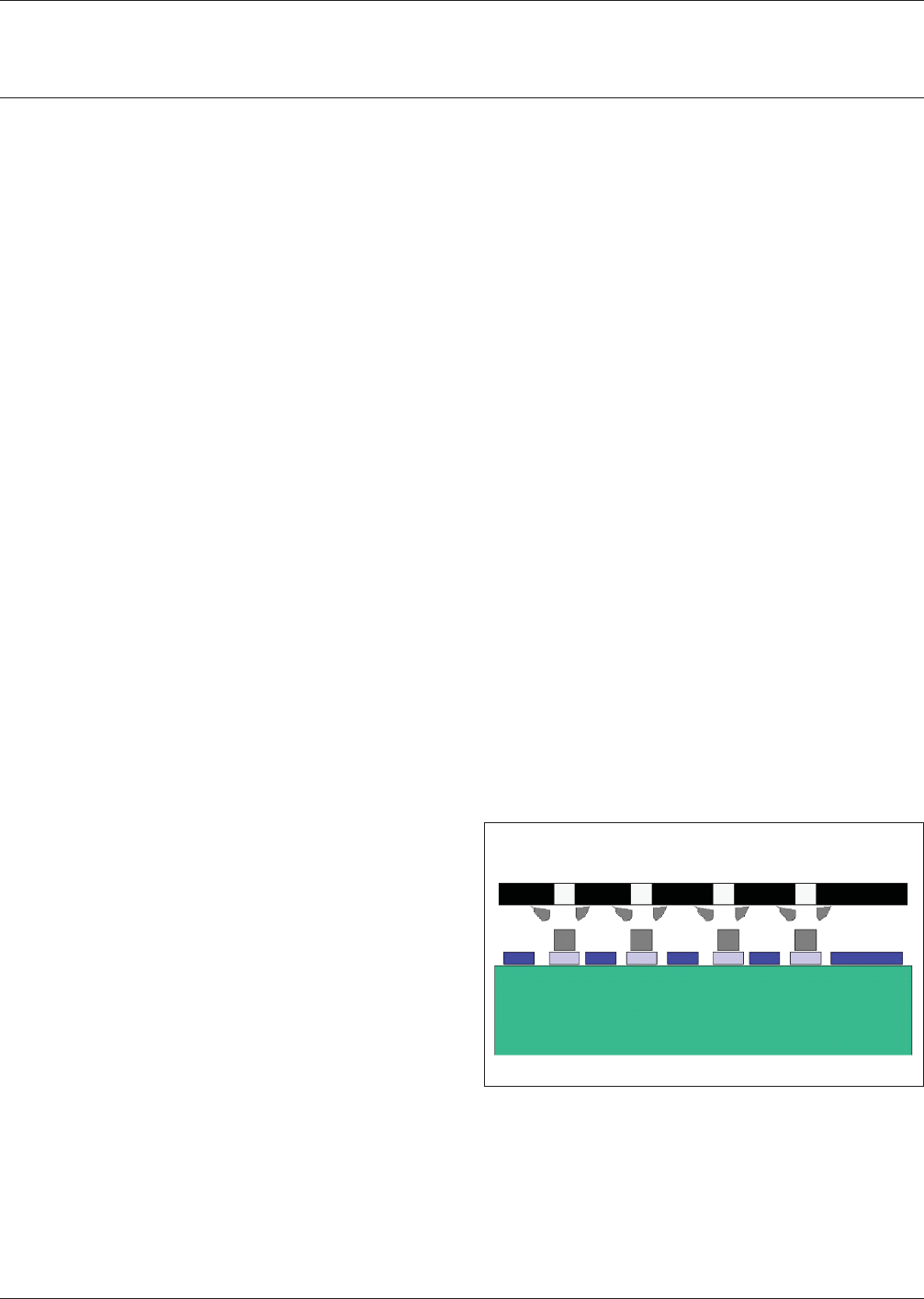
IPC-7526-1-1
Figure 1-1 Cleaning Stencil Bottom
(Figure 1-1) Failure to underwipe or clean the bottom side
of the stencil contributes to inconsistencies in solder paste
deposition.
Cleaning Stencil Bottom
February 2007 IPC-7526
1