Betriebsanleitung_HF3_14_de.pdf - 第596页
9 2KE0041502 - englisch_BA 04.1 1.2010 ENGLISH 1.5.2 Operation The owner or the operator of the process cooler is obligated to establish emergency practices (in the case of accidents and malfunctions). A short version of…

8
2KE0041502 - englisch_BA
04.11.2010
ENGLISH
1.4 Handling of Refrigerants
When handling refrigerants, all legal provisions and guidelines must be complied
with. Only qualified personnel may perform these activities.
The operator of the process cooler is responsible for the proper disposal of used refrigerants
and system parts.
1.5 Safety Requirements
concerning the operation of refrigeration systems within the European Union.
The following information applies to refrigeration systems with closed refrigeration cycles that
are used within the European Union. In some member states additional requirements may
apply, e.g. due to environmental considerations.
In the refrigeration units described in this operating manual, working pressures occur that are
subject to the regulations laid down in the Pressure Vessel Directive 97/23/EC and European
standard EN 378 (Parts 1 – 4, version September 2000).
Apart from the requirements relating to the design, equipment and testing of the refrigeration
systems prior to delivery to the customer, also the operator of such systems has to comply
with requirements in accordance with European standard EN 378 and/or additional national
regulations. These concern the installation, the operation and requalification tests of
refrigeration systems.
1.5.1 Installation
If the process cooler is installed below ground level or on upper floors of a building, without any
adequate number of emergency exits, requirements relating to the protection of people in
accordance with EN 378 have to be complied with.
With respect to the actual refrigerant charge of the process cooler, a minimum room volume
must be maintained and not be fallen short of.
Refriferant
R134a
WKS 40.02-NE 9
Minimum room sizes in [m
3
] are required for the installation of refrigeration units, depending on
the refrigerant being used.
It can thus be ensured that in the case of refrigerant leaks caused by damage to the equipment
– and thus the displacement of oxygen – will not have any detrimental effect on the health of
persons.
1. For Your Safety
9
2KE0041502 - englisch_BA
04.11.2010
ENGLISH
1.5.2 Operation
The owner or the operator of the process cooler is obligated to establish emergency
practices (in the case of accidents and malfunctions). A short version of the operating
instructions must be drawn up by the operator – based on this present Operating Manual – and
made known to the employees.
The quick reference guide must be clearly legible and affixed in the immediate
vicinity of the process cooler.
See Sample Quick Reference Guide.
The owner or operator of a system is obligated to keep a logbook for the process
cooler.
The system logbook must either be available on site near the process cooler, or in the event
that the data are stored in a computer of the owner or operator, a printout of the log must be
kept in the vicinity of the process cooler. It must be ensured that these data are accessible to
qualified persons for the performance of repairs and requalification/repeat tests.
See Sample System Log
1.5.3 Repeat/Requalification Testing
To ensure compliance with minimum safety and health requirements as set forth in standard
EN 378, regular testing (requalification testing) of the process coolers is to be carried out by
competent persons.
The operator is responsible for the performance of the retests.
(See Chapter Repeat Testing).
1.6 Purpose of the Process Cooler
The process cooler described in this manual is designed exclusively for the cooling of water
within the specified operating temperature limits.
1. For Your Safety
10
2KE0041502 - englisch_BA
04.11.2010
ENGLISH
2. DESCRIPTION OF THE PROCESS COOLER
The process cooler is a unit ready for plug-in and is equipped with refrigeration and water
circuits including all fittings and regulating/control devices required for automatic operation.
The heat extracted from the water is given off to the ambient air via the refrigeration circuit – by
means of the fans.
2.1 Refrigeration Circuit
The refrigeration circuit is a closed-loop system in which the refrigerant circulates as the
working medium.
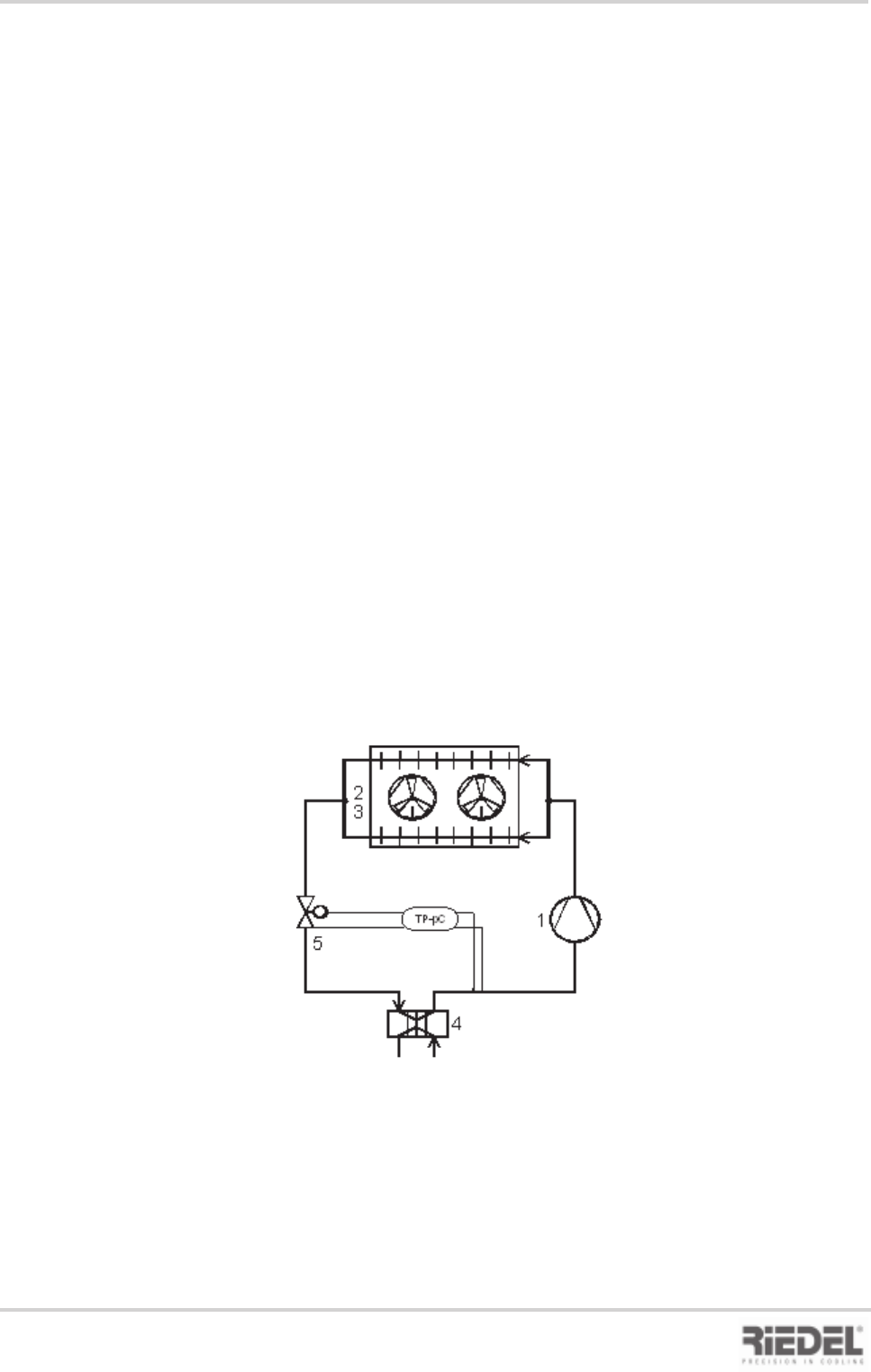
The water heated by the equipment to be cooled is re-cooled in the evaporator (3). The liquid
refrigerant is thereby passed through the piping in a counter-flow arrangement with respect to
the water. The refrigerant evaporates as it takes up the waste heat from the cooling water of the
equipment to be cooled.
The vaporised refrigerant is drawn in by the compressor (1) and is then compressed (rise in
pressure and temperature). The refrigerant also absorbs the heat of the compressor motor; this
heat is given off to the surrounding air by the condensers (2) - in the form of waste heat –by
means of the fan.
The refrigerant is thus liquefied and is passed to the inlet of the expansion valve (4) via the
liquid receiver, the shut-off valve, the filter drier and the sight glass. The expansion valve permits
liquid refrigerant to enter the evaporator as a function of the temperature.
The circuit is now complete.
Block flow diagram, refrigerant circuit
2. Description of the Process Cooler