Anritsu_MG3692C.PDF - 第11页
11 TRACE A: Ch1 8PSK Meas Ti me 1.5 -1.5 -1.9607643757 1.96078437567 I - Q 300 M /div MG3700A MG3690C Carrier Frequency = 38.000 GHz RF IF LO IF Up-Conversion (Option 7) Application and Setup IF Up-Conversion (Option 7) …
10
Internal LF and Pulse Generators (Option 27)
An internal pulse generator and two internal waveform generators are added, one provid-
ing a frequency or phase modulating signal and the other an amplitude modulating signal.
This Internal LF and Pulse Generators option can only be ordered in combination with
either FM/ΦM, AM, or Pulse options, 12, 14, and 26 respectively.
Waveforms: Sinusoid, square-wave, triangle, positive ramp, negative ramp, Gaussian
noise, uniform noise. (Check Option 10 for User-Defined)
Rate:
0.1 Hz to 10 MHz sinusoidal
0.1 Hz to 1 MHz square-wave, triangle, ramps
Resolution: 0.1 Hz
Accuracy: Same as instrument timebase ± 0.014 Hz
Waveform Outputs: Two BNC connectors on the rear panel, FM/ΦM OUT and AM OUT
Pulse Modes: Singlet, doublet, triplet, quadruplet
Pulse Triggers: Free-run, triggered, gated, delayed, triggered with delay, swept-delay
Pulse Inputs/Outputs: Video pulse and sync out, rear-panel BNC connectors
① For 50 GHz and 67 GHz units, overshoot > 40 GHz is 20% typical at rated power.
② Period must be longer than the sum of delay and width by 5 clock cycles minimum.
③ Rise time and Pulse Width Compression, > 20 GHz, degrades by 2 ns,
with High Power Option 15.
* Typical
Amplitude Modulation (Option 14)
Option 14 adds amplitude modulation, driven externally via a rear panel BNC connector 50 Ω.
For internal modulation, add Internal LF and Pulse Generators Option 27.
All amplitude modulation specifications apply at 50% depth, 1 kHz rate, with RF level set
6 dB below maximum specified leveled output power, unless otherwise noted. Amplitude
Modulation is not available < 10 MHz with Option 22.
AM Depth (typical): 0-90% linear; 20 dB log
AM Bandwidth* (3 dB):
DC to 50 kHz minimum
DC to 100 kHz typical
Flatness (DC to 10 kHz rates): ± 0.3 dB
Accuracy:
Reading ± 5%
Distortion: < 5% typical
Incidental Phase Modulation (30% depth, 10 kHz rate):
<0.2 radians typical
External AM Input: Log AM or Linear AM input, rear-panel BNC, 50 Ω input impedance.
For internal modulation, add LF Generator Option 27.
Sensitivity:
Log AM: Continuously variable from 0 dB per volt to 25 dB per volt.
Linear AM: Continuously variable from 0% per volt to 100% per volt.
Maximum Input: ± 1 Vpk
*Typical below 2.2 GHz, when ordered with Options 4 and 15.
Pulse Modulation (Option 26)
Option 26 adds pulse modulation, driven externally via a rear panel BNC connector, TTL.
For internal modulation, add Internal LF and Pulse Generators Option 27.
Pulse modulation specifications apply at maximum rated power, unless otherwise noted.
Pulse modulation is not available < 10 MHz with Option 22.
On/Off Ratio: > 80 dB (> 70 dB with high power Option 15)
Minimum Leveled Pulse Width:
100 ns, ≥1 GHz
1 µs, <1 GHz
Minimum Unleveled Pulse Width: < 10 ns
Level Accuracy Relative to CW (100 Hz to 1 MHz PRF):
± 0.5 dB, ≥ 1 µs pulse width
± 1.0 dB, < 1 µs pulse width
Pulse Delay (typical): 50 ns in External Mode
PRF Range:
DC to 10 MHz, unleveled
100 Hz to 5 MHz, leveled
External Input: Rear-panel BNC. For internal modulation, add Pulse Generator Option 27
Drive Level: TTL compatible input
Input Logic: Positive-true or negative-true, selectable from modulation menu.
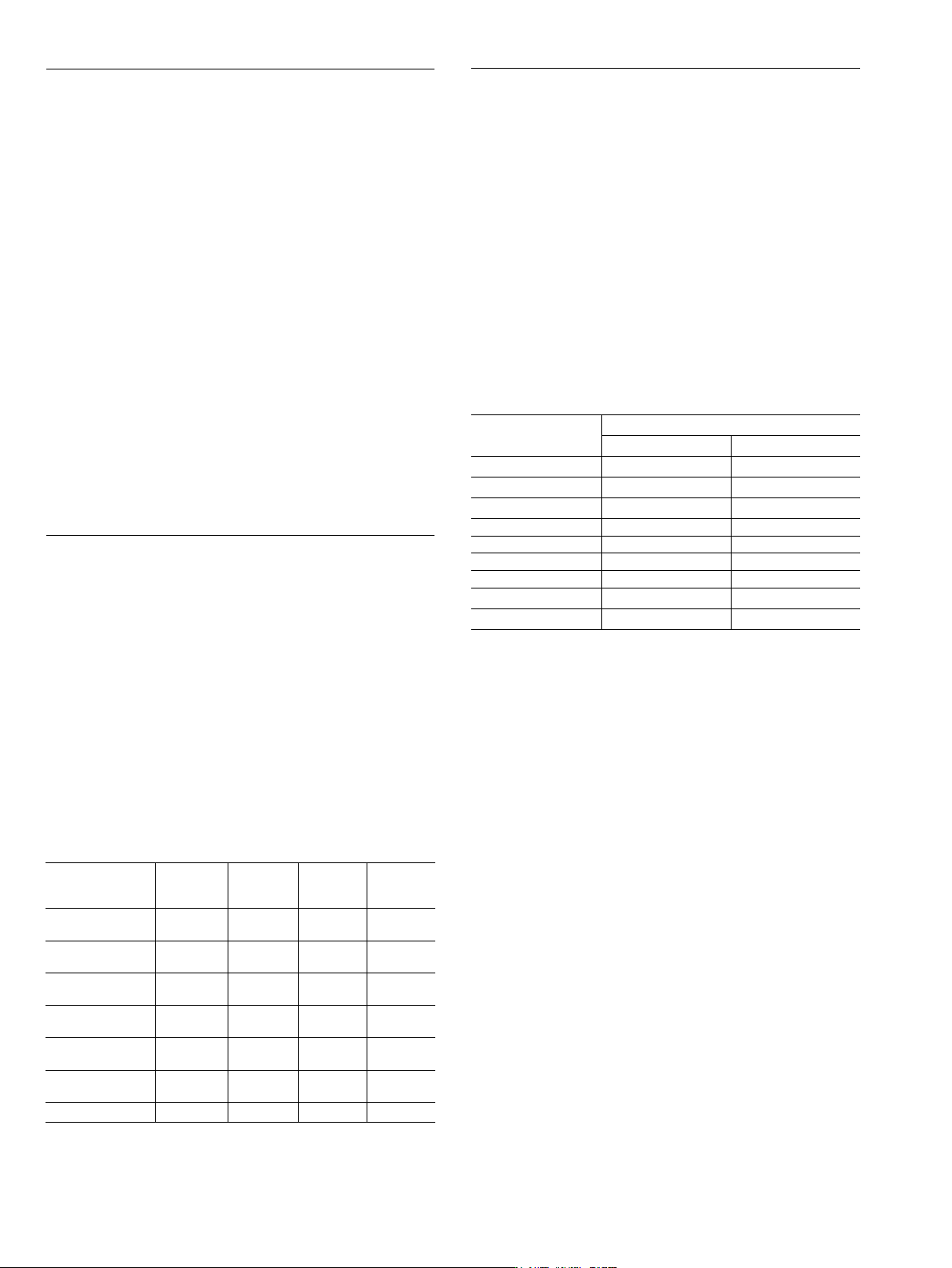
Pulse
Parameter
Selectable Clock Rate
Narrow (100 MHz) Wide (10 MHz)
Pulse Width 10 ns to 160 ms 100 ns to 1.6 s
Pulse Period
②
100 ns to 160 ms 600 ns to 1.6 s
Variable Delay
Singlet 0 ms to 160 ms 0 s to 1.6 s
Doublet 100 ns to 160 ms 300 ns to 1.6 s
Triplet 100 ns to 160 ms 300 ns to 1.6 s
Quadruplet 100 ns to 160 ms 300 ns to 1.6 s
Resolution 10 ns 100 ns
Accuracy 10 ns (5 ns typical) 10 ns (5 ns typical)
Frequency
Range
Rise and Fall
Time
(10% to 90%)
Overshoot
Pulse Width
Compression
Video
Feedthrough
≥ 10 MHz to < 31.25 MHz
(Opt. 4)
400 ns* 33%* 40 ns* ± 70 mV*
≥ 31.25 MHz to < 125 MHz
(Opt. 4)
90 ns* 22%* 12 ns* ± 130 mV*
≥ 125 MHz to < 500 MHz
(Opt. 4)
33 ns* 11%* 12 ns* ± 70 mV*
≥ 500 MHz to < 2200 MHz
(Opt. 4)
15 ns* 10% 12 ns* ± 50 mV*
≥ 10 MHz to < 1000 MHz
(Opt. 5)
15 ns, 10 ns* 10% 8 ns* ± 30 mV*
≥ 1 GHz to < 2 GHz
(Opt. 5)
10 ns, 5 ns* 10% 8 ns* ± 30 mV*
≥ 2 GHz to 67 GHz
③
10 ns, 5 ns* 10%
①
8 ns* ± 30 mV*
11
TRACE A: Ch1 8PSK Meas Time
1.5
-1.5
-1.9607643757 1.96078437567
I - Q
300
M
/div
MG3700A
MG3690C
Carrier Frequency = 38.000 GHz
RF
IF
LO
IF Up-Conversion (Option 7) Application and Setup
IF Up-Conversion (Option 7)
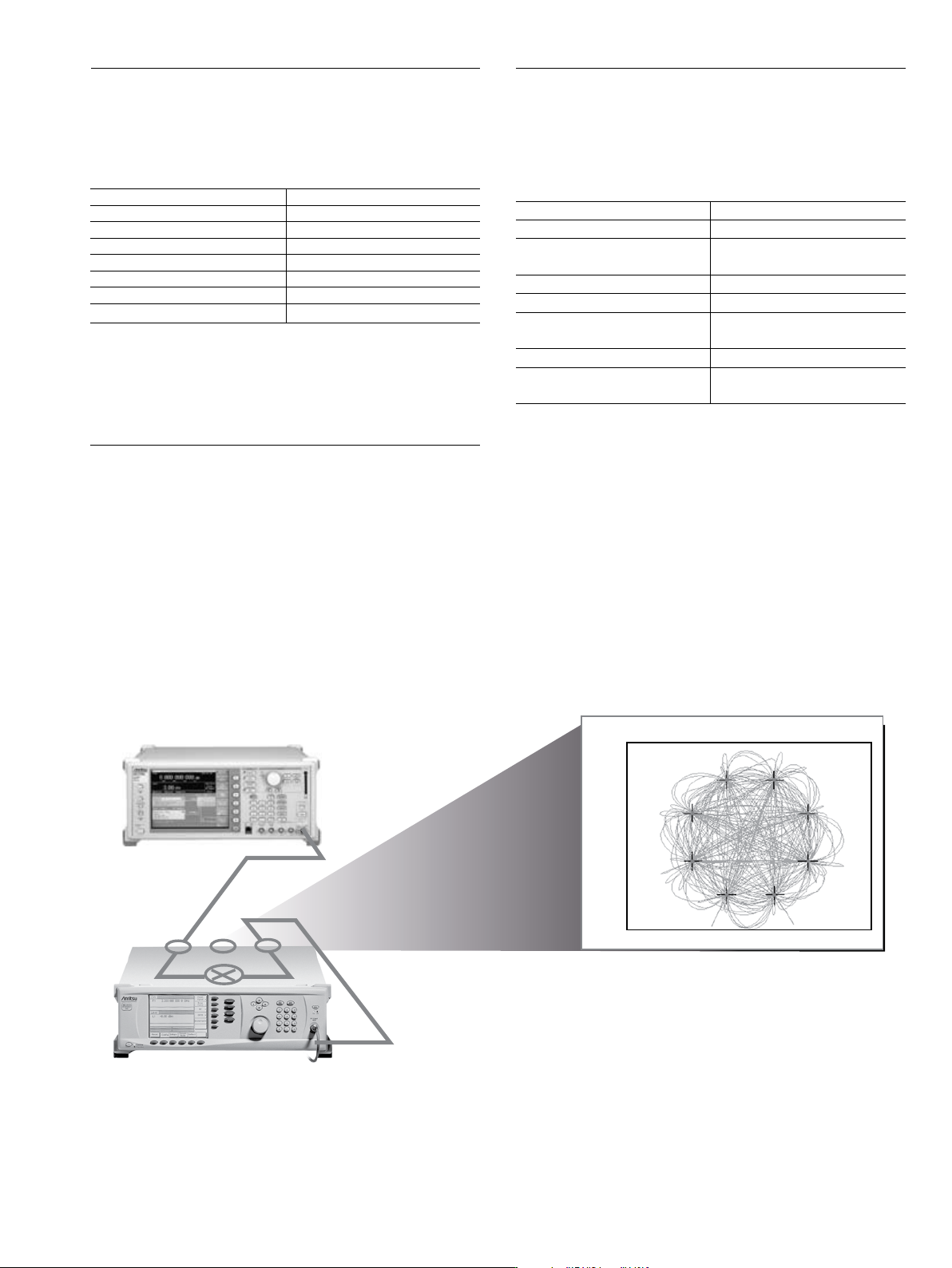
Option 7 adds an internal mixer that can be used for the generic up-conversion of
an IF signal. The mixer’s RF, LO, and IF ports are made available at the rear panel
of the MG3690C, via three female K-Connectors. The typical application will feed the
MG3690C microwave output, which can be moved to the rear panel via option 9K,
to the mixer’s LO port. An external IF signal will be fed to the mixer’s IF port. The
new up-converted signal will be available at the mixer’s RF port.
The IF Up-Conversion option is particularly useful to create a microwave frequency
IQ-modulated signal. Lower frequency IQ-modulated RF sources are readily
available, such as the Anritsu MG3700A. Option 7’s IF input can be used to feed in
an IQ-modulated signal from an MG3700A, up-converting it to as high as 40 GHz
with an MG3694C. A typical setup is shown below.
User-Defined Modulation Waveform Software (Option 10)
An external software package provides the ability to download user-defined
waveforms into the internal LF Generator’s (Option 27) memory. The MG3690C
provides as standard with the LF Generator sinusoidal, square-wave, triangle,
positive ramp, Gaussian noise, and uniform noise waveforms.
Two look-up tables of 65,536 points can be used to generate two pseudo-random
waveforms, one for amplitude modulation and the other for frequency or phase
modulation. The download files are simple space-delimited text files containing
integer numbers between 0 and 4095, where 0 corresponds to the minimum
modulation level and 4095 the maximum.
In addition to the capability of downloading custom waveforms, the software
offers a virtual instrument modulation panel. Custom modulation setups with user
waveforms can be stored for future use. For IFF signal simulation, the internal
generators can be synchronized. They can also be disconnected from the internal
modulators, making the low frequency waveforms available at the rear panel for
external purposes.
Scan Modulation (Option 20)
Option 20 adds a microwave linearly controlled attenuator to provide deep AM ca-
pability. This modulator is inserted outside the leveling loop but before the optional
step attenuator. It is switched in and out of the RF path. Scan modulation is driven
externally only.
One application of this feature is storing an antenna pattern wave form in memory
and using it to feed the external input to the scan modulator, Option 20.
Mixer Type Double Balanced
RF, LO Range 1 GHz to 40 GHz
IF Range DC to 700 MHz
Conversion Loss 10 dB Typical
Max Power into any Port 30 dBm
Isolation, RF to LO 23 dB
LO Drive Level (recommended) +10 dBm to +13 dBm
Input P
1 dB
+3 dBm Typical
Frequency Range 2 GHz to 18 GHz
Attenuation Range 0 dB to 60 dB
Flatness/Accuracy
± 1.5 dB/± 1.5 dB, 0 to 40 dB
± 3 dB/± 2 dB, 40 to 60 dB
Step Response < 1 µs
Sensitivity –10 dB/V
Modulation Bandwidth
20 kHz (small signal)
5 kHz (large signal)
Insertion Loss < 6 dB (when engaged)
Input
Rear Panel BNC connector
High Impedance
12
Millimeter Wave Multipliers
1
- 63850 series
(Option 18 recommended for DC bias.)
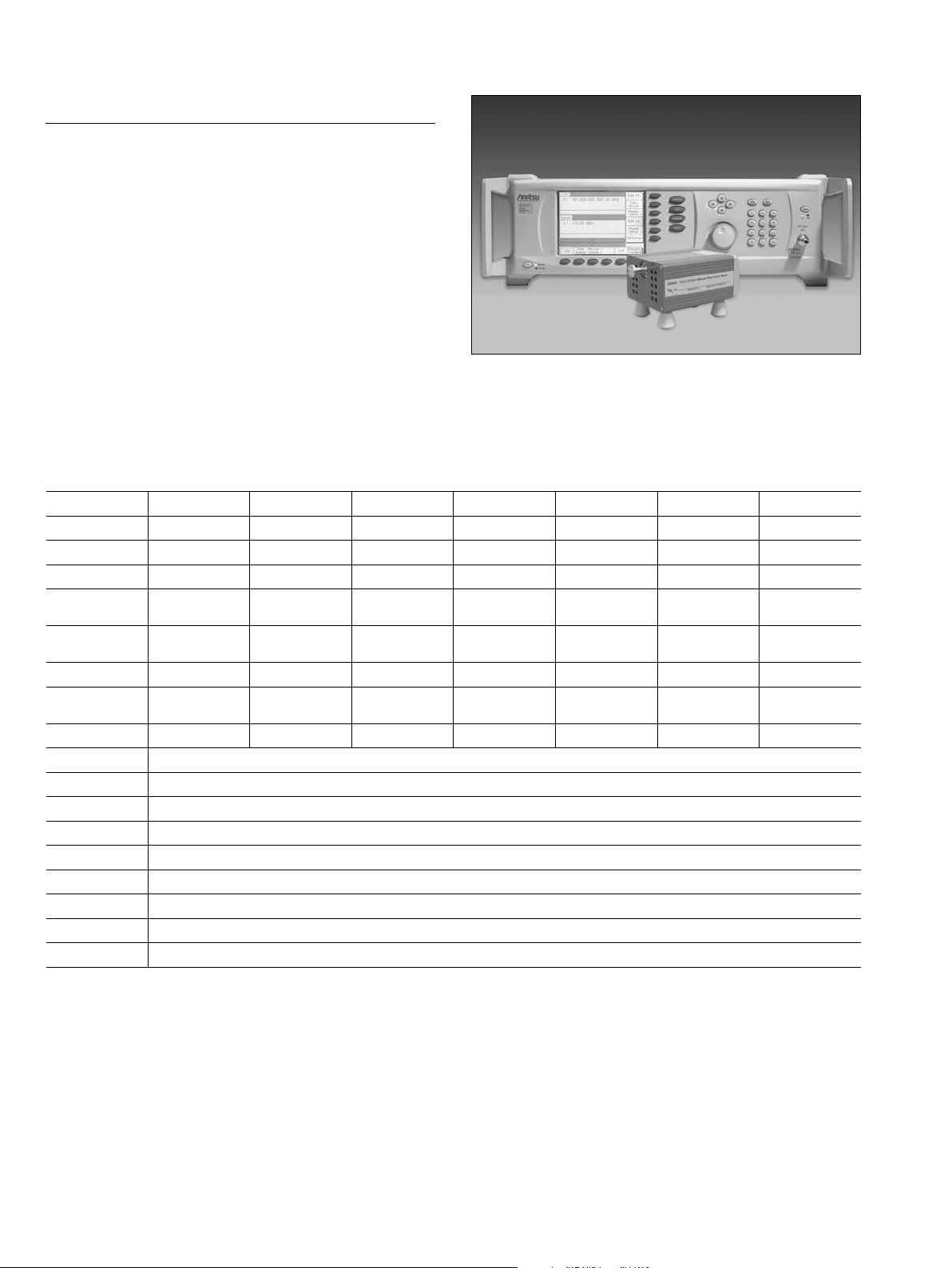
63850 series external, waveguide output, multipliers are available for banded frequency
coverage up to 325 GHz.
These external multipliers require at a minimum an MG3692C, with 20 GHz coverage.
The output power required to drive the modules is +10 dBm. They can be powered up
by an external power supply (+12 Vdc, 1.5A typ.) using the supplied double banana
power cord. It is recommended to purchase an MG3690C with option 18, which adds the
capability to bias these modules without the need of an additional power supply. Option 18
adds a rear panel Twinax connector that supplies the proper DC bias for these modules, and
a cable to power them up. Option 18 is not available with options 7 and 15.
63850 series multipliers have a saturated, unleveled, output power, yet their inherent
flatness is exceptional. Modulating the input drive will indeed modulate the output, except
for the case of Amplitude Modulation. Since the output is saturated, Amplitude Modulation
is not recommended with these mmW modules. Frequency and Phase Modulation is
possible, but the achieved deviation will be multiplied based on the multiplication factor of
the module. Pulse modulation is also possible, with even sharper rise and fall times than
the input. All modulation performances are not specified.
For ease of operation, the MG3690C allows the user to enter a frequency scaling factor,
the module's multiplication factor, which will be used only for purposes of displaying the
proper frequency at the output of the mmW module, on the MG3690C front panel display.
MG3690C with 63850 Series Millimeter Wave Multiplier
mmW Frequency Coverage
1
These mmW modules are produced by OML Inc. (Oleson Microwave Labs), located in Morgan Hill, CA., with mutual collaborative experiences over many years.
For detailed and up-to-date specifications, please call OML, Inc. or visit their website at www.oml-mmw.com.
2
Waveguide output flanges are per MIL.F-3922/67B-(xxx)
3
Power rolls off from –15 dBm at 200 GHz, to –25 dBm typical at 220 GHz.
4
Output power is estimated.
Multiplier p/n
1
63850-15 63850-12 63850-10 63850-08 63850-06 63850-05 63850-03
Frequency 50 GHz - 75 GHz 60 GHz - 90 GHz 75 GHz - 110 GHz 90 GHz - 140 GHz 110 GHz - 170 GHz 140 GHz - 220 GHz 220 GHz - 325 GHz
Waveguide Output WR-15 WR-12 WR-10 WR-08 WR-06 WR-05 WR-03
Flange
2
(008) (009) (010) (M08) (M06) (M05) (M03)
Output Power
(typical)
+8 dBm +6 dBm +5 dBm –5 dBm –13 dBm
–15 dBm
3
–25 dBm
4
Output Flatness
(typical) (Unleveled)
± 2 dB ± 2 dB ± 3 dB –– –– –– ––
Output Match > 12 dB > 12 dB > 12 dB > 12 dB > 12 dB > 12 dB 6 dB (typical)
Multiplication
Factor (m)
x4 x6 x6 x8 x12 x12 x18
Input Frequency 12.5 GHz - 18.75 GHz 10.0 GHz - 15.0 GHz 12.5 GHz - 18.4 GHz 11.2 GHz - 17.5 GHz 9.1 GHz - 14.2 GHz 11.6 GHz - 18.4 GHz 12.2 GHz - 18.1 GHz
Frequency Accuracy (LO Synthesizer's Accuracy x m)
Frequency Resolution (LO Synthesizer's Resolution x m)
Harmonics & Spurious –15 dBc (typical)
Input Power Required +10 dBm
RF Input Connector SMA (female)
DC Power 12 Vdc, 1.5A (double banana power cord included) Option 18 is recommended on the synthesizer, to supply the necessary bias.
Dimensions 120 mm x 110 mm x 70 mm (not including feet or interfaces)
Weight < 1 kg
Temperature +20 ºC to +30 ºC