User-Manual-NeoDen-IN6-Reflow-oven.pdf - 第12页
10 belt speed proportionally if it is t oo l ong, and vice versa. Next, the sha pe of the graph curve must be compared with the desired one (Fig. 2). If the shape is inconsistent, it shall be compared with the following …

9
temperature rise slope will exceed 2-5 ° C per second, or the reflow peak temperature will be
higher than the recommended one. This may cause excessive crimping, delamination or
burning of PCB and damage the integrity of components.
Today, the most commonly used alloy is Sn63 / Pb37. This ratio of tin and lead makes the alloy
eutectic. Eutectic alloy is an alloy melted at a specific temperature, while non eutectic alloy has
a melting range, rather than a melting point, sometimes called plastic loading state. All
examples described in this paper refer to eutectic tin / lead, which is widely used and has a
melting point of 183 ° C.
The ideal cooling zone curve should be a mirror image of the reflow zone curve. The closer the
mirror image relationship is, the closer the solid structure of the solder joint is, the higher the
quality of the solder joint is, and the better the integrity of the joint is.
The first parameter to be considered in making the temperature curve is the speed setting of the
transmission belt, which will determine the time spent by the PCB in the heating channel. A
typical solder paste manufacturer's parameters require a heating curve of 3-4 minutes. Dividing
the total heating channel length by the total heating sensing time is the accurate transmission
belt speed. For example, when the solder paste requires a heating time of 4 minutes, using a six
foot heating channel length, the calculation is: 6 feet ÷ 4 minutes = 1.5 feet per minute = 18
inches per minute.
Next, it is necessary to determine the temperature setting of each zone. It is important to
understand that the actual zone temperature is not necessarily the display temperature of this
zone. The displayed temperature only represents the temperature of the thermistor couple in the
area. If the thermocouple is closer to the heating source, the displayed temperature will be
relatively higher than that in the area. The closer the thermocouple is to the direct channel of
PCB, the displayed temperature will be more able to reflect the temperature in the area. It is
advisable to consult with the furnace manufacturer to understand the relationship between the
clearly displayed temperature and the actual interval temperature. In this paper, we will
consider interval temperature rather than display temperature. Table 1 lists the interval
temperature settings for typical PCB assembly reflow.
Table 1 temperature setting of typical PCB return section
Area
Temperature Setting
Actual plate temperature at the end of zone
Preheat
210°C(410°F)
140°C(284°F)
Active
177°C(350°F)
150°C(302°F)
Reflow
250°C(482°C)
210°C(482°F)
After the speed and temperature are determined, they must be input to the furnace controller.
Once all parameters are input, start the machine, and after the furnace is stable (that is, all the
actual displayed temperatures are close to the set parameters), the curve can be made. The next
PCB is put into the conveyor belt, triggering the thermometer to start recording data. For
convenience, some thermometers include a trigger function to automatically start the
thermometers at a relatively low temperature, which is slightly higher than the human body
temperature of 37 ° C (98.6 ° f). For example, an automatic trigger at 38 ° C (100 ° f) allows
the thermometer to work almost as soon as the PCB is put into the conveyor belt and enters the
furnace, so as not to cause false triggering when the thermocouple is handled by hand.
Once the initial temperature profile is generated, it can be compared with the profile
recommended by the solder paste manufacturer or the profile shown in Figure 2.
First, it must be confirmed that the total time from ambient temperature to reflow peak
temperature is in line with the desired heating curve residence time, increasing the conveyor
10
belt speed proportionally if it is too long, and vice versa.
Next, the shape of the graph curve must be compared with the desired one (Fig. 2). If the shape
is inconsistent, it shall be compared with the following graph (Fig. 3 ~ 6). Select the curve that
best matches the shape of the actual shape. The deviation from the left to the right (process
sequence) should be considered. For example, if there is a difference between preheating and
reflow area, first adjust the difference between preheating area correctly. Generally, it is better
to adjust one parameter at a time, and run the curve setting before making further adjustment.
This is because the change of a given area will also affect the result of the subsequent area. We
also suggest that the adjustments made by novices should be relatively small. Once experience
has been gained in a particular furnace, there will be a better "feel" for how much adjustment to
be made.
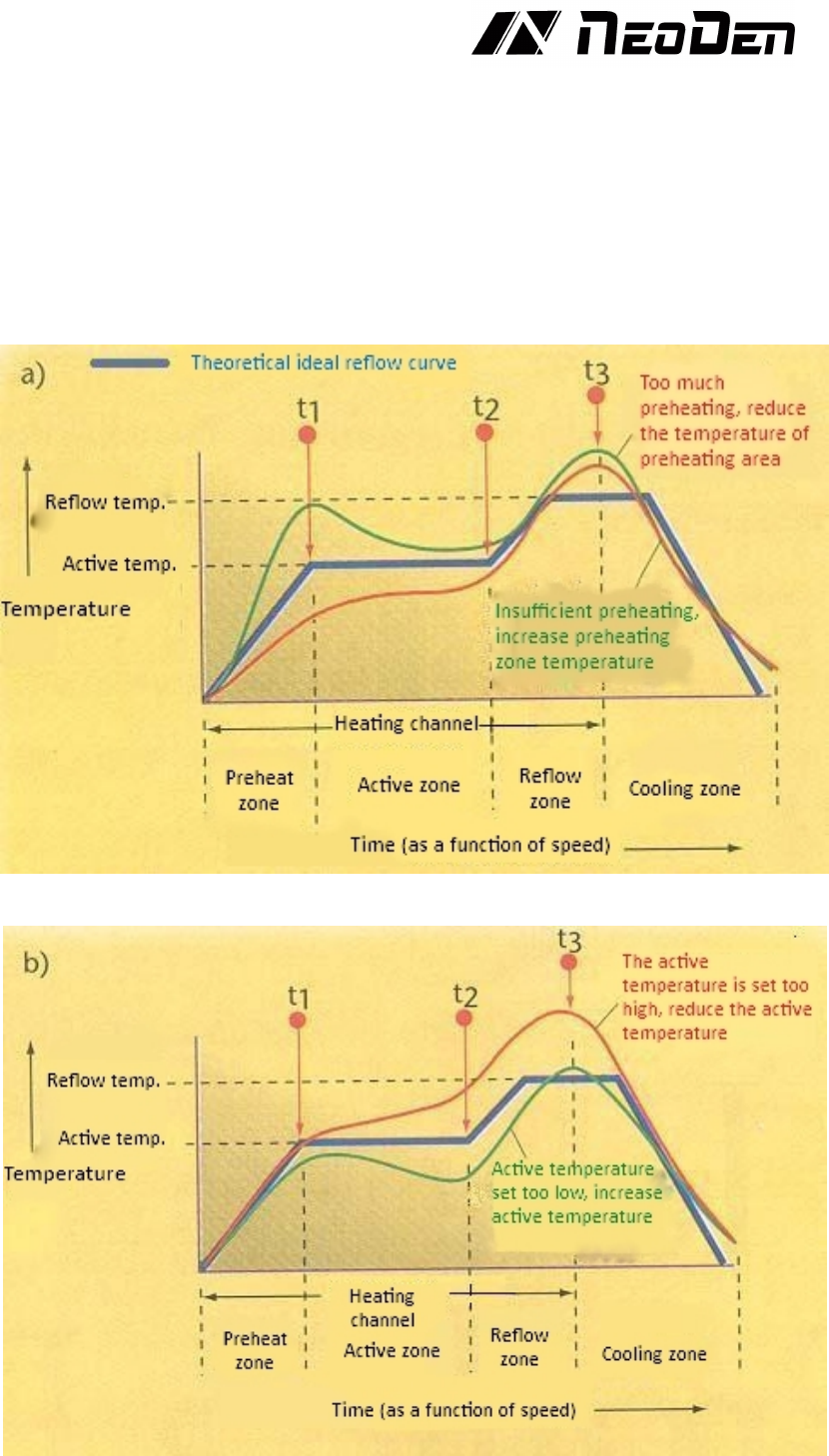
Figure 3. Insufficient or excessive preheating reflow curve
Figure 4. Too high or too low temperature in the active zone
11
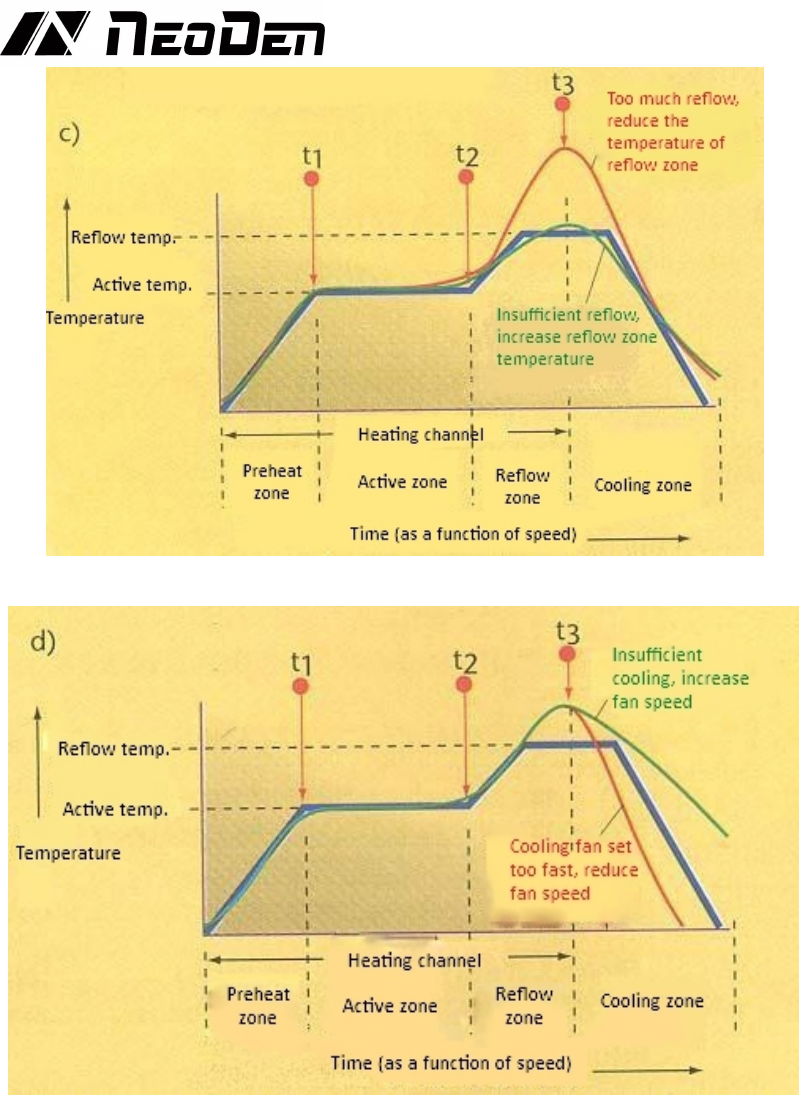
Figure 5. Too much or not enough reflow
Figure 6. Cooling too fast or not enough
When the final curve is consistent with the desired figure as much as possible, the furnace
parameters should be recorded or stored for later use. Although this process starts slowly and
laboriously, it can finally achieve proficiency and speed, resulting in high-quality PCB
production efficiency.
6. Details about temperature area setting
♦Set the temperature and belt speed to initial value, to the cooling oven, should be preheated
for 25 minutes.
♦When the temperature is stable, let PCB pass heat reflow system. If there is no reflow, can
properly reduce the transfer chain rotation speed. Another way is that, do not adjust the speed,
and increase the temperature properly. When adjust the temperature, notice that it cannot
exceed the PCB and component bearing capacity.
♦Let the PCB pass the reflow system in the new speed or new set temperature. If there is no
reflow, turn to redo the above step. Otherwise, need temperature fine-turning.