User-Manual-NeoDen-IN6-Reflow-oven.pdf - 第9页
7 time is short, it will affect the welding quality, and serious i s causing the solder paste doe s not melt. If the peak temperature is high or the reflow time is l ong, t he met al power will be oxidized and affect the…
6
♦Power-off
Turn the red power switch to the OFF position and turn off the machine.
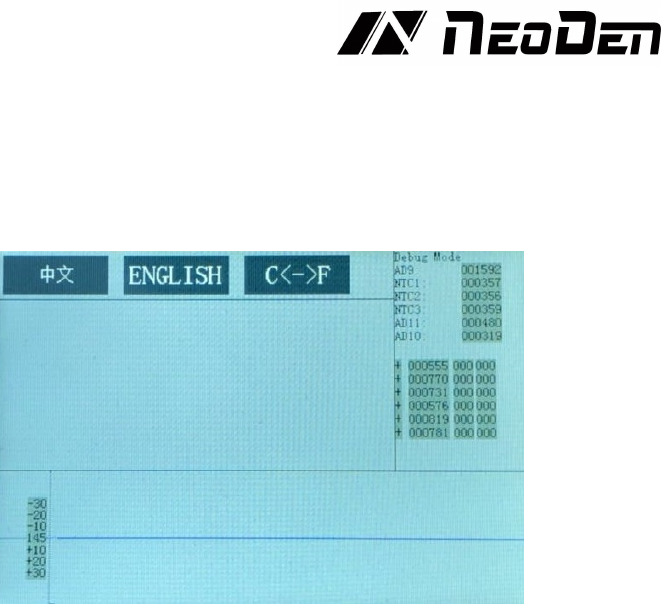
♦Change language and the unit of temperature in machine
After the power switch is turned to ON, the NeoDen logo will be displayed on the screen. Long
press the OK button to enter the Debug mode interface. In this interface, you can change the
language and temperature unit of the machine.
5. Temperature wave setting principle
5.10 what is the heating unit temperature?
The heating unit temperature refers to the real-time temperature of the heating plate.
5.11 what is furnace temperature?
Furnace temperature refers to the air temperature between the chain surface and the heating
plate.
5.12 what is PCB surface temperature?
PCB surface temperature refers to the temperature of component welding feet during PCB
welding. (the guiding temperature on the welding curve provided by the solder paste
manufacturer refers to the plate temperature.)
When working, the temperature displayed on the panel is the actual temperature of the heating
unit, which does not represent the temperature in the furnace and the actual temperature of the
board. Therefore, the displayed temperature will be about 20-40 degrees higher than the
temperature in the furnace. The actual temperature is related to the chain speed, PCB size,
thickness, material and component density.
5.1 The reflow soldering theory and the temperature wave
When the PCB goes into heat up area (dry area), the solvent and gas in the solder paste will
evaporate. At the same time, the flux can wet the pad and the component tip and foot. The
solder paste melts, caves in and covers the pad, leading to the pad and component pins insulate
the oxygen. PCB goes into heat preservation area. PCB and components get full preheating. In
case of damaging the PCB and components when it goes into the welding area and the
temperature heats up quickly. When PCB goes into the welding area, the temperature heats up
and the solder paste melts. When PCB goes into cooling area, the liquid solder paste the
soldering points solidify. The reflow process is finished.
The temperature is the key to welding quality. The actual and the setting temperature warming
slope and the peak temperature should be accordant. Before the temperature reaches 160℃,
please control
the heat up speed in about 1℃/S. If heat up too quickly, the PCB and the components will be
damaged, and the PCB may be out of shape. On the other side, the flux volatilizes too fast. And
it is easy to make soldering tin ball. Set the peak temperature 20℃-40℃ higher than the solder
paste melting point. Set the reflow time 10S-60S. If the peak temperature is low or the reflow
7
time is short, it will affect the welding quality, and serious is causing the solder paste does not
melt. If the peak temperature is high or the reflow time is long, the metal power will be
oxidized and affect the welding quality and serious is causing the component and PCB
damaged.
5.2 The set of the temperature wave
Set according to the temperature curve of solder paste and the welding principle provided
above. Solder paste with different metal content should use different temperature curve, and set
specific reflow temperature curve according to the temperature curve provided by solder paste
manufacturer. In addition, the temperature curve is also related to the density and size of the
heated PCB and components.
In the assembly of printed circuit board (PCB) using surface mount components, an optimized
reflow temperature curve is one of the most important factors to obtain high quality solder
joints. The temperature curve is a function of the temperature on the circuit assembly to the
time. In the reflow process, at any given time, it represents the temperature on a specific point
on the PCB to form a curve.
Several parameters affect the shape of the curve, the most important of which is the belt speed
and the temperature setting of each zone. The belt speed determines the duration of the board
exposed to the set temperature in each zone. Increasing the duration allows more time for the
circuit assembly to approach the temperature setting in that zone. The total duration of each
zone determines the total processing time.
The temperature setting of each zone affects the temperature rising speed of PCB, and high
temperature produces a large temperature difference between the PCB and the zone. The set
temperature of the increase zone allows the board to reach the set temperature faster. Therefore,
a graph must be made to determine the temperature curve of PCB. Next is the outline of this
step, which is used to generate and optimize graphics.
Before starting the curve making process, the following equipment and auxiliary tools are
required: high precision temperature curve instrument (in6), thermocouple (in6), tool for
attaching thermocouple to PCB (mainly high temperature tape) and solder paste parameter table.
There are several ways to attach thermocouples to PCB, the better way is to use high-
temperature solder such as silver / tin alloy, and the solder joints are minimized.
Another acceptable method is fast, easy and accurate enough for most applications. A small
amount of thermal compound (also called thermal conductive paste or thermal grease, which is
often used on computer CPU or graphics card CPU) spots cover the thermocouple, and then use
high-temperature tape (such as Kapton) to stick it.
Another way to attach thermocouples is to use high-temperature adhesives, such as
cyanoacrylate adhesives, which are generally not reliable.
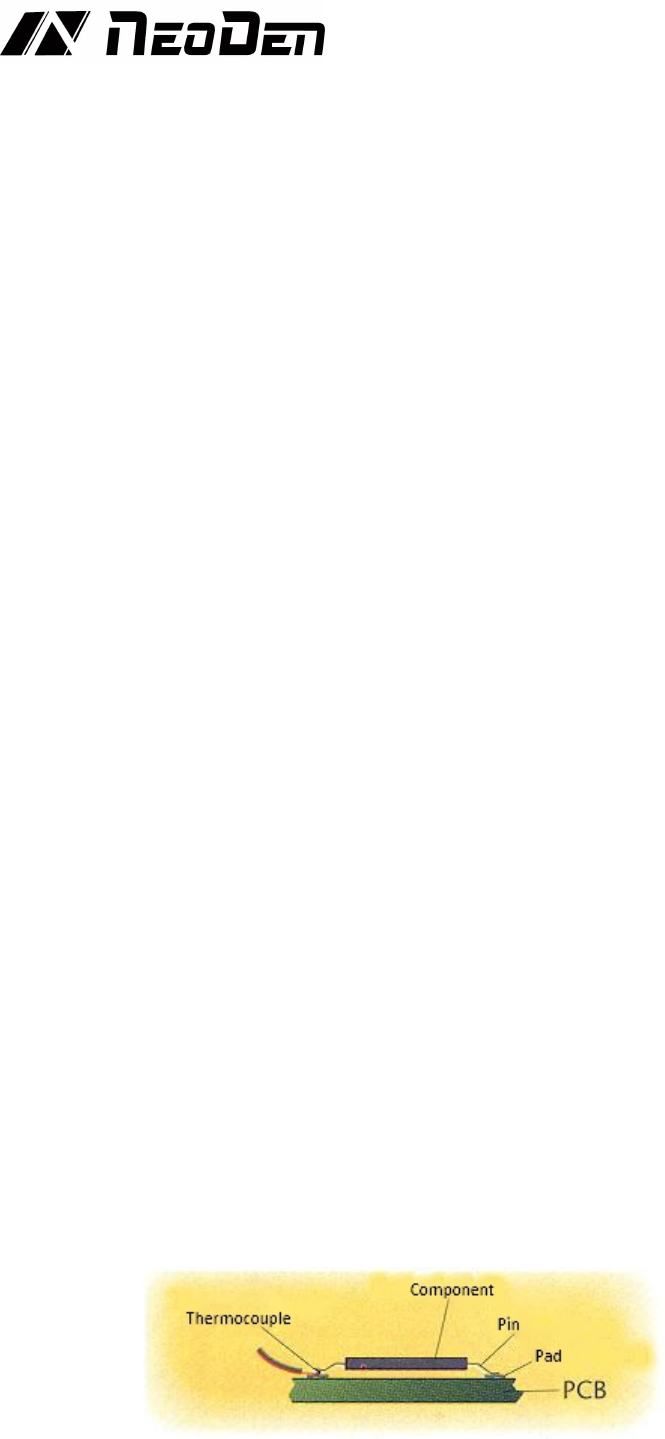
The attachment position should also be selected. It is usually best to attach the thermocouple tip
between the PCB pad and the corresponding component pin or metal end.
(Figure 1. Attach thermocouple tip between PCB pad and corresponding component pin or
metal end)
8
The solder paste characteristic parameter table is also necessary. The information it contains is
very important to the temperature curve, such as the desired temperature curve duration, solder
paste activity temperature, alloy melting point and the desired maximum reflow temperature.
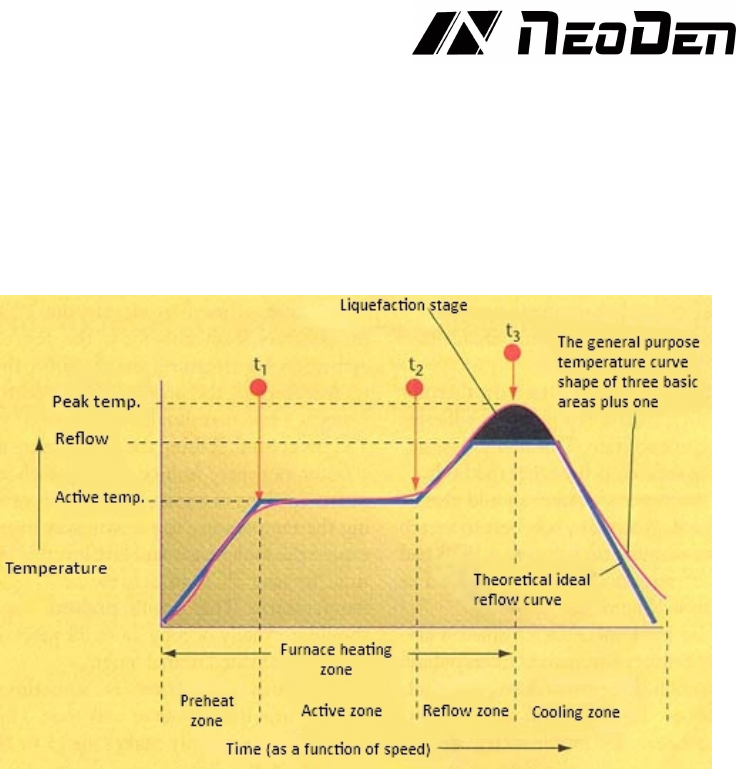
Before we start, we must have a basic understanding of the ideal temperature curve. In theory,
the ideal curve consists of four parts or intervals, the first three zones are heated and the last
zone is cooled. The more the temperature range of the furnace, the more accurate and close to
the setting of the temperature curve. Most pastes can be reflowed successfully in four basic
temperature zones.
(Figure 2. Theoretically, the ideal reflow curve consists of four zones, the first three zones are
heated and the last zone is cooled.)
Preheating area, also known as slope area, is used to raise the temperature of PCB from the
ambient temperature to the required active temperature. In this area, the temperature of the
product rises continuously at the speed of no more than 2-5 ° C per second. If the temperature
rises too fast, some defects will be caused, such as the tiny crack of ceramic capacitor. If the
temperature rises too slowly, the solder paste will be over sensitive to the temperature, and
there is not enough time to make the PCB reach the active temperature. The preheating area of
the furnace generally accounts for 25-33% of the total length of the heating channel.
The active area, sometimes called drying or wetting area, generally accounts for 33-50% of the
heating channel. It has two functions. The first is to sense the temperature of PCB at a fairly
stable temperature, allowing different quality components to be homogeneous in temperature
and reducing their considerable temperature difference. The second function is to allow the flux
to be activated and volatile substances to evaporate from the paste. The general active
temperature range is 120 ~ 150 ° C. if the temperature of the active zone is set too high, the flux
does not have enough time to activate, the slope of the temperature curve is an upward
increasing slope. Although some solder paste manufacturers allow some temperature increase
during the activation, the ideal curve requires relatively stable temperature, so that the PCB
temperature is equal at the beginning and end of the active region. Some furnaces on the market
can not maintain a flat active temperature curve. Choosing a furnace that can maintain a flat
active temperature curve will improve weldability. Users have a larger processing window.
Reflow zone, sometimes called peak zone or final heating zone. The function of this area is to
increase the temperature of PCB assembly from the active temperature to the recommended
peak temperature. The activity temperature is always a little lower than the melting point
temperature of the alloy, and the peak temperature is always at the melting point. The typical
peak temperature range is 205-230 ° C. if the temperature setting in this area is too high, the