EN_BRO_Melt_Flow_Indexer_Rev.I.pdf - 第17页
More than just MFR and MVR Ad d-On Additional extension of our standardized Melt Flow Indexers mi2, mi3 and mi40 With our modular Add-Ons , GÖT TFERT Melt Flow Index ers can be flexibly expanded. This way , a classical pl…
SOFTWARE miCONNECT
• Uniform and user-friendly operating concept
• Browser-based testing software
• Easy setup, management and analysis of test plans
• Support for Microsoft
®
Access and Microsoft
®
SQL databases
• Flexible search filter (test plans / test results)
• OPC/UA interface
• Easy installation
Our Melt Flow Indexers can be specifically adapted
to special material properties and testing
requirements through various optional features.
From automatic cutting units to corrosion-resistant
designs – for greater efficiency, precision and
durability in daily operation.
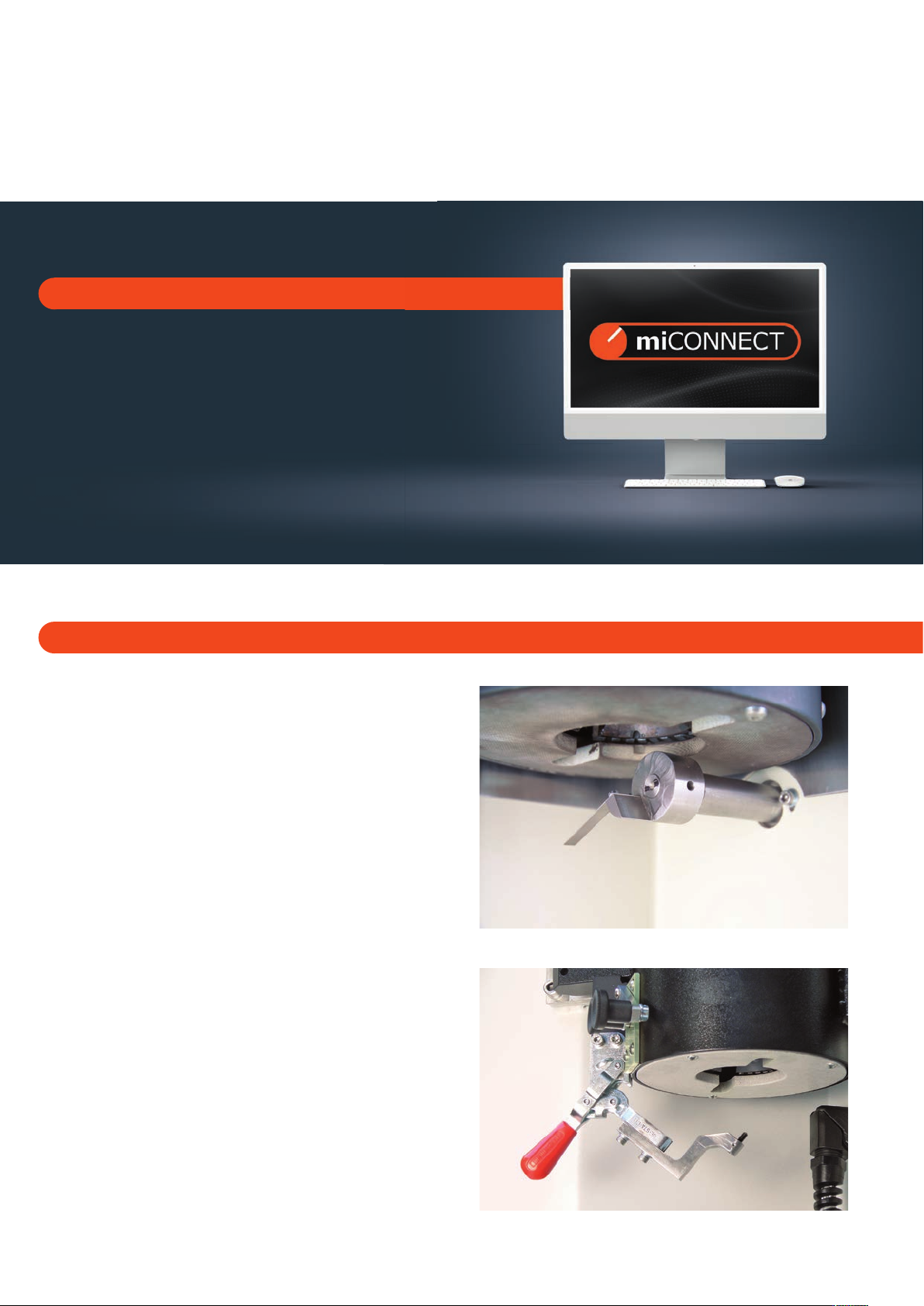
• Automatic melt cutting unit (also for highly
adhesive materials) (Fig. 1)
• Time-saving: pre-compression and extrusion for
viscous test materials (mi3)
• Nitrogen purge for hygroscopic polymers
• Barrel and piston in corrosion-resistant or
wear-resistant design
• Die plug (Fig. 2)
Software and Options
mi2, mi3 und mi40
Fig. 1
Fig. 2
Optional versions for individual requirements
16
More than just MFR and MVR
Add-On
Additional extension of our standardized Melt Flow Indexers
mi2, mi3 and mi40
With our modular Add-Ons, GÖTTFERT Melt Flow Indexers can
be flexibly expanded. This way, a classical plastometer becomes
a versatile system for comprehensive material characterization.
Depending on the application, additional functions can be
integrated. This makes our instruments suitable not only for
standard testing, but also for demanding tasks in quality
assurance, development and process optimization.
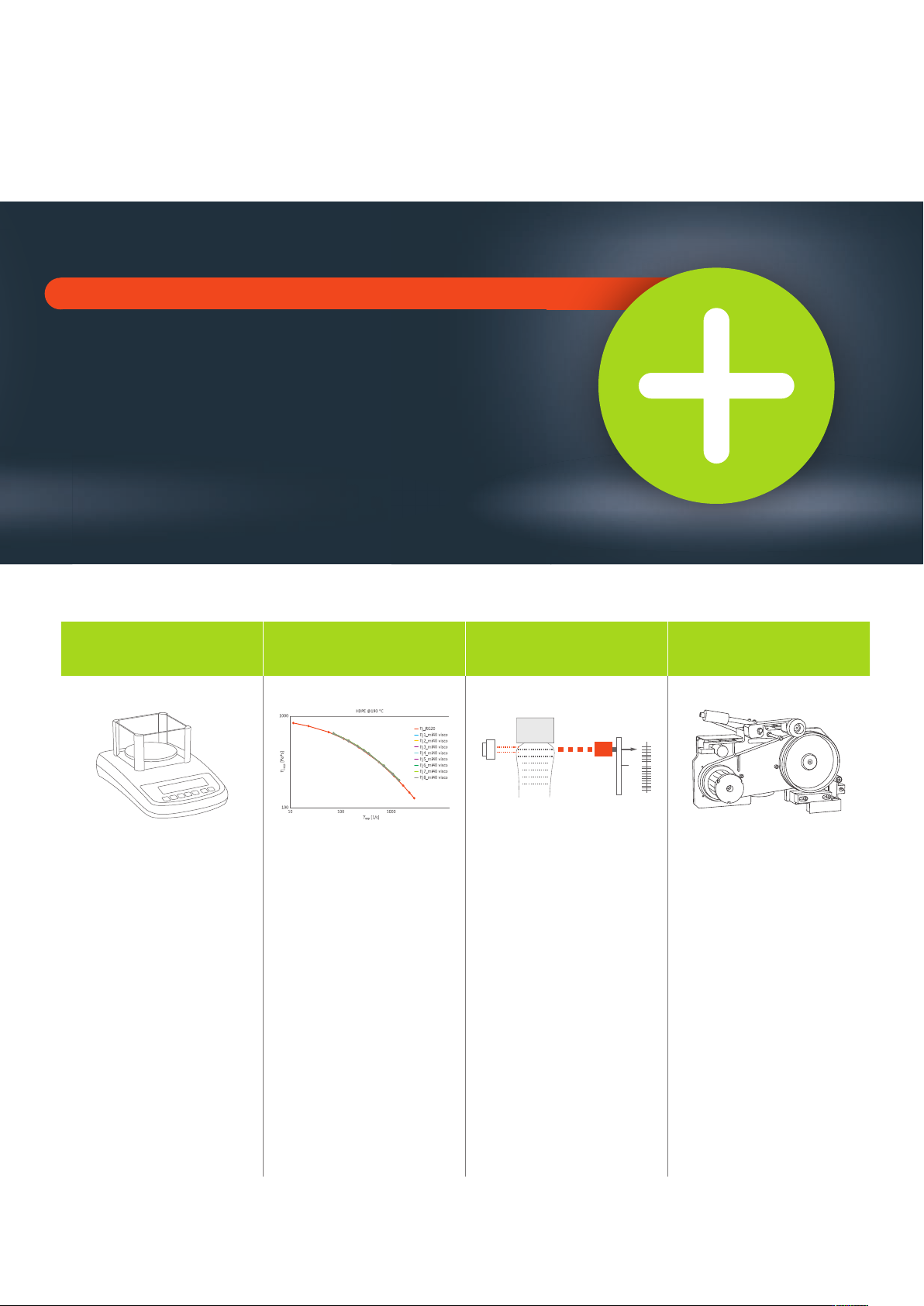
MELT DENSITY VISCOSITY
DIE SWELL
MEASUREMENT
ELONGATION
When determining the Melt
Volume Rate (MVR) according
to Method B, the extruded
volume per unit of time is
measured via the piston
speed in cm³/10 min.
The melt density can be
measured directly and used
for converting between MVR
and MFR.
This Add-On requires a
laboratory balance as well as
the optional melt cutting unit.
With the “Viscosity Measu-
rement” Add-On, the mi40
becomes the mi40 visco.
This enables the plastometer
to perform viscosity measu-
rements in accordance with
the Capillary Rheometer
standard ISO 11443.
The intuitive handling of the
plastometer is combined with
the extended material
characterization capabilities
of a Capillary Rheometer. This
option allows viscosity to be
measured quickly and easily,
making it suitable as a QC
criterion, for example in
incoming goods inspection.
The Die Swell Measurement is
an Add-On from the series of
GÖTTFERT Capillary
Rheometers.
With the help of a laser
measuring head, which can
be adjusted in height, it is
possible to measure the
material-dependent swelling
of the extruded polymer
strand.
This Add-On is particularly
important for process optimi-
zation and quality control in
companies processing
elastomers (HDPE, PVC).
The D-MELT consists of a
GÖTTFERT Melt Flow Indexer
(Plastometer) mi40 and an
integrated HAUL-OFF
system.
The specially developed
D-MELT measuring method
makes it possible to
determine both the melt flow
rate (MFR) and the melt elast-
icity (ME) with only one filling
of the test barrel.
The HAUL-OFF system, which
measures the melt elasticity,
is fed directly by the Melt
Flow Indexer, also called
plastometer.
17
REDESIGN:
mi3 & mi40
REDESIGN:
mi
40
Applications
mi2, mi3 and mi40
The position transducer in the instrument has
a path resolution of 0.006 mm per pulse. For
optimal measuring results, this resolution can
be selected in three levels (high, normal and
low) depending on the MVR value.
For optimal determination of the piston path
resolution (mm per measuring point), this value
can also be set to be determined automatically.
This is particularly advantageous when
working with unknown materials.
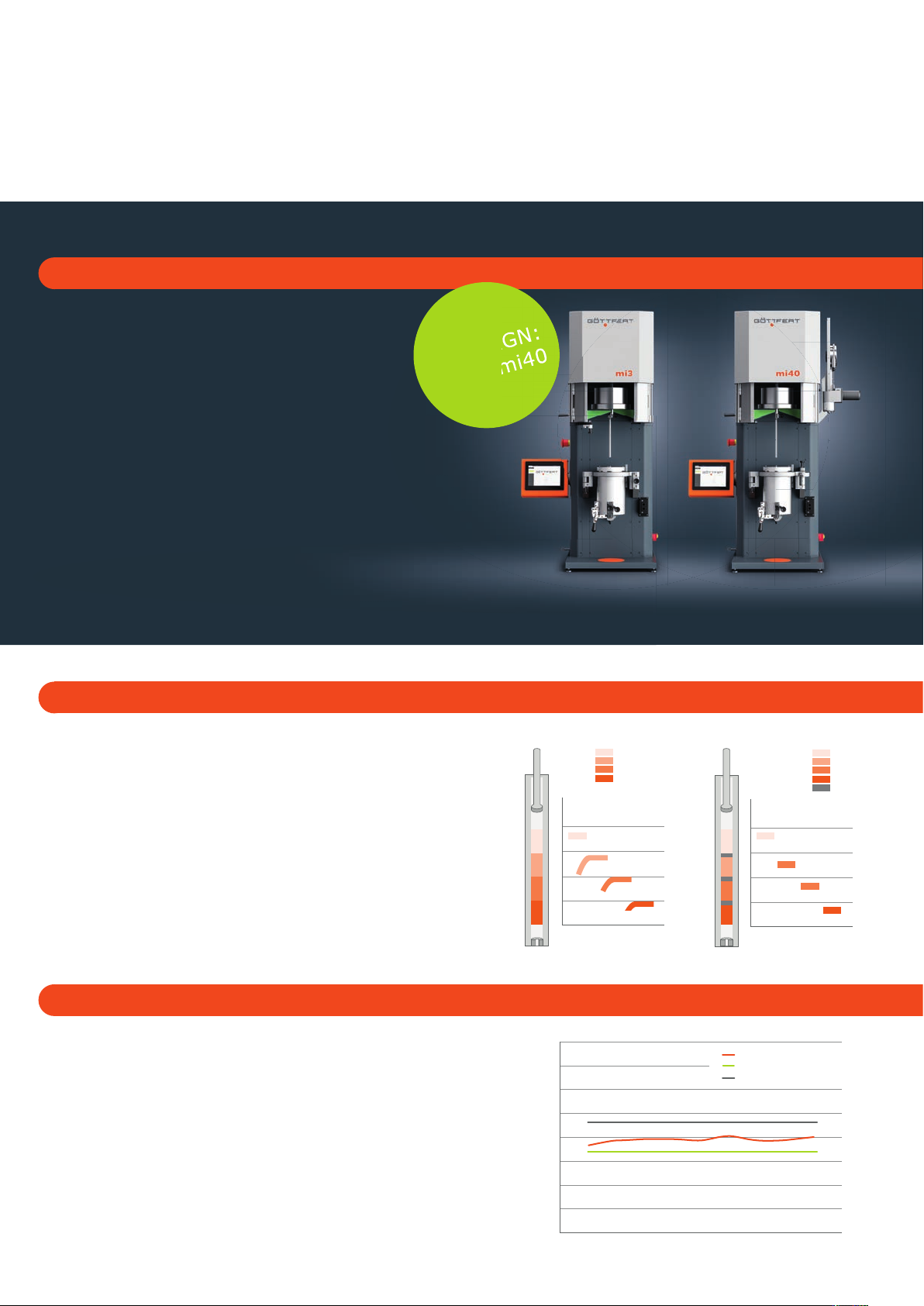
More stable and precise than required by the standard
The current ISO 1133-2:2011 standard requires a tempe-
rature accuracy of ±0.3 °C up to 70 mm before the die.
Our instruments exceed these requirements significantly, as
shown in the diagrams. This also applies when measure-
ments are performed according to Part 1 of the standard.
Automatic resolution determination
Multi-load measurement
Temperature profi le
With relaxation phase for higher precision
In conventional multi-weight measurements, the
relaxation phase is missing, which results in higher scatter.
The multi-load function of the mi40 (up to 8 weights)
gives the material targeted time to relax, reduces
pre-shear effects and thus ensures measurement results
that are much closer to single-weight measurements.
Last 1
Last 2
Last 3
Last 4
MFR in g/10min
MFR in g/10min
Last 1
Last 2
Last 3
Last 4
Ruhezone
0 10 20 30 40 MP
0 10 20 30 40 MP
Material measurement
Max. limit value
Min. limit value
0 10 20 30 40 50 60 70 80 90 100
Temperature [°C]
Position before the die [mm]
188
188,5
189
189,5
190
190,5
191
191,5
192
18