A000062-datasheet.pdf - 第25页
9 Certifications 9.1 Certifications Summary Certification Status CE/RED (Europe) Y es UKCA (UK) Y es FCC (USA) Y es IC (Canada) Y es RCM (Australia) Y es RoHS Y es REACH Y es WEEE Y es 9.2 Declaration of Conformity CE DoC…
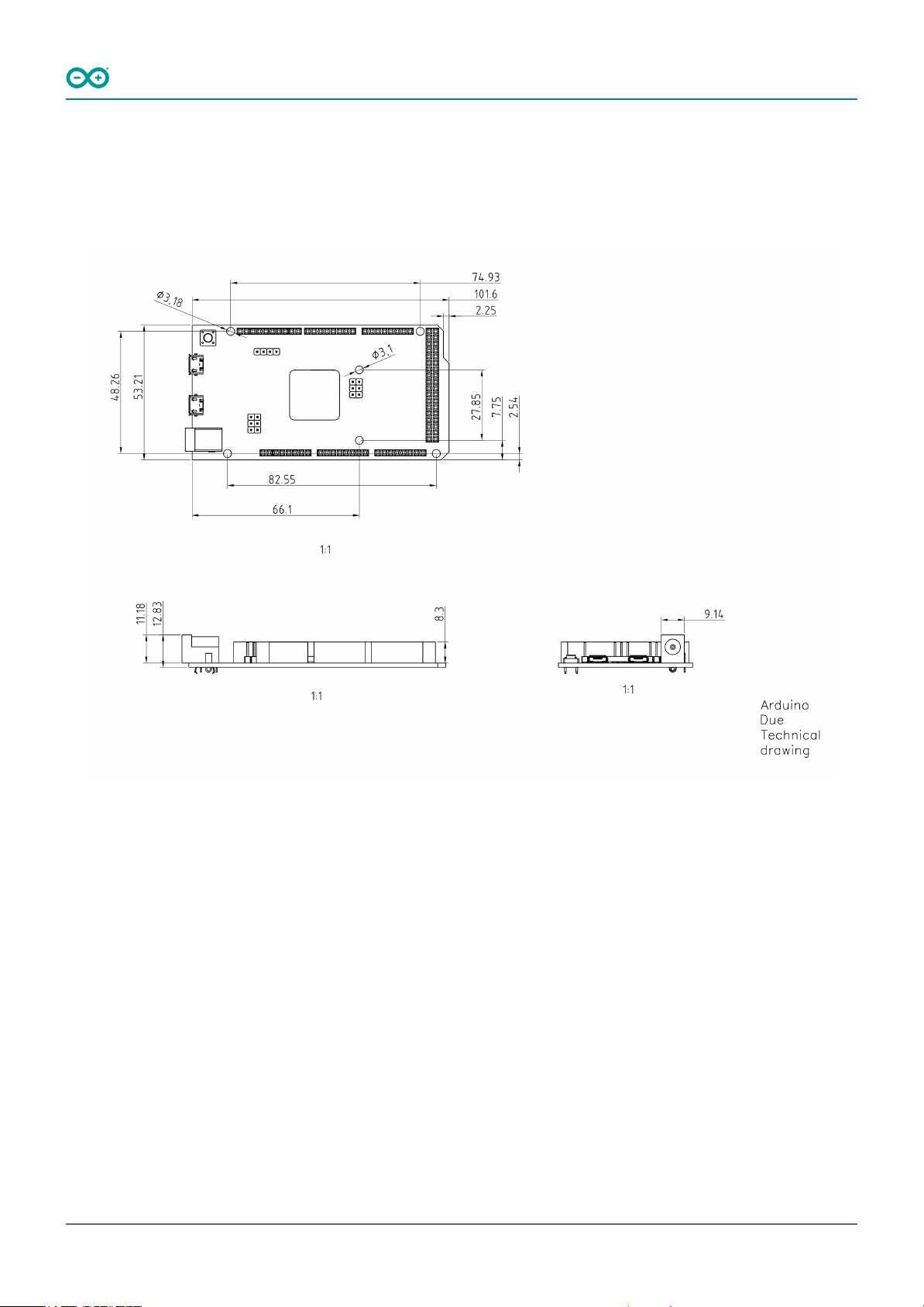
8.2 Board Connectors
Connectors of the Arduino Due are placed on the left side of the board; their placement is shown in the figure
below. All the dimensions are in mm.
Arduino Due Technical drawing
Arduino® Due
24 / 50 Arduino® Due Modified: 15/09/2026
9 Certifications
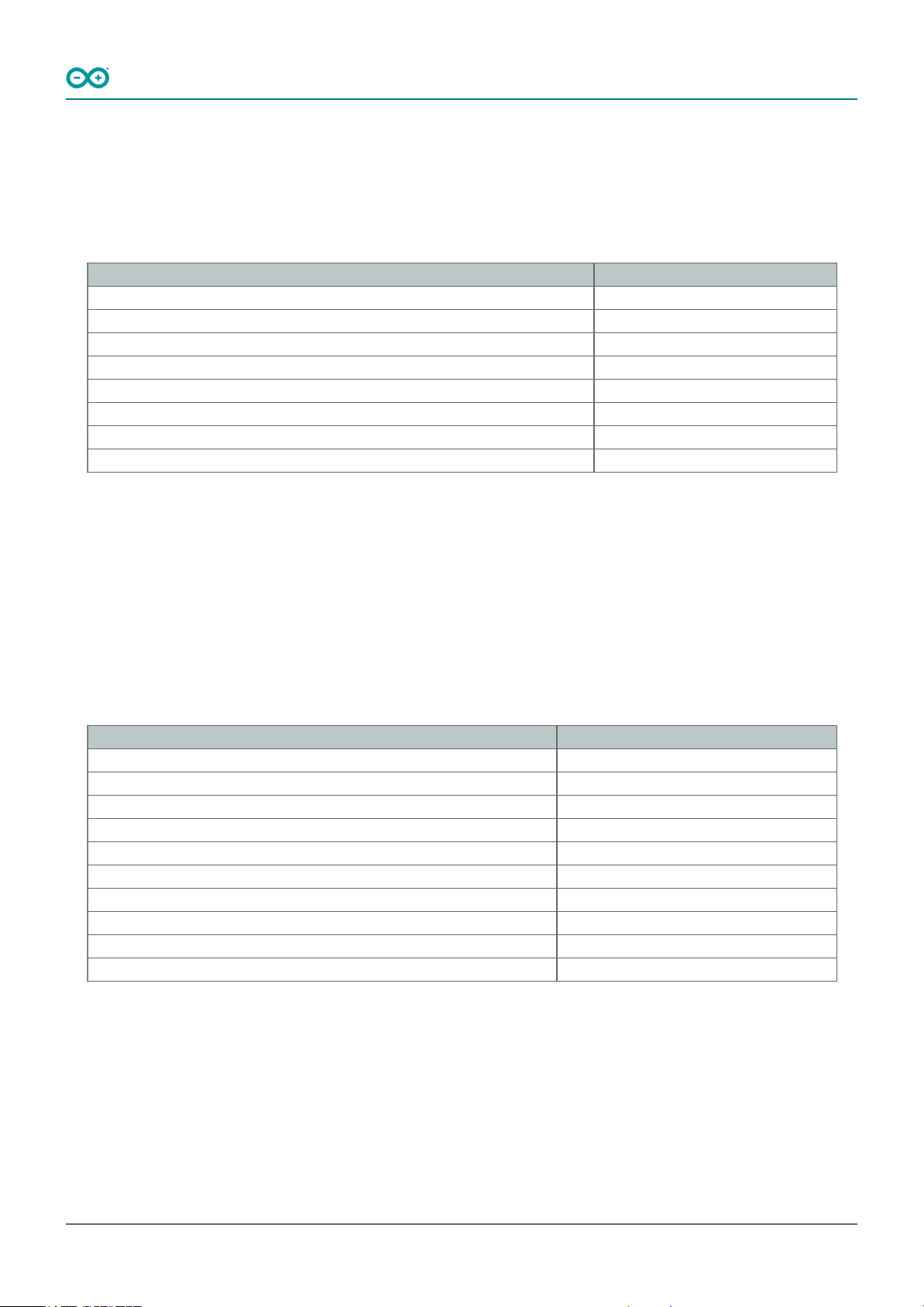
9.1 Certifications Summary
Certification Status
CE/RED (Europe) Yes
UKCA (UK) Yes
FCC (USA) Yes
IC (Canada) Yes
RCM (Australia) Yes
RoHS Yes
REACH Yes
WEEE Yes
9.2 Declaration of Conformity CE DoC (EU)
We declare under our sole responsibility that the products above are in conformity with the essential requirements
of the following EU Directives and therefore qualify for free movement within markets comprising the European
Union (EU) and European Economic Area (EEA).
9.3 Declaration of Conformity to EU RoHS & REACH 211 01/19/2021
Arduino boards are in compliance with RoHS 2 Directive 2011/65/EU of the European Parliament and RoHS 3
Directive 2015/863/EU of the Council of 4 June 2015 on the restriction of the use of certain hazardous substances in
electrical and electronic equipment.
Substance Maximum limit (ppm)
Lead (Pb) 1000
Cadmium (Cd) 100
Mercury (Hg) 1000
Hexavalent Chromium (Cr6+) 1000
Poly Brominated Biphenyls (PBB) 1000
Poly Brominated Diphenyl ethers (PBDE) 1000
Bis(2-Ethylhexyl) phthalate (DEHP) 1000
Benzyl butyl phthalate (BBP) 1000
Dibutyl phthalate (DBP) 1000
Diisobutyl phthalate (DIBP) 1000
Exemptions: No exemptions are claimed.
Arduino Boards are fully compliant with the related requirements of European Union Regulation (EC) 1907 /2006
concerning the Registration, Evaluation, Authorization and Restriction of Chemicals (REACH). We declare none of the
SVHCs (https://echa.europa.eu/web/guest/candidate-list-table), the Candidate List of Substances of Very High
Concern for authorization currently released by ECHA, is present in all products (and also package) in quantities
totaling in a concentration equal or above 0.1%. To the best of our knowledge, we also declare that our products do
not contain any of the substances listed on the "Authorization List" (Annex XIV of the REACH regulations) and
Arduino® Due
25 / 50 Arduino® Due Modified: 15/09/2026

Substances of Very High Concern (SVHC) in any significant amounts as specified by the Annex XVII of Candidate list
published by ECHA (European Chemical Agency) 1907 /2006/EC.
9.4 Conflict Minerals Declaration
As a global supplier of electronic and electrical components, Arduino is aware of our obligations with regard to laws
and regulations regarding Conflict Minerals, specifically the Dodd-Frank Wall Street Reform and Consumer
Protection Act, Section 1502. Arduino does not directly source or process conflict minerals such as Tin, Tantalum,
Tungsten, or Gold. Conflict minerals are contained in our products in the form of solder or as a component in metal
alloys. As part of our reasonable due diligence, Arduino has contacted component suppliers within our supply chain
to verify their continued compliance with the regulations. Based on the information received thus far we declare
that our products contain Conflict Minerals sourced from conflict-free areas.
9.5 FCC Caution
Any Changes or modifications not expressly approved by the party responsible for compliance could void the user’s
authority to operate the equipment.
This device complies with part 15 of the FCC Rules. Operation is subject to the following two conditions:
(1) This device may not cause harmful interference
(2) this device must accept any interference received, including interference that may cause undesired operation.
FCC RF Radiation Exposure Statement:
1. This Transmitter must not be co-located or operating in conjunction with any other antenna or transmitter.
2. This equipment complies with RF radiation exposure limits set forth for an uncontrolled environment.
3. This equipment should be installed and operated with a minimum distance of 20 cm between the radiator &
your body.
Note: This equipment has been tested and found to comply with the limits for a Class B digital device, pursuant to
part 15 of the FCC Rules. These limits are designed to provide reasonable protection against harmful interference in
a residential installation. This equipment generates, uses and can radiate radio frequency energy and, if not
installed and used in accordance with the instructions, may cause harmful interference to radio communications.
However, there is no guarantee that interference will not occur in a particular installation. If this equipment does
cause harmful interference to radio or television reception, which can be determined by turning the equipment off
and on, the user is encouraged to try to correct the interference by one or more of the following measures:
Reorient or relocate the receiving antenna.
Increase the separation between the equipment and receiver.
Connect the equipment into an outlet on a circuit different from that to which the receiver is connected.
Consult the dealer or an experienced radio/TV technician for help.
English: User manuals for license-exempt radio apparatus shall contain the following or equivalent notice in a
conspicuous location in the user manual or alternatively on the device or both. This device complies with Industry
Canada license-exempt RSS standard(s). Operation is subject to the following two conditions:
(1) this device may not cause interference
Arduino® Due
26 / 50 Arduino® Due Modified: 15/09/2026