A000062-datasheet.pdf - 第6页
2 Features 2.1 General Specifications Overview The Arduino Due is a versatile micr ocontroller boar d designed for a wide range of applications. Po wered b y the Atmel SAM3X8E ARM Cortex-M3 CPU , it offers high performanc…

1 Application Examples
The Arduino Due combines the performance of the Atmel SAM3X8E microcontroller with the flexibility of the
Arduino platform, offering a versatile solution for developers, hobbyists, and professionals alike. With its 32-bit
architecture and clock speed of 84 MHz, the Due delivers robust performance for demanding applications.
Embedded Systems Development: The Arduino Due can be utilized to create a real-time data acquisition
system for monitoring and analyzing environmental parameters in industrial settings. By interfacing sensors
such as temperature, humidity, and pressure sensors with the Due's abundant I/O pins, developers can capture
real-time data and process it using the Due's powerful microcontroller. The system can then transmit this data
wirelessly or via USB to a host computer for analysis, allowing for continuous monitoring and remote
management of critical processes.
Robotics: The Arduino Due can serve as the brain of an autonomous mobile robot capable of navigating and
interacting with its environment. By integrating sensors such as ultrasonic range finders, gyroscopes, and
encoders, developers can equip the robot with perception capabilities to sense its surroundings and detect
obstacles. Using the Due's abundant I/O pins and powerful processing capabilities, algorithms for localization,
mapping, and path planning can be implemented to enable autonomous navigation. Additionally, actuators
such as motors or servos can be controlled by the Due to execute motion commands, allowing the robot to
move and manipulate objects in its environment autonomously.
3D Printing & CNC Machines: The Arduino Due can function as a versatile controller for DIY projects. By
interfacing stepper motor drivers and end-stop switches with the Due's numerous I/O pins, enthusiasts can
create their own 3D printers or CNC machines. The Due's high-speed processing capabilities enable precise
control of stepper motors for accurate positioning and movement.
Prototyping: The Arduino Due serves as an invaluable tool for quickly iterating and testing new ideas for IoT
devices. By leveraging the Due's extensive I/O capabilities and compatibility with various sensors,
communication modules, and actuators, developers can rapidly assemble and test prototypes of IoT devices.
Whether it is a smart home sensor node, a weather station, or a remote monitoring system, the Arduino Due
provides a flexible platform for integrating components, writing firmware, and validating functionality. With the
Due's support for Arduino libraries and easy-to-use development environment, prototypers can focus on
innovation and experimentation, accelerating the process of bringing ideas to fruition.
Arduino® Due
5 / 50 Arduino® Due Modified: 15/09/2026
2 Features
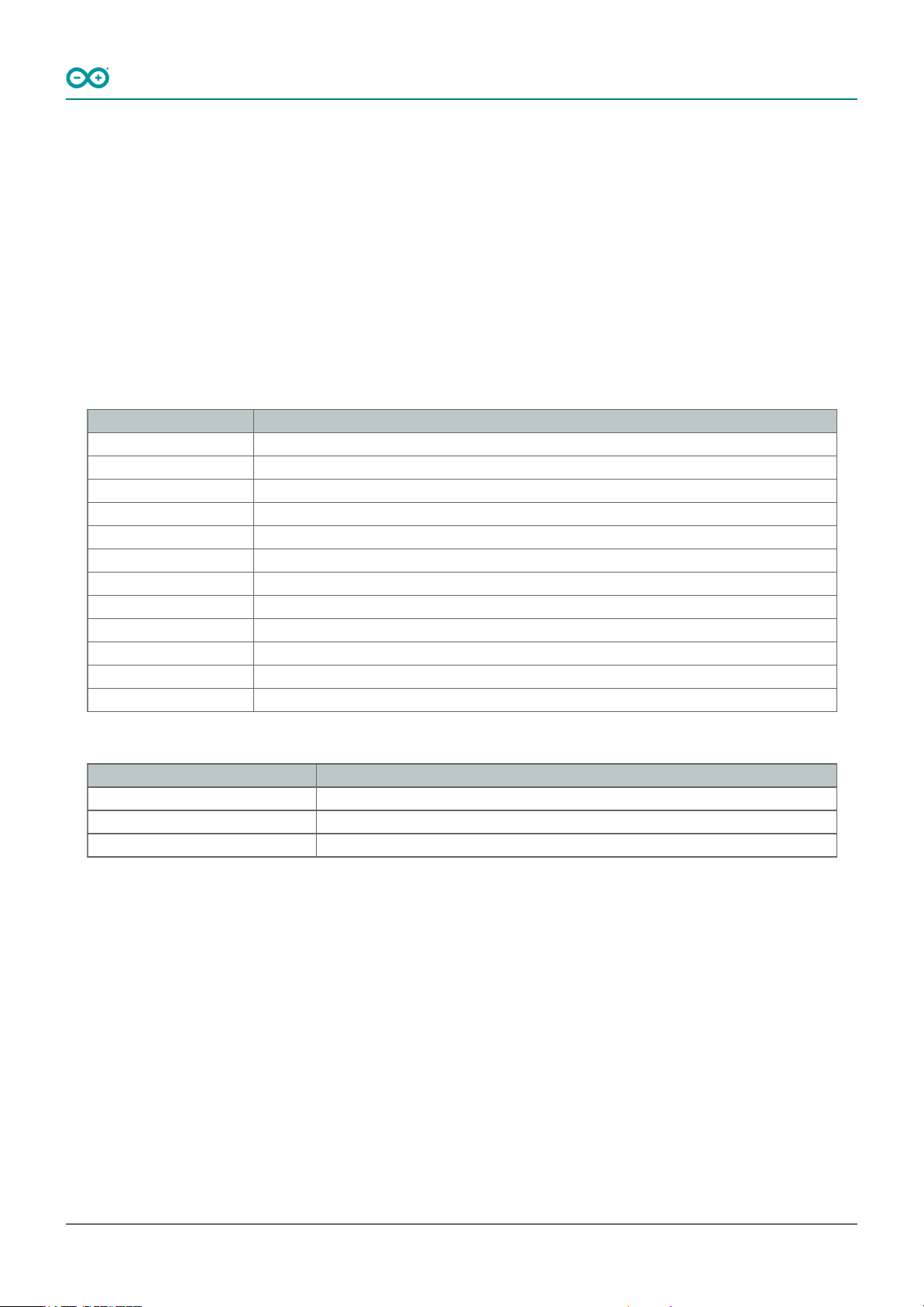
2.1 General Specifications Overview
The Arduino Due is a versatile microcontroller board designed for a wide range of applications. Powered by the
Atmel SAM3X8E ARM Cortex-M3 CPU, it offers high performance and a robust set of features, making it suitable for
complex projects. The Due's 32-bit architecture provides enhanced processing capabilities compared to traditional
Arduino boards. Designed with a similar form factor to the Arduino® Mega, it maintains compatibility with most
Arduino shields through its extensive set of I/O pins and headers. The following table summarizes the board's main
features.
Feature Description
Microcontroller Atmel SAM3X8E ARM Cortex-M3 32-bit ARM Cortex-M3 / 84 MHz Clock speed
Memory SAM3X 512 KB Flash / 96 KB SRAM (divided into two banks: 64 KB and 32 KB)
USB-to-serial ATmega16U2 connected to the SAM3X hardware UART
Digital Inputs Digital Inputs not 5 V compatible (x54)
Analog Inputs The Due's analog inputs pins measure from ground to a maximum value of 3.3 V (x12)
PWM Pins PWM Pins with 8 bits resolution (x12)
Communication UART (x4), I2C (x2), SPI (x1 SPI header), Native USB port (x1), Programming USB port (x1)
Power Input voltage (VIN): 7-12 VDC / DC Current per I/O Pin: 8 mA
Dimensions 101.6 mm x 53.34 mm
Weight 36 g
Operating Temperature -40 °C to +85 °C
Certifications CE/RED, UKCA, FCC, IC, RCM, RoHS, REACH, WEEE
2.2 Microcontroller
Component Details
Atmel SAM3X8E 32-bit ARM Cortex-M3 at 84 MHz
Flash Memory 512 KB
Programming Memory 96 KB SRAM (divided into two banks: 64 KB and 32 KB)
Arduino® Due
6 / 50 Arduino® Due Modified: 15/09/2026
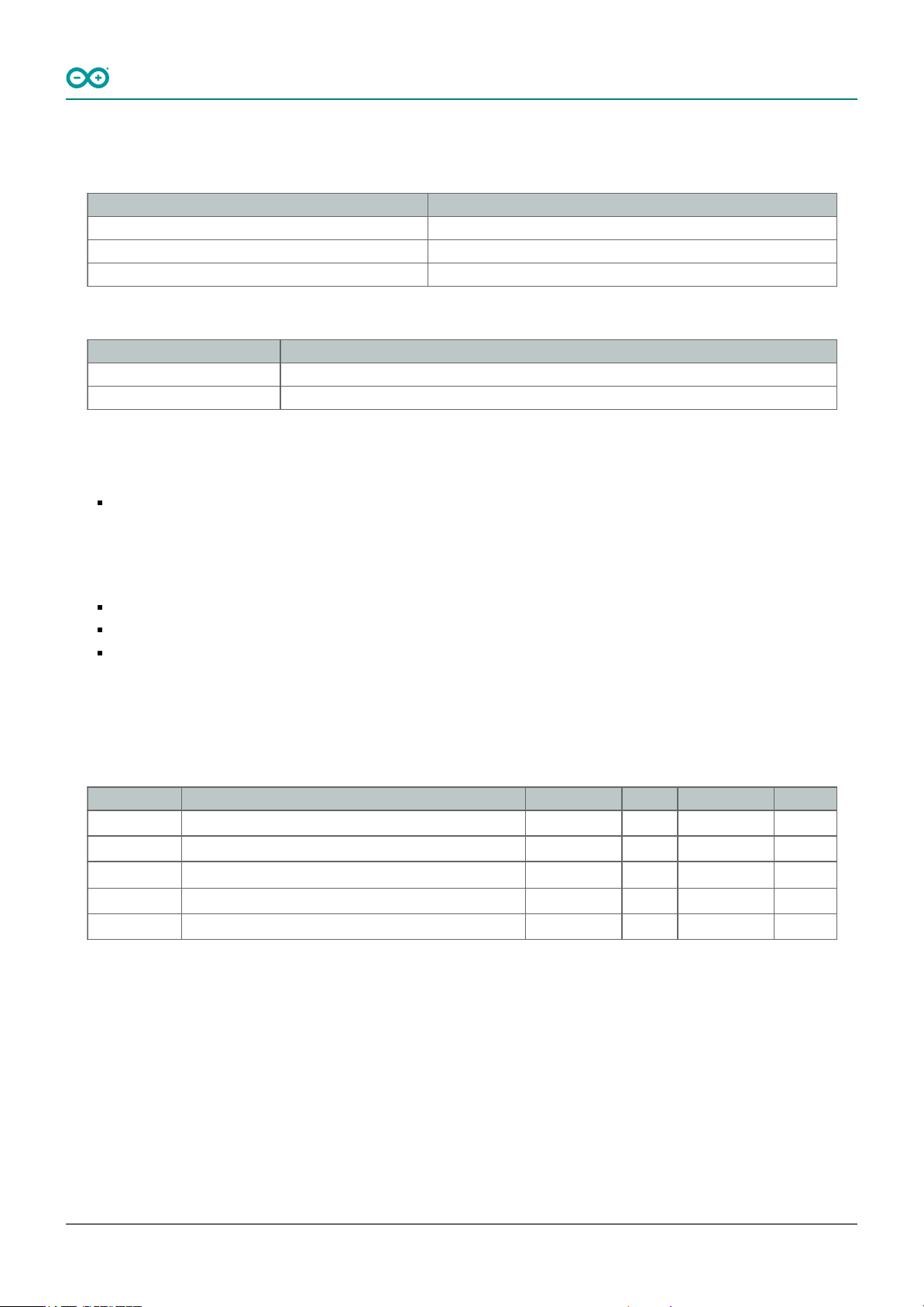
2.3 Inputs
Characteristics Details
Number of inputs 54x digital inputs, 12x analog inputs
Inputs overvoltage protection Yes
Antipolarity protection Yes
2.4 Outputs
Characteristics Details
DAC1 and DAC2 True analog output 12-bits resolution (4096 levels)
PWM outputs 12x PWM outputs
3 Accessories
USB Cable Type-A Male to Micro Type-B Male (Not included)
4 Related Products
Arduino Mega Proto Shield Rev3 (A000080)
Arduino 4 Relays Shield (A000110)
Arduino Motor Shield Rev3 (A000079)
5 Rating
5.1 Recommended Operating Conditions
Symbol Description Min Typ Max Unit
V
IN
Input voltage from VIN pad 6.0 7.0 16 V
V
USB
Input voltage from USB connector 4.8 5.0 5.5 V
V
DD
Input high-level voltage
0.7*V
DD
V
DD
V
V
IL
Input low-level voltage 0
0.3*V
DD
V
T
OP
Operating Temperature -40 25 85 °C
Note: V
DD
controls the logic level and is connected to the 3.3 V power rail. V
AREF
is for the analog logic.
Arduino® Due
7 / 50 Arduino® Due Modified: 15/09/2026