00900330-01_UM_ASM-ProcessLens_EN.pdf - 第50页
3 Machine description 3.1 Overview of the modules 50 Instruction manual ASM ProcessLens 03/2021 3.1.4 Single conveyor assembly Fig.36: PCB single conveyor A Front side of the machine B Rear side of the machine 1 Rear co…
3 Machine description
3.1 Overview of the modules
Instruction manual ASM ProcessLens 03/2021 49
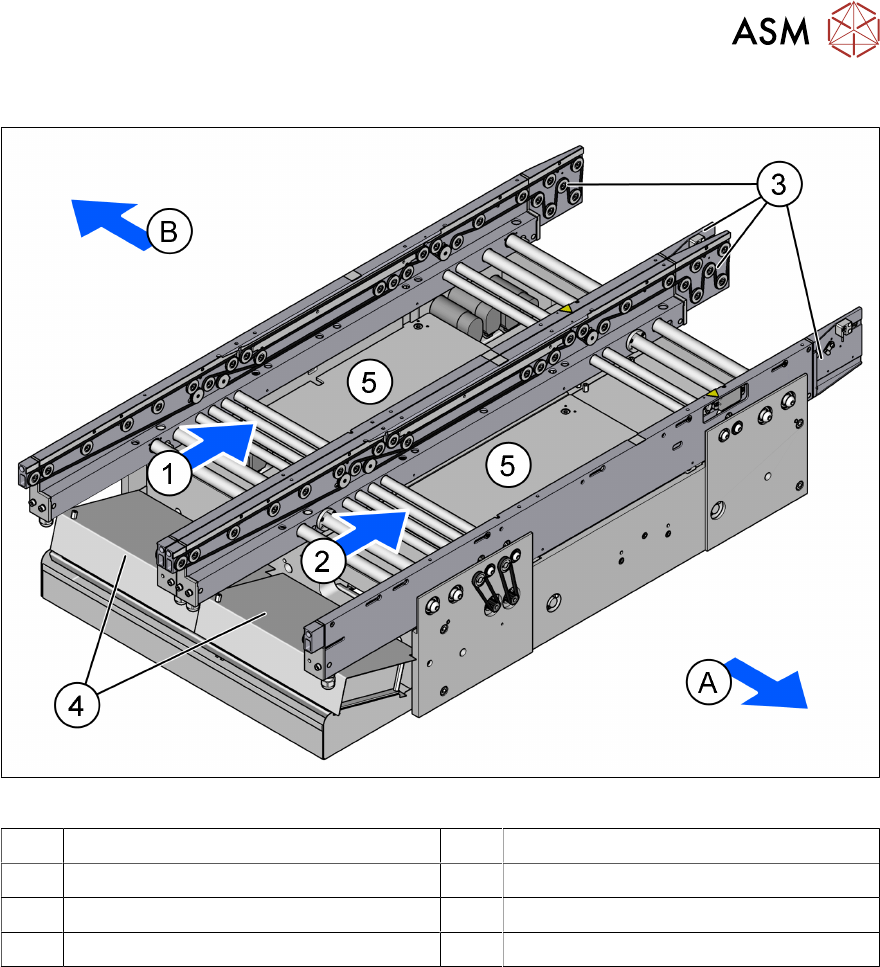
3.1.3 Dual conveyor assembly
Fig.35: PCB dual conveyor
A Front side of the machine B Rear side of the machine
1 Lane 1 2 Lane 2
3 Conveyor rails 4 Conveyor control units
5 Lifting tables
3.1.3.1 Description
The PCB conveyors are designed as three-part conveyors with input, processing and output con-
veyor sections. The two areas, input conveyor and output conveyor, serve as buffer zones for the
printed circuit boards.
The conveyor belts are driven by brushless DC motors. Light barriers monitor and control transport-
ation of the boards. Once the board has reached the placement area and has passed the light bar-
riers, it is braked. A laser light barrier records the position of the board. As soon as the circuit board
has reached its target position, the conveyor belt is stopped and the board is clamped from below.
The width of the circuit board conveyor is set and monitored by an integral control circuit. It can be
selected by calling up the program. The control electronics activate the drive motor until the re-
quired width has been reached. The width adjustment is therefore independent of other machine
components.
The conveyor height can be selected on the machine to allow the machines to be integrated into
lines with a conveyor height of, 900, 930 or 950 mm. The standard height is 930 mm.
The communication between the PCB conveyors of the individual machines takes places via the
SMEMA or IPC-HERMES-9852 interface.
3 Machine description
3.1 Overview of the modules
50 Instruction manual ASM ProcessLens 03/2021
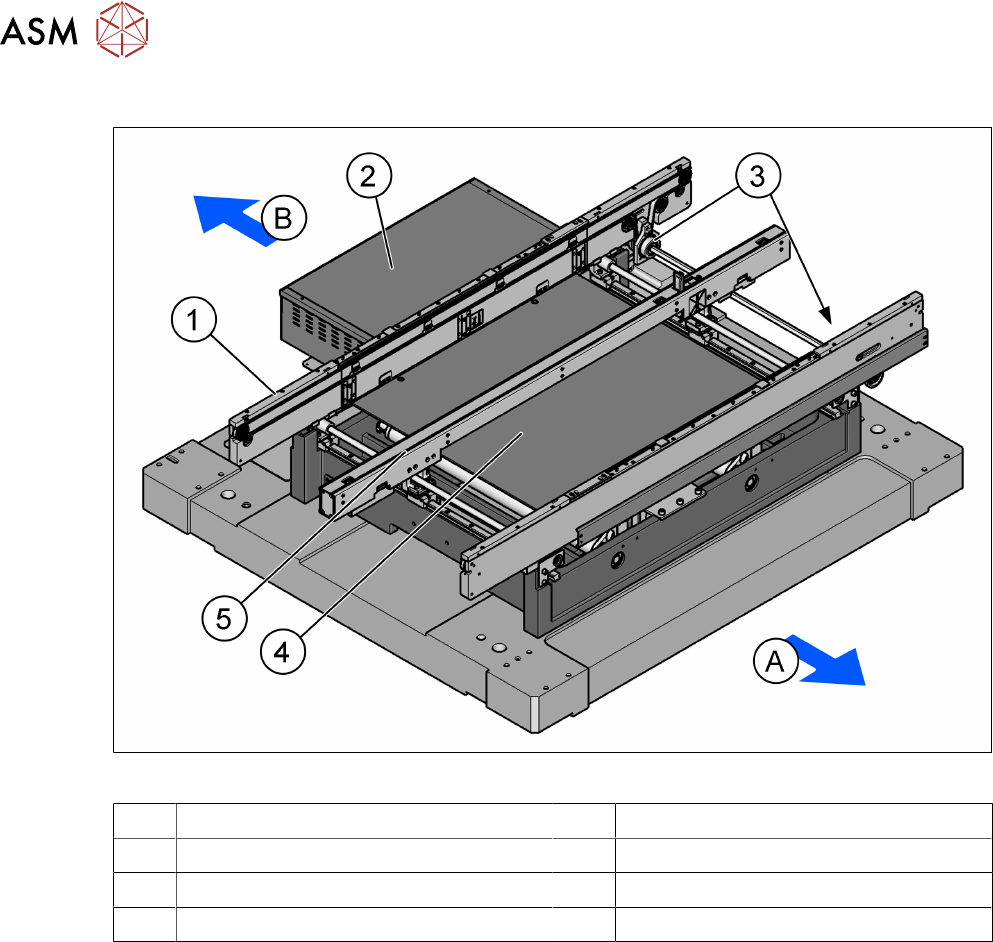
3.1.4 Single conveyor assembly
Fig.36: PCB single conveyor
A Front side of the machine B Rear side of the machine
1 Rear conveyor rail 2 Conveyor control unit
3 Fixed front rail 4 Lifting table
5 Stopper and sensors rail
3.1.4.1 Description
The PCB conveyor is a single lane conveyor. The machine requires a length of 1100 mm. Both
sides have a 150 mm extension to the upstream or downstream conveyor. The standard conveyor
is a front fixed rail and it only has one lifting table without input/output buffer. A conveyor extension
option exists to increase the length of the single stage conveyor to allow for a barcode capability to
be attached where no upstream conveyor exists.
The conveyor height can be selected on the machine to allow the machines to be integrated into
lines with a conveyor height of, 900, 930 or 950 mm. The standard height is 930 mm.
The communication between the PCB conveyors of the individual machines takes places via the
SMEMA or IPC-HERMES-9852 interface.
3.1.5 Definition of PCB warpage
This is the maximum allowable PCB warpage for the SPI to be able to measure accurately.
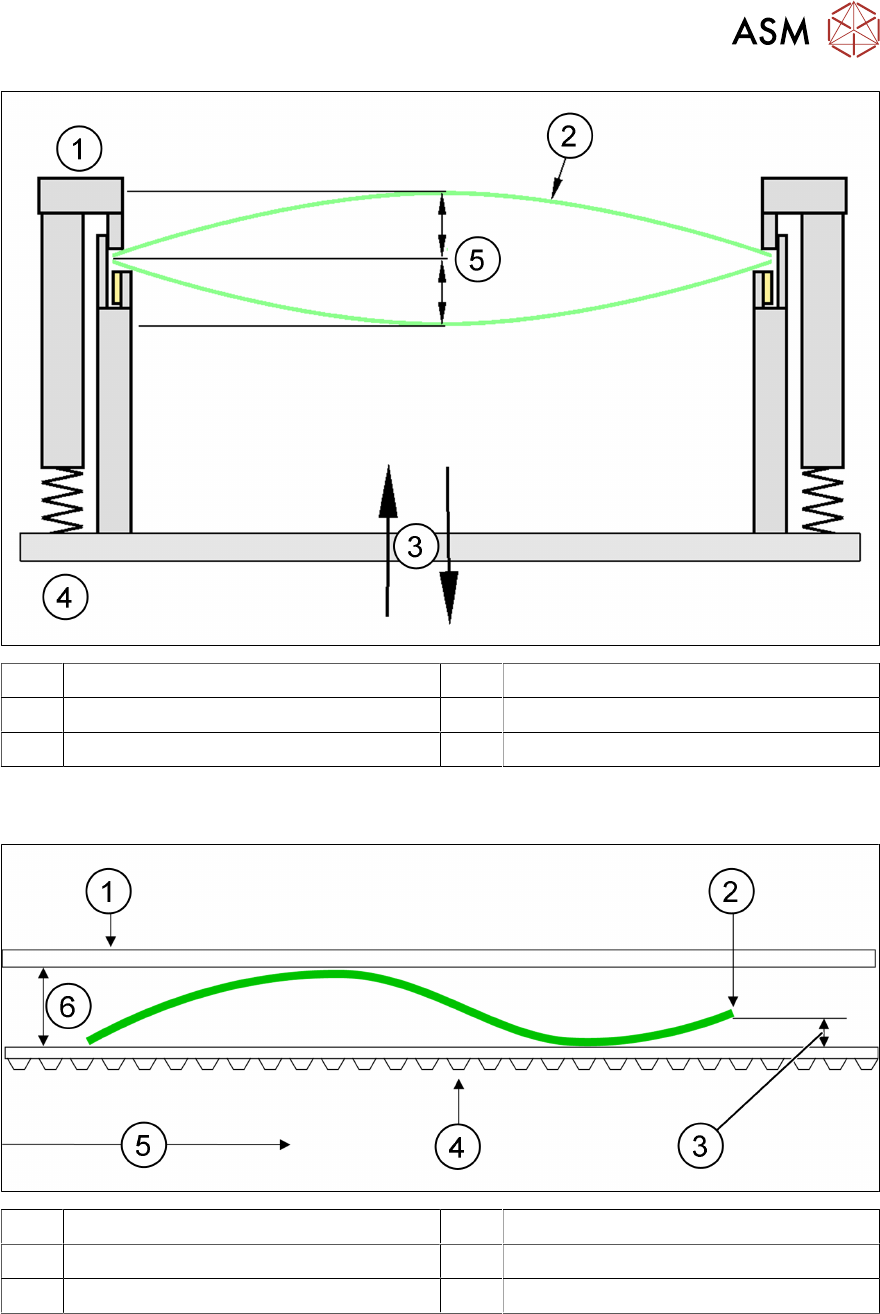
3.1.5.1 PCB warpage on the conveyor
PCB warpage across the direction of travel max. 1% of the PCB diagonal, but not exceeding
±5mm.
3 Machine description
3.1 Overview of the modules
Instruction manual ASM ProcessLens 03/2021 51
1 Fixed clamped edge 2 Printed circuit board
3 Movable clamping device 4 Conveyor rail
5 +/- 4.5 mm
PCB warpage in the direction of transport + PCB thickness < 5.5 mm. Bending up of board edge
max. 2.5 mm.
1 Fixed clamped edge 2 Front board edge
3 Max. 2.5 mm 4 Conveyor belt
5 PCB transport direction 6 5.5 mm