ISM6636A&B_Rev1.10解密.pdf - 第18页
18 Innovision Semiconductor Preliminary Datas heet ISM6636 A/B Rev1.10 01/2023 If the ISM6636A/B d etects o ver-current condition for 16 consecut ive cycles a nd PG signal is low, or the V OS falls below to 50 % of set v…
17
Innovision Semiconductor
Preliminary Datasheet
ISM6636A/B
Rev1.10 01/2023
Switching frequency
The switching frequency of the
ISM6636A/B is depend on the VOUT.For
the VOUT of 5V, the SW frequency is
normally 1.875MHz when the VOS is
connected to the VOUT.
Enable
The EN pin is used to enable or disable
ISM6636A/B. It has a precise threshold that
is monitored internally by the UVLO circuit.
If the EN pin is floating, the internal resistor
pulls it down to prevent the device from
inadvertently switching.
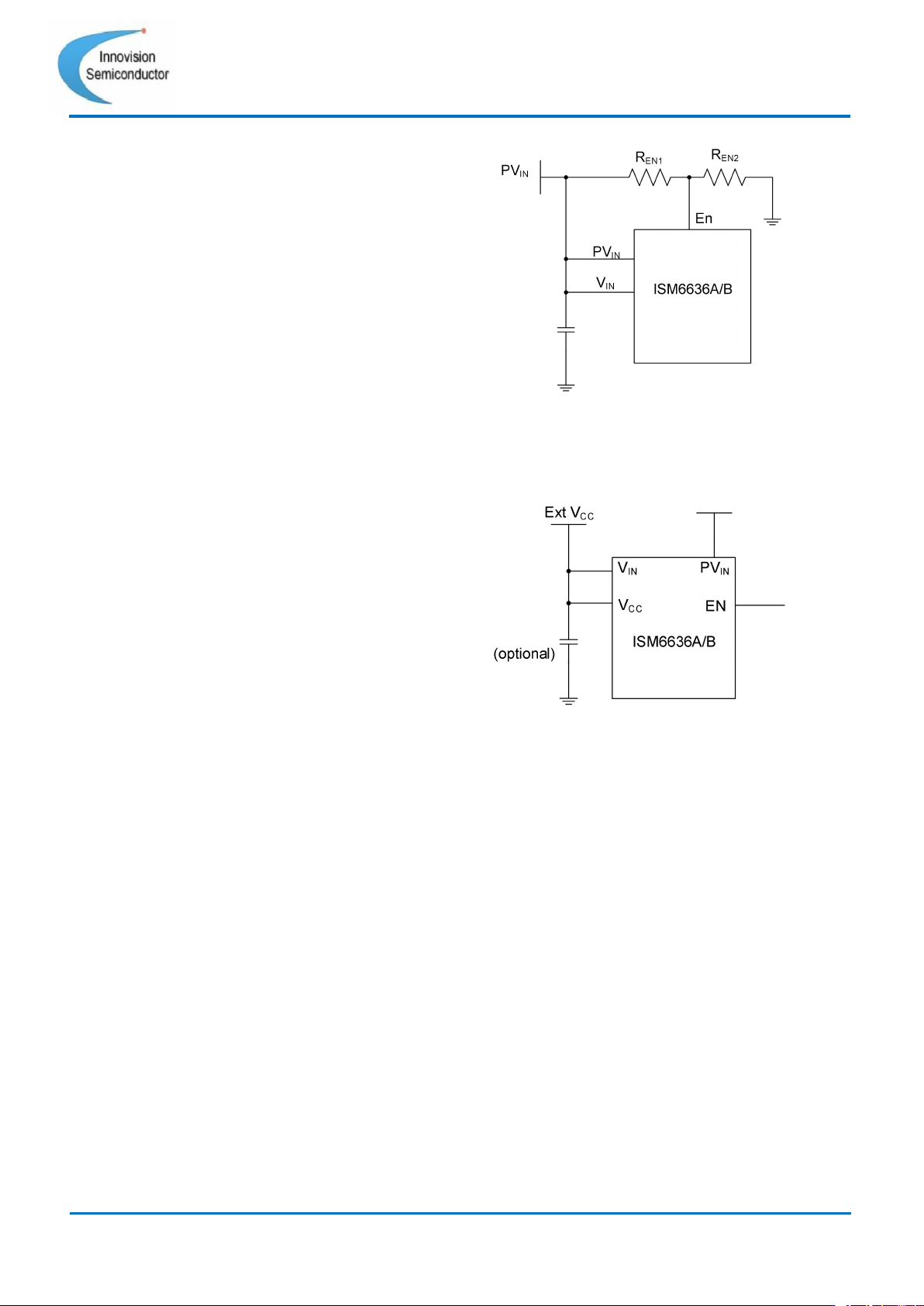
The EN pin can also be used to achieve
accurate input voltage UVLO. The input of
the EN pin is the PVIN voltage obtained by
a set of resistance dividers, REN1 and
REN2 (Figure 2). The user can program the
UVLO threshold voltage by selecting
different ratios. This will help to shut down
the device when the PVIN is below the
required voltage level.
The EN pin can be connected directly to the
PVIN without any external resistance
dividers. This is a useful feature when no
enable signals are available.
The EN pin can also be used to monitor
other power supplies for a particular power
sequencing arrangement (Figure 2).
Figure 2 Single Supply Configuration
Figure 3 External Bias Supply
Over-current protection (OCP)
The ISM6636A/B is designed with over
current protection function (OCP). The
current information is sensed through the
low side FET Rds_ON.The on-die OCP
provides accurate overcurrent protection
without the use of additional external sense
resistor. Since the current sense is done
on-die, the noise impact to the system is
minimized.
The OCP threshold is internally
temperature compensated, making it
almost constant at different ambient
temperatures.
18
Innovision Semiconductor
Preliminary Datasheet
ISM6636A/B
Rev1.10 01/2023
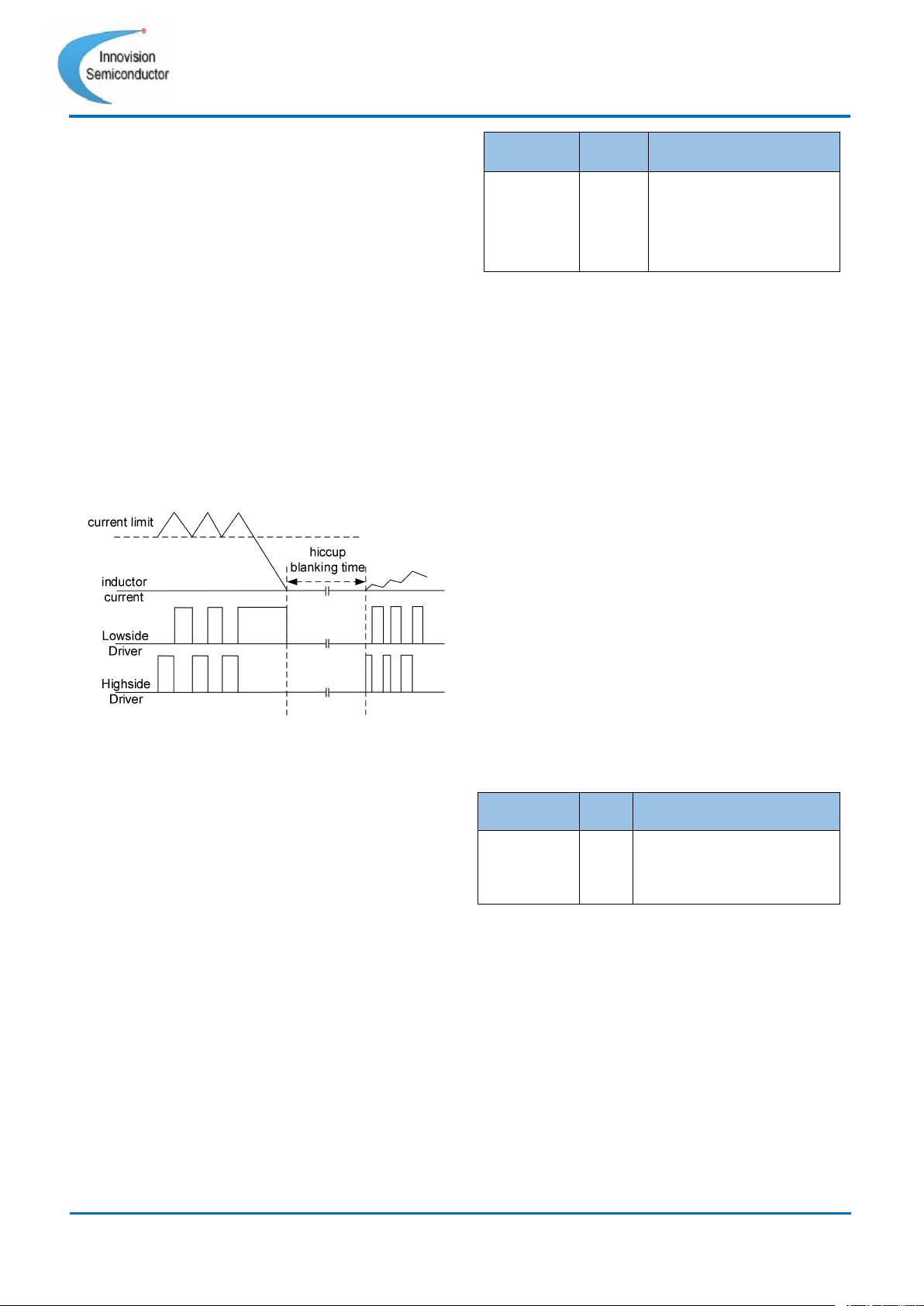
If the ISM6636A/B detects over-current
condition for 16 consecutive cycles and PG
signal is low, or the VOS falls below to 50%
of set value, the low side FET remains on
until the current falls to 0A, and then
ISM6636A/B enters hiccup mode (Figure 4).
Both the high side and low side FETs
remain off during the fault protection mode.
After the blanking time, ISM6636A/B will
attempt to restart. If the over-current fault is
still present, the above operation repeats
itself. The ISM6636A/B will remain in
hiccup mode until the over-current fault is
cleared.
Figure 4 OCP in Hiccup Mode
Over-voltage protection (OVP)
The ISM6636A/B is designed with over
voltage protection function (OVP). OVP is
provided by sensing the voltage at the VOS
pin. When the VOS exceeds the output
OVP threshold with greater than OVP delay
(usually 7μs), a fault condition will occur.
The OVP threshold is determined by the
user register bit OV_Threshold definition
(see Table 4 below).
Register
Bits
Name/Description
0x17
[1:0]
OV_SET:
00:105% of VOUT
01:110% of VOUT
10:115% of VOUT
11:120% of VOUT(default)
Table 4 OV_Threshold Register Description
When OVP happens, the high side FET is
turned off immediately and the PG pin is
pulled low. The low side FET is fully turned
on until the inductor current reaches zero.
Once zero crossing is reached, both high
side and low side FETs are tri-stated. When
the output voltage is discharged below the
reference voltage level, PWM starts
switching again. When the output voltage
falls below the 102.5% of reference level,
PG re-asserts.
If OV_Response register is set to 0, the
high side FET remains off until reset by
cycling VCC or EN signals. The voltage at
the VOS pin falling below the output OVP
threshold does not turn on the high side
FET, but it turns off the low side FET to
prevent the negative current from building
up.
Register
Bits
Name/Description
0x1A
[0]
OV_Response:
0:latch off
1:no latch off
Table 5 OV_Response Register Description
Over-temperature protection
(OTP)
When the on-die temperature falls within
the operating range, the device will
automatically restart. The OTP threshold
19
Innovision Semiconductor
Preliminary Datasheet
ISM6636A/B
Rev1.10 01/2023
has a built-in 20 ℃ hysteresis to prevent
chattering.
When the OTP threshold is exceeded, both
high side and low side FETs are turned off
and the internal SS circuit is pulled low. The
internal LDO regulator remains on during
an OTP fault.
Power Good (PG)
The Power Good (PG) behavior is
determined by the user registers PG_
Threshold definition.
Register
Bits
Name/Description
0x18
[1:0]
PG_Threshold
0:80% of V
OUT
1:85% of V
OUT
2:90% of V
OUT
3:95% of V
OUT
The user register PG_Threshold defines
the upper PG threshold as the percentage
of Vout. For the lower PG threshold, a
hysteresis of 5% needs to be applied.
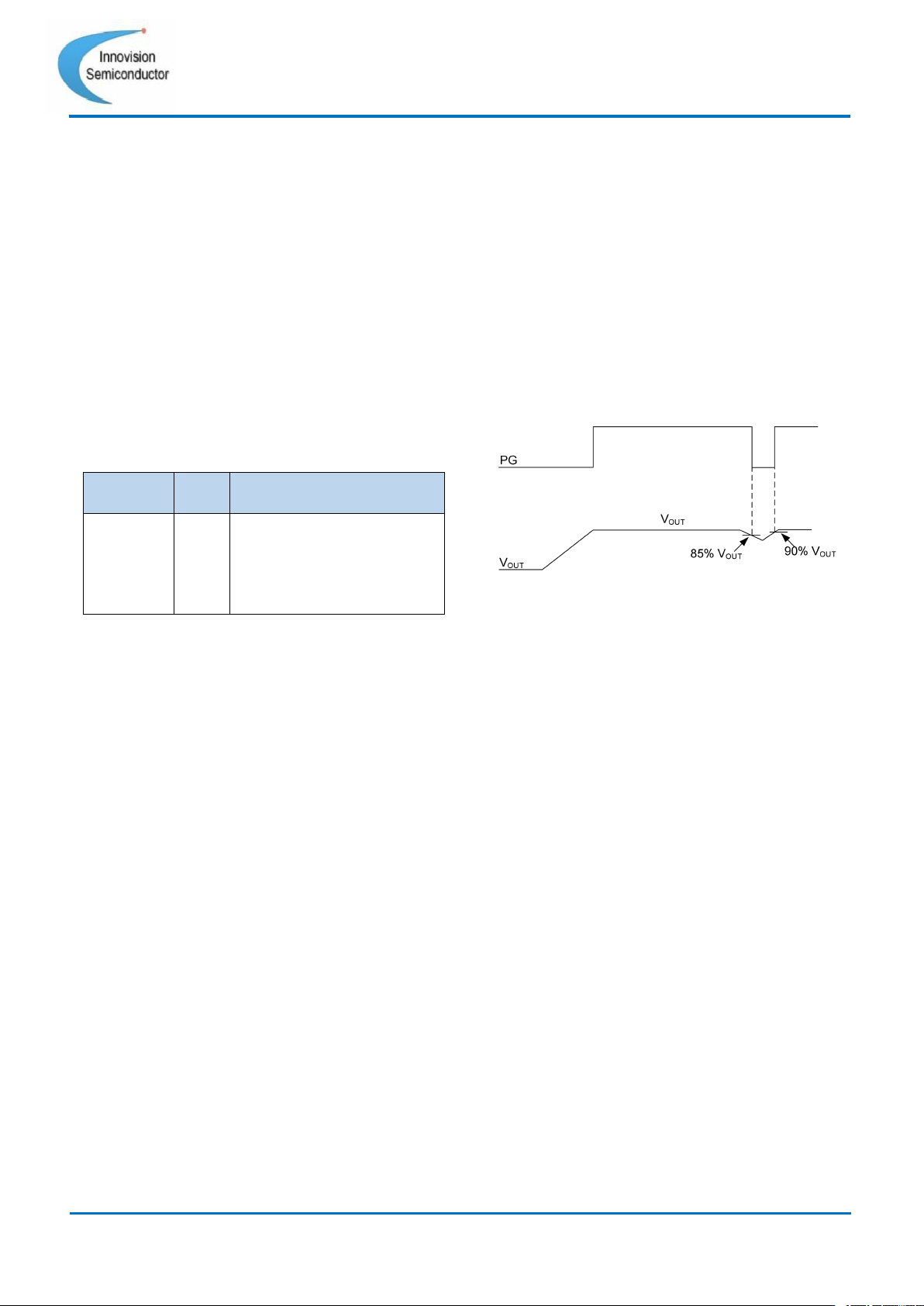
When VOS is higher than the upper
threshold, PG signal is asserted. When the
VOS drops below the lower threshold, the
PG signal will be de-asserted.
Figure 5 shows the PG behavior in this
case. In normal operation, when the output
voltage falls below the lower PG threshold,
the PG de-asserts; when the output voltage
rises above the upper PG threshold, the PG
asserts.
Figure 5 PG Signal
For pre-biased start-up, the PG signal will
not be activated until the first on time
control signal is generated.