ISM6636A&B_Rev1.10解密.pdf - 第27页
27 Innovision Semiconductor Preliminary Datas heet ISM6636 A/B Rev1.10 01/2023 Register = 0x12 Set Vout voltage Register = 0x13 Set Vout voltage Register 0x12 a nd 0x13 need to be used togeth er to im plement the VOUT vo…
26
Innovision Semiconductor
Preliminary Datasheet
ISM6636A/B
Rev1.10 01/2023
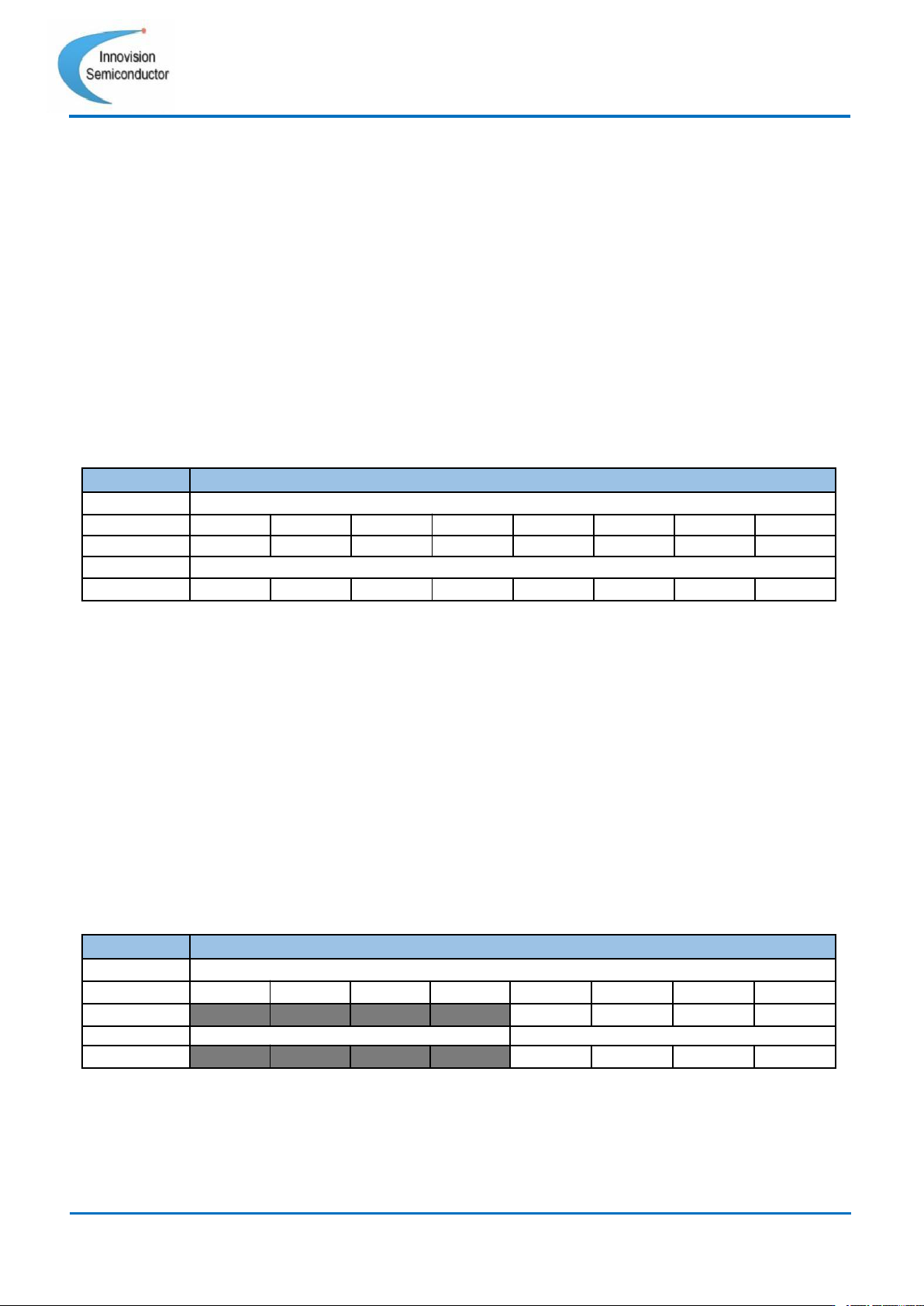
Register = 0x0F Module temperature report (Temp_Report)
When the VIN pin is working normally, the temperature information of the module can be
read through the I2C protocol. Temperature readable range is: -40°C~180°C.
LSB=1°C. There is a constant offset in reading temperature information. The calculation
formula can be referred to as follows:
5
Example 1:When the read I2C value is 0x65, 0x65=Dec(101)=101*1-75=26°C. Indicates the
module temperature 26°C.
The reading of temperature information will have a certain offset according to different
usage scenarios, but the maximum deviation will not exceed
±
10°C.
Command
Temp_Report
Format
unsigned binary
Bit
7
6
5
4
3
2
1
0
Access
R
R
R
R
R
R
R
R
Function
Range: -40°C--180°C, LSB=1°C.
Default
0
0
0
0
0
0
0
0
Table 14 Register = 0x0F
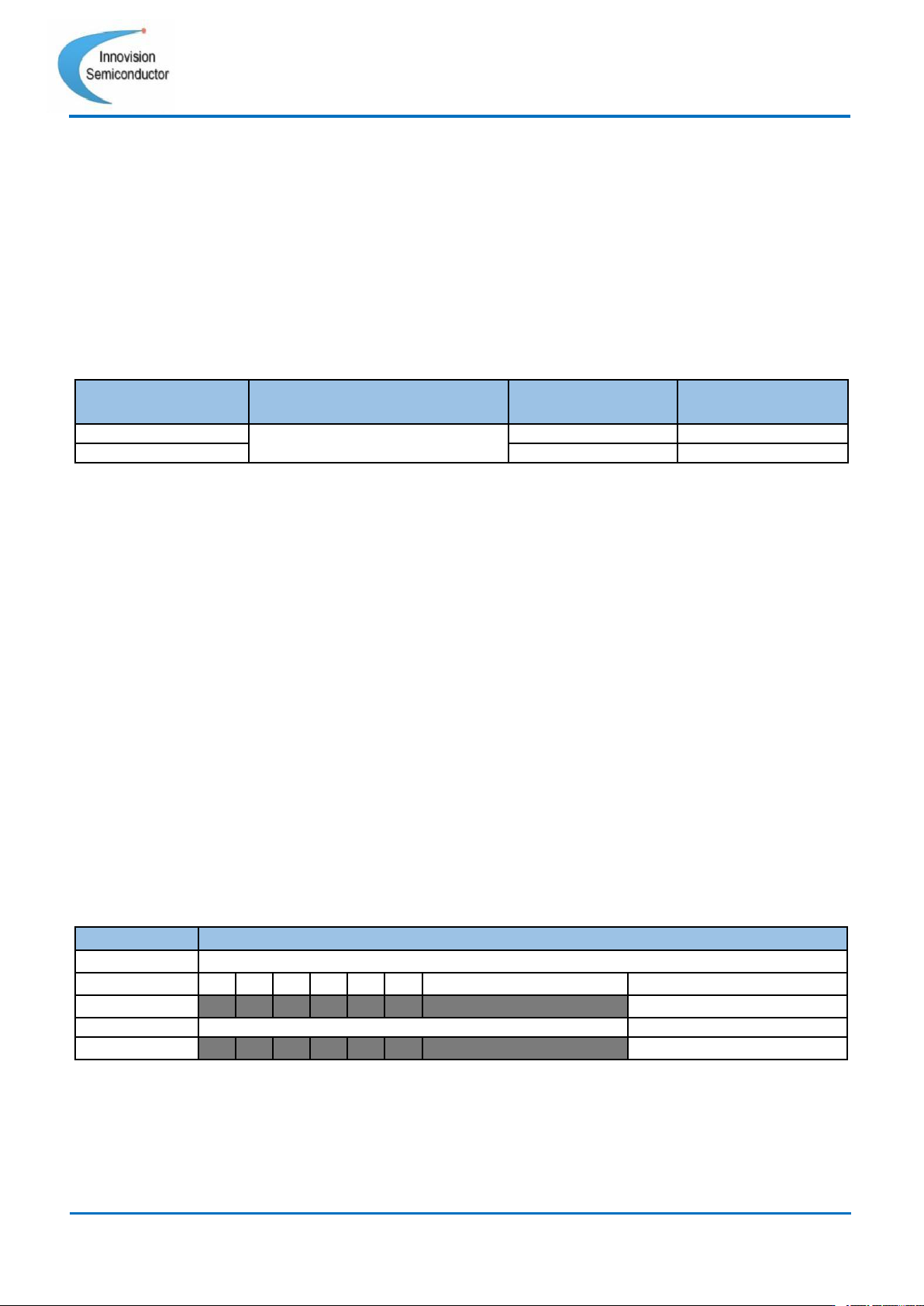
Register = 0x11 Ramp compensation amplitude setting (Ramp_Amplitude)
The ISM6636X provides an adjustable ramp compensation (Ramp) setting function. 0x00
indicates the minimum ramp compensation amplitude, 0xFF indicates the maximum ramp
compensation amplitude, and the amplitude increases as the bit increases. The ramp
compensation amplitude will affect the output load transient response (Load transient) and
frequency jitter (Jitter) of the module. When the ramp compensation amplitude increases,
the load transient response may become worse, but the jitter will become better. When the
ramp compensation amplitude is reduced, the load transient response (Load transient) will
be better, but the jitter (Jitter) will be worse. If the factory default settings can meet the
application requirements of the user's load transient response, it is recommended that the
default value is to be used.
Command
Ramp_Amplitude
Format
unsigned binary
Bit
7
6
5
4
3
2
1
0
Access
R
R
R
R
R/W
R/W
R/W
R/W
Function
no use
Adjust compensation ramp
Default
0
0
0
0
1
1
1
1
Table 15 Register = 0x11
27
Innovision Semiconductor
Preliminary Datasheet
ISM6636A/B
Rev1.10 01/2023
Register = 0x12 Set Vout voltage
Register = 0x13 Set Vout voltage
Register 0x12 and 0x13 need to be used together to implement the VOUT voltage setting
function. For ISM6636A/B, LSB = 10mV/Step. Register 0x12 Bit[0] and register 0x13 Bit[7:0]
form 9 bits with a total of 512 bits, which are used to set the output voltage.
These two registers will set the default value of the output voltage when the module leaves
the factory, as shown in the following table (16).
Base Part
Numbers
Package
Output
voltages(V)
Part Numbers
ISM6636B
LGA3.3X3.3-14L(P0.55T1.45)
3.30
ISM6636B-3300
ISM6636A
5.00
ISM6636A-5000
Table 16 ISM6636X part number table
ISM6636A\B output voltage is fixed at 5V\3.3V.
The user can adjust the output voltage in a small range.When modifying the voltage, you
must first write register 0x13 Bit[7:0] and then write register 0x12 Bit[0], the output voltage
command will take effect.
The output voltage calculation formula is as follows:
For ISM6636A/B,
the output voltage = ((Vout_high_bit * 256) + Vout_low_byte)* 0.01V + 0.8V.
Example: ISM6636A-5000 LSB=10mV/Step. Read register 0x12 Bit[0]=1, register 0x13
value is 0xA4. Converted to binary, it is Vout Bit[8:0]=110100100, which is calculated as
follows according to the formula:
Now need to modify the output voltage to 5.1V. The sequence needs to be followed, 1.
Write 0xAE to register 0x13. 2. Write 0B to 0x12[0]. When register 0x12[0] is written, the
command takes effect and the output voltage is modified to 5.1V.
Command
Vout_High_Bit
Format
unsigned binary
Bit
7
6
5
4
3
2
1
0
Access
R
R
R
R
R
R
R/W
R/W
Function
no use
Set up Vout voltage.
Default
0
0
0
0
0
0
\
Default
Table 17 Register = 0x12

28
Innovision Semiconductor
Preliminary Datasheet
ISM6636A/B
Rev1.10 01/2023
Table 18 Register = 0x13
The setting of the output voltage needs to be determined according to the loop conditions.
The suffixes of ISM6636A\B are different, corresponding to the different inductance values.
It is recommended that when using this function, the voltage adjustment range should not
exceed 20% of the default setting and follow the above programming principles.
Register = 0x14 Soft Start and Switch Mode
Register = 0x1B I2C start (I2C Enable)
Register = 0x1C Soft Stop Power down
These three register addresses are related to the power-off and startup mode of the
ISM6636X.
ISM6636X supports soft start (Soft Start) and soft shutdown (Soft Stop) time rate adjustable.
When the VCC voltage exceeds the undervoltage protection value, the internal soft start
(Soft Start) circuit will work, and the output voltage will rise to the target voltage at the rate
set by register 0x14. The target voltage is determined by registers 0x12 and 0x13. During
the soft-start, the over-current protection (OC) and over-voltage protection (OV) functions
are enabled to ensure that the module is fully protected. The soft start register (Soft Start)
0x14 has a total of 4 settings, which are as follows:
For ISM6636A/B-xxxx,
[4:3]=00 : 1mV/µs; [4:3]=01 : 2mV/µs; [4:3]=10 : 0.5mV/µs; [4:3]=11 : 4mV/µs;
The Soft Stop rate is the same as the Soft Start rate and cannot be set independently. If
you want to implement the Soft Stop function, it can only be realized through the register
0x14 Bit[2] and register 0x1C Bit[3] via I2C. The module does not support the EN pin control
soft stop (Soft Stop) function. Shutdown (Soft Stop) is off by default.
The startup and shutdown of the module are realized by the external EN pin and the three
internal registers. The specifics can be referred to the following table:
Command
Vout_Low_Byte
Format
unsigned binary
Bit
7
6
5
4
3
2
1
0
Access
R/W
R/W
R/W
R/W
R/W
R/W
R/W
R/W
Function
Set Vout voltage.
Default
Default
Default
Default
Default
Default
Default
Default
Default