OCP-02502-G.pdf - 第17页
VITRONICS REFLOW SOLDERING SYSTEMS EM 02502- G 15-Nov-00 (c) PAGE Operator’s Manual 16 SELECT AND START A PROCESS ( Product Or Recipe ) Operating the Reflow Oven involves “Starting a Process” by selecting File , then Sta…
VITRONICS REFLOW SOLDERING SYSTEMS
EM 02502-G 15-Nov-00 (c) PAGE Operator’s Manual
15
PRODUCTS & RECIPES
PRODUCT AND RECIPE EXPLANATION
Each individual Printed Circuit Assembly to be processed by the oven will have it's
own “unique physical description” ( PRODUCT) and the “unique treatment”
(RECIPE) it will receive when being processed through the oven.
REMEMBER:
A PRODUCT consists of a product (Printed Circuit Assembly) name,
description, the product dimensions and a Recipe.
A RECIPE consists of a Recipe name, description, process set points and
process alarm limits.
A Recipe is referenced in each Product when the Product is “Started”.
VITRONICS REFLOW SOLDERING SYSTEMS
EM 02502-G 15-Nov-00 (c) PAGE Operator’s Manual
16
SELECT AND START A PROCESS (Product Or Recipe)
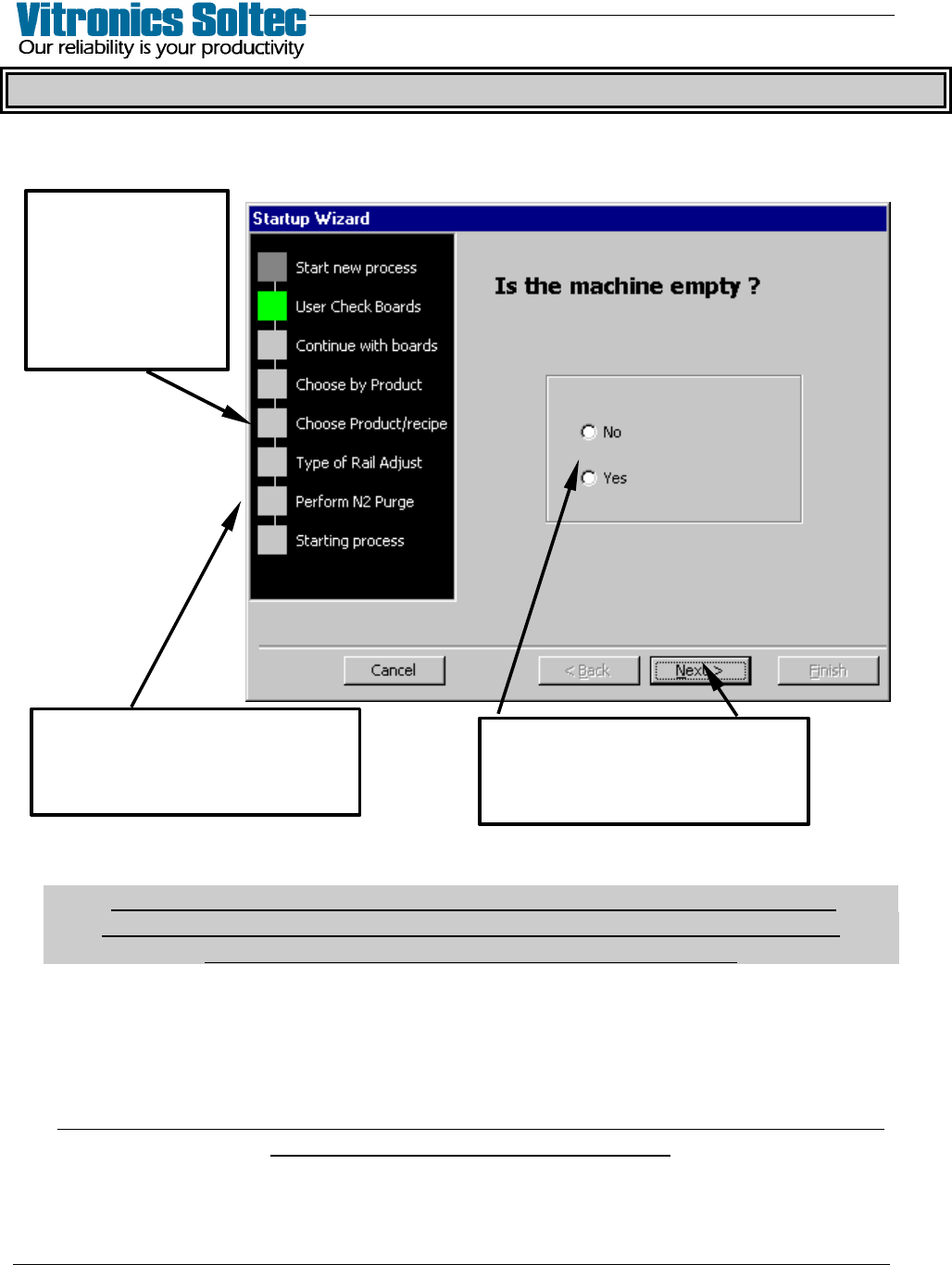
Operating the Reflow Oven involves “Starting a Process” by selecting File, then
Start New Process, which produces the Start-up Wizard:
The “PROCESS” which is started can be a PRODUCT or a RECIPE at the discretion
of Reflow Oven Operator.
(If a “Recipe” is selected, the default “Product” is automatically selected.
Board Width, Length, and Jam setting are applied to the “Selected Recipe”
See “Edit Product” to change “Default Product” file )
The cell fans will start immediately, and slowly accelerate to full RPM within the next
minute. On ovens with a rail or combination conveyor, the display will ask about
adjusting the rail width. If the answer was YES, the rail width can be adjusted
manually using the manual selector switches at the Off-load end of the oven.
On ovens with the "automatic rail width adjustment option", the rail width adjustment
begins after the Operator selects “Start”.
At this “Step”,
select
“Advanced” to
disable some
repetitive
questions
The Start-up Wizard
progresses through the
“Steps” shown.
Provide the requested
information at each “Step”,
then select “Next”
VITRONICS REFLOW SOLDERING SYSTEMS
EM 02502-G 15-Nov-00 (c) PAGE Operator’s Manual
17
OVEN STATUS - ALARMS, WARNINGS, AND SHUTDOWNS
ALARM LEVELS
There are five (5) alarm levels. Starting with the least serious, they are:
1) Notify - During this condition:
1) No change occurs in the Oven Operation
2) The Oven Status Bar will display the “Parameter Status”.
2) Warning - During this condition:
1) The Yellow light on the light tower will be on
2) The audible alarm will be off.
3) The conveyor will remain at setpoint
4) The heaters will remain at setpoint
5) Nitrogen or Air will remain at setpoint
6) Cell Fans will continue to run
7) The Oven Status Bar will display WARNING in Blue Letters.
No user input is required to clear this alarm state. The oven will go to the
process ready state when the alarm condition no longer exists.
3) Critical Warning - During this condition:
1) The Red light on the light tower will be on
2) The audible alarm will be on
3) The conveyor will continue to run at setpoint
4) The heaters will continue temperature at setpoint
5) Nitrogen or Air will remain at setpoint
6) Cell Fans will continue to run at setpoint
7) The Oven Status Bar will display CRITICAL WARNING in Blue Letters.
4) Alarm - During this condition:
1) The Red light on the light tower will be on
2) The audible alarm will be on
3) The conveyor will run if oven temp above 100 deg
4) The heaters will turn off
5) Nitrogen or Air will be turned off
6) Cell Fans will continue to run (Full speed with Nitrogen Option)
7) The Oven Status Bar will display ALARM in Blue letters.
5) Critical Alarm - During this condition:
1) The Red light on the light tower will be on
2) The audible alarm will be on
3) The conveyor will run
4) The heaters will turn off
5) Nitrogen or Air will be turned off
6) Cell Fans will stop
7) The Oven Status Bar will display CRITICAL ALARM in Red Letters.
SELECT “SETUP”, and “DISPLAY LAYOUT” TO SET “RED”
SCREEN BACKGROUND WHEN ALARMS OCCUR