96722_AX-201 AX-301 AX501 Spec bookl.pdf - 第10页
Depending on the base, the machine can be equipped with different types of place- ment robots; there are three available; the standard placement robot , the compact placement robot and the X-Y Robot. A compact placement …
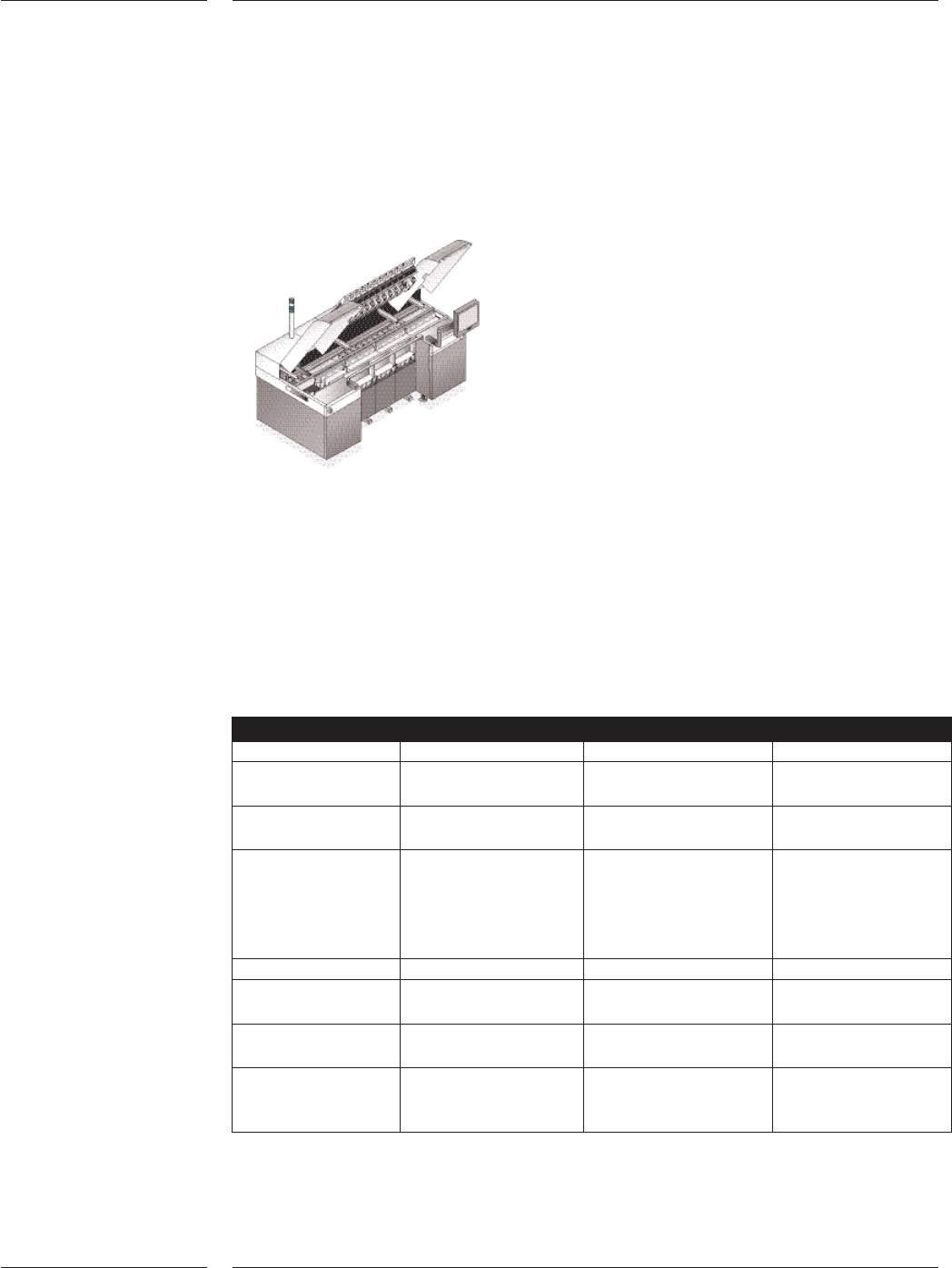
The machine base contains all mechanical interfaces for connection of the placement
robots, feeder and tray trolleys and board transport units. It also holds the controls and
supply systems as well as safety covers and doors to provide safe working conditions for the
operator. Three bases are available: AX-501 holding five trolley positions, AX-301
holding three trolley positions, and AX-201 holding a maximum of four trolley positions.
Machine base
Each board transport unit contains a run-in section, where boards from the previous
machine are received, and a run-out section, where boards are transferred to the next
machine. In between the run-in and run-out section is the working area of the machine
where the components are placed on the board. The automated transport unit adjusts to
the correct width and thickness of the board and all boards in the working area are clamped
on the side. Boards in the working area can be supported using pins or strips with
magnetic interface.
Board transport
AX-501 AX-301 AX-201
Minimum board 50 x 50mm, 50 x 50mm, 50 x 50mm,
dimensions (L x W) 50 x 25mm optional 50 x 25mm optional 50 x 20mm optional
Maximum board 515 x 390mm, 475 x 390mm, 515 x 457mm
dimensions (LxW) 515 x 457mm optional 475 x 457mm optional
Board thickness 0.3mm - 6mm 0.3mm - 6mm 0.3mm - 6mm
Optional other Optional other Optional other
transport systems are transport systems are transport systems are
available like flexfoil available like flexfoil available like flexfoil
or 10 mm for carriers or 10 mm for carriers or 11 mm for carriers
Board weight Max. 2 kg. Max. 2 kg. Max. 3 kg.
Board transport Standard left to right, Standard left to right, Standard left to right,
optional right to left optional right to left optional right to left
Transport mechanism Indexing Indexing Conveyor belt
(Walking beam) (Walking beam)
Board transport SMEMA (940-965mm) SMEMA (940-965mm) SMEMA(940-965mm)
and Japanese and Japanese and Japanese
(885-915mm) (885-915mm) (885-915mm)
3 Features
3.1 AX Base
Figure 1
3.2 Board
Transport
Features
7 of 34
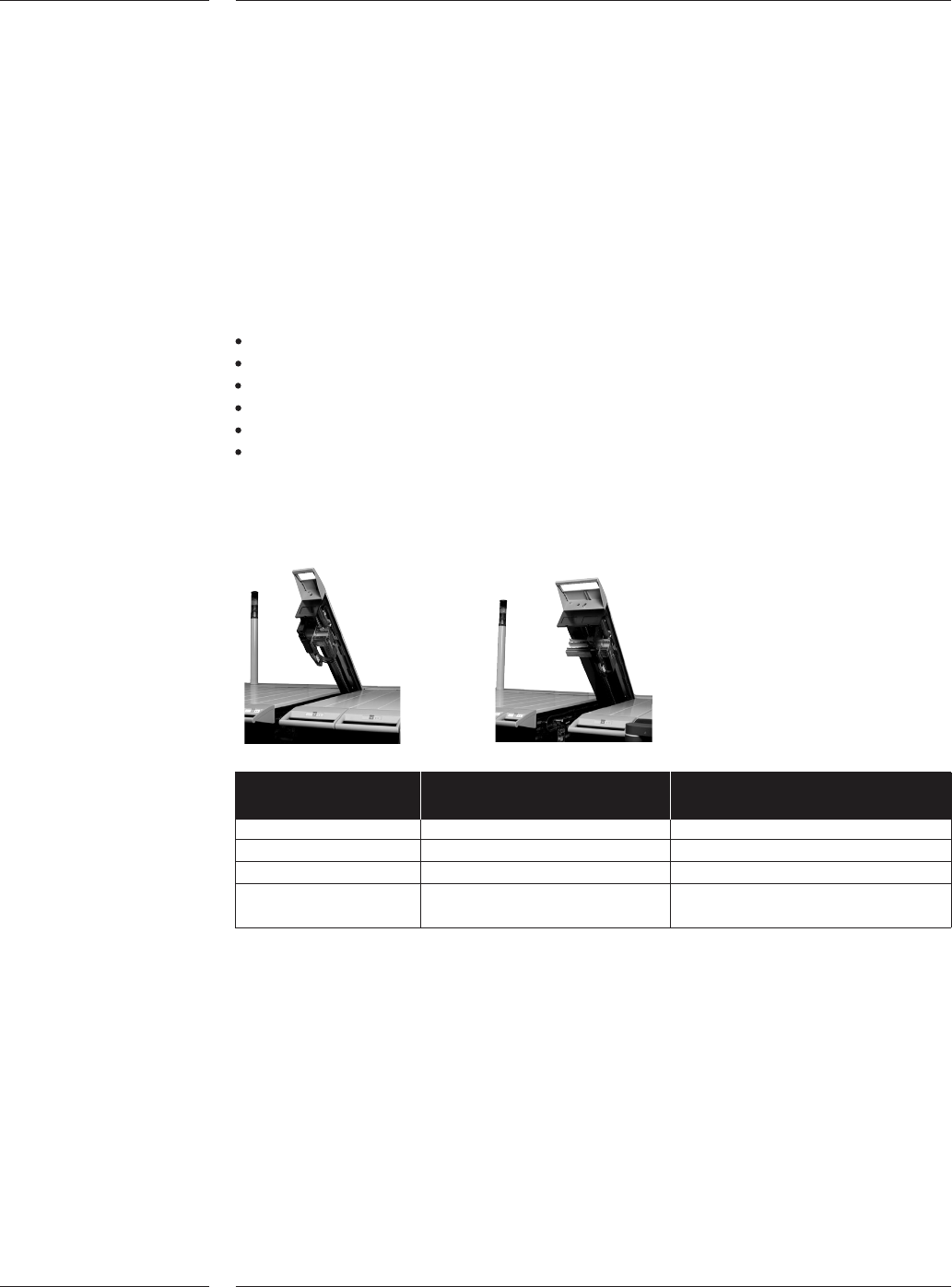
Depending on the base, the machine can be equipped with different types of place-
ment robots; there are three available; the standard placement robot , the compact
placement robot and the X-Y Robot. A compact placement robot is half the width
of a standard placement robot. This allows scaling the machine in output while
maintaining the available feeding positions, and achieving same specifications.
Standard and compact robot specifics:
Direct drive Y spindle using high-resolution rotary encoders
Linear X motor and encoder
Placement head interface
Safety interlocks
Quick exchange connection cables to placement controller
Air controller and local vacuum system (venturi)
The X-Y Robot is an integrated in the machine-base self-calibrating robot with lin-
ear motors and encoders. The H-drive manipulator has two Y-axes and one X-axis.
Please refer to the matrix on page 31 for the base-placement robot relationship.
Standard placement Compact placement
robot robot
Working area 200 x 590mm 80 x 590mm
Weight 52 kg 32 kg
Dimensions (LxWxH) 1625 x 240 x 250mm 1625 x 120 x 250mm
Max. number of
partnumbers 26 11
3.3 Placement
modules
3.3.1.Placement
robot
Figure 2
Features
8 of 34
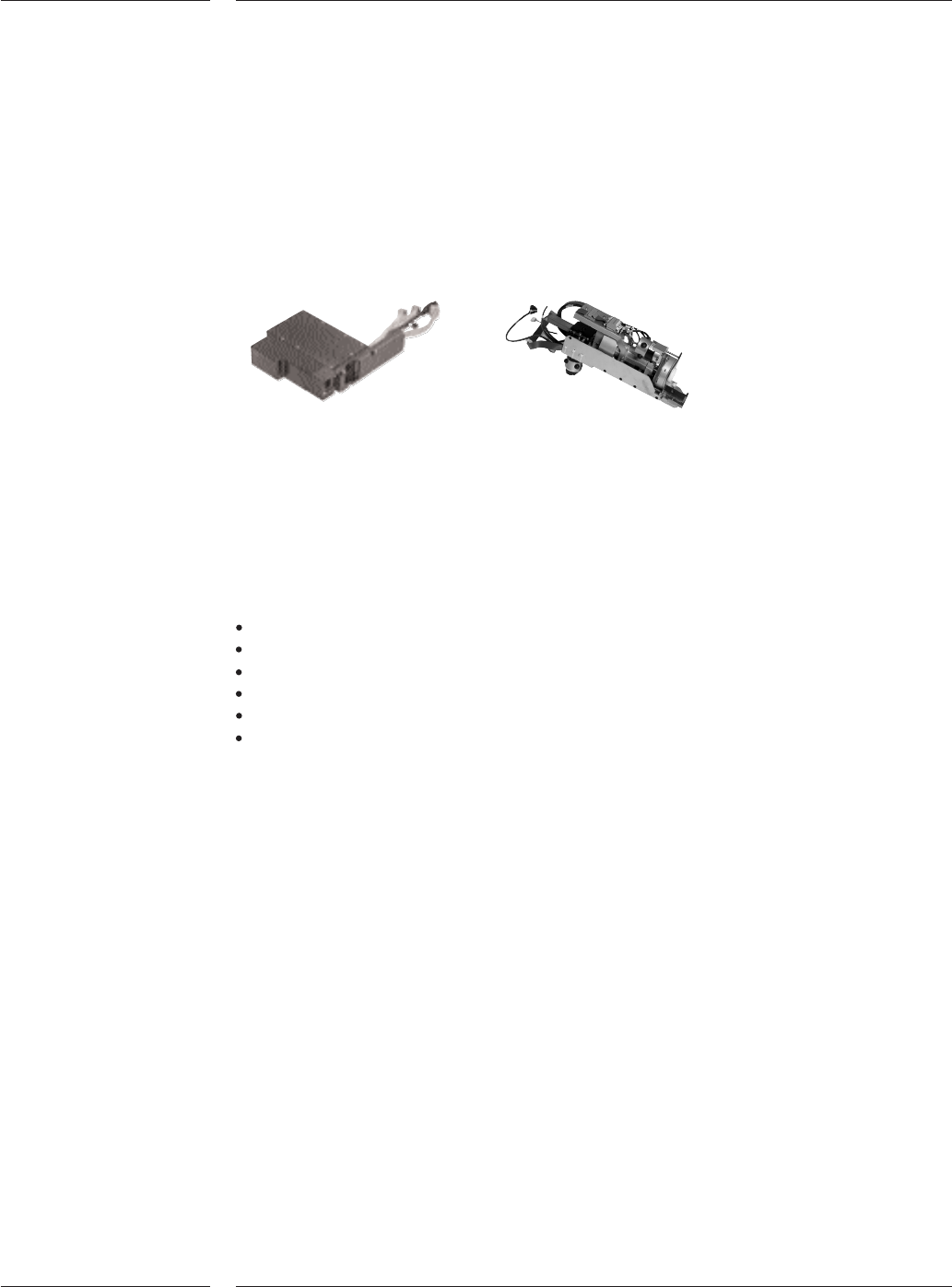
Each placement robot is fitted with one or more placement heads, which is
equipped with Z-height, phi-rotation and real time force control. With every
component placement, the placement head measures the impact position and
calculates the appropriate Z-height to correct for any applicable board warpage.
This adaptive Z-height feature (Board- and component thickness variation
correction) enables that the appropriate placement dwell time and force is well
within the tolerance of process requirements. All placement heads can use vacuum
toolbits for component pick-up, detection and placement.
Placement heads
Four types of placement heads are available:
1. Placement Head Single Vision (PH-SV)
2. Placement Head Laser Vision (PH-LV)
3. Placement Head Dual Vision (PH-DV)
4. Placement Head High Accuracy (PH-HA)
They execute the following tasks:
Align components
Pick and place components
Z-movement
Rz-movement
Force sensing and control
Board- and component thickness variation correction
The Placement Head Single Vision uses a Z-stroke linear motor. This linear motor
controls the pick force, placement Z-speed, dwell time and force. On top of these
control functions, the Placement Head Laser Vision has the capability to perform
component presence check and 'on the fly' laser alignment for components down
to 01005.
The Placement Head Dual Vision (which consists of two placement heads in a single
assembly) is configured in a doubled up configuration, effectively giving four
placement heads. This can pick, rotate and place components with the highest
speed. Component presence as well as the relative position will be checked by the
component vision system.
The Placement Head High Accuracy (configured in a set of two) combines accuracy
with placement forces up to 40N. It also has the capability to detect bent leads of
through-hole components using "variable through hole check". When a lead is bent
the placement head will measure a resistance force when the lead touches the
board. If the force exceeds the programmable limit (between 4 and 14 N) the
component will be rejected. For the most challenging components the PH-HA can
also use mechanical gripper to pick and place components.
3.3.2 Placement
heads
Figure 3
Features
9 of 34