Technical_reference.pdf - 第48页
Technical Service Manual 48 Revision Dat e: August 2004 5 INCHES 2.5 INCHES 2.75 IN 6 IN FAN MOTOR GAUGE -Mak e from 3/32” alum sheet 3/4 IN Hole is to f acilitate rem oval of gauge from under blower wheel. ¼ inch drill …

Technical Service Manual 47 Revision Date: August 2004
TOP CELL MOTOR REPLACEMENT
1. If they are not already marked with serial numbers, mark the fans and motors so they will not be mixed up.
2. At the rear of the oven, assemble three screw assemblies. A screw assembly consists of one 5/32" hex head
screw, one flat washer, and one rubber washer in that order. The rubber washers are to aid in vibration isolation.
3. Using RTV, put a very small dab of RTV on each support leg of the motor. Place rubber washer (not the rubber
washer from the screw assembly in Item 2 above) on each leg and position them so that they are centered on the
screw holes.
4. Put a small amount of RTV into each of the fan mounting holes on the cell plate.
5. Insert one screw assembly into a hole on the motor base and place the motor up against the cell face. Center the
holes and hand-tighten the screw.
6. CAUTION: Orient the motor so that the wires will reach the terminal block.
7. Insert the second screw into a hole on the motor base and hand-tighten it.
8. Finally, insert the last motor mounting screw into the last hole and hand-tighten it.
9. Using the 1/8" T-handle, tighten all three screws until they are tight and the motor is securely fastened onto the
cell plate.
10. Properly connect the motor wires to the connector block. (Red=L2, Yellow=L3, Blue=L1).
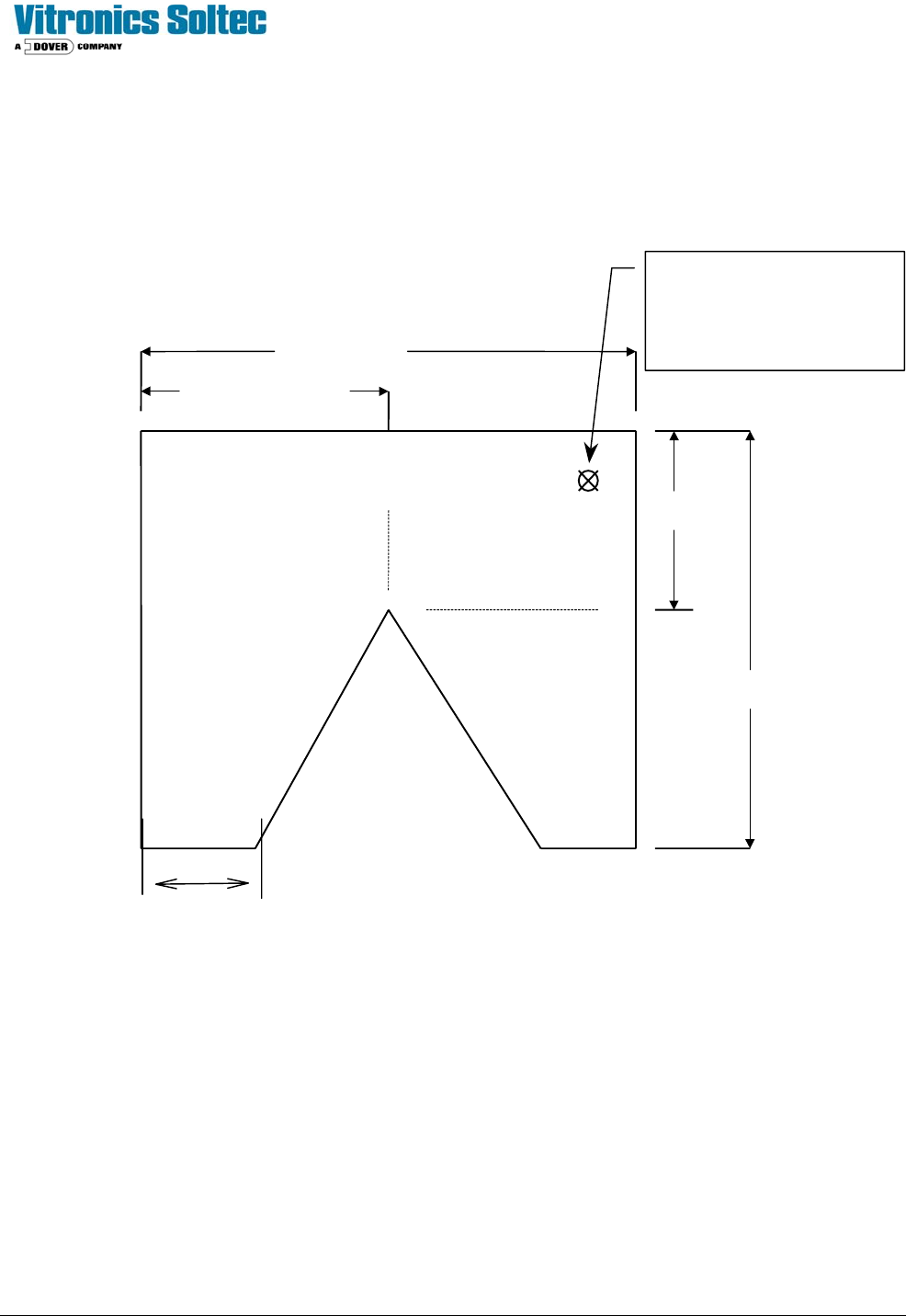
11. At the oven, place the fan mounting gauge in the cell up against the cell face with the opening of the V facing the
rear of the oven and surrounding the motor shaft. Make sure that the sides of the gauge are between the screws
in the cell plate. Hold the gauge in place. See drawing for the fan gauge.
12. Place the matching fan blade onto the motor shaft of the motor that you just installed. Note that the fan has two
setscrews and the motor shaft has two flats on it.
13. With the fan blade resting against the gauge, tighten the setscrews with a 1/8" hex key bit on a torque wrench set
to 50 inch pounds. Remove the gauge by sliding it forward and down out of the cell.
14. Retrieve the heater panel for this cell and set the rear of it into place in the cell between the bracket and the cell.
Be careful not to bend the thermocouple wire. Prop the heater panel up from the front so that you can reconnect
the heater wires.
15. Reconnect the wires to the panel referring to the SKETCH made when the panel and wires were removed. Use
two 11/32" wrenches so NOT break the ceramic block or tear the foil connected to the lower (closest to the panel)
nut on the stud. Reconnect the wires to the over-temperature switch.
16. Carefully place the thermocouple wire in its protective 1/8" vinyl tubing through the correct hole in the panel. If the
thermocouple(s) location was NOT marked (circle) prior to removing the panel, then count four rows from the left
and seven holes (6 visible) from the front to locate the correct hole.
17. Once the thermocouple is located in its proper hole, raise the heater panel in place.
18. Replace the front panel bracket and fasten it with two Philips head screws. Remove the vinyl tubing protecting the
thermocouple(s).
19. Replace the left and right ICBs and fasten them in place with two Philips head screws each. Refer to the sketch of
ICB placement to adjust them.
20. Carefully bend the thermocouple into its correct place and replace the clamp and screw. Tighten the screw.
Technical Service Manual 48 Revision Date: August 2004
5 INCHES
2.5 INCHES
2.75 IN
6 IN
FAN MOTOR GAUGE
-Make from 3/32” alum sheet
3/4 IN
Hole is to facilitate removal of
gauge from under blower
wheel.
¼ inch drill bit, ¼ inch
from out outside edges.

Technical Service Manual 49 Revision Date: August 2004
HEATER REMOVE AND REPLACE PROCEDURES
Make a clear sketch of the Inter Cell Baffle (ICB) settings for all cells. The ICBs will be removed and replaced
during this procedure.
TOP HEATER REMOVAL
1. Remove power from the oven.
2. Loosen the screw holding the thermocouple in place on the cell face. Using a permanent black marker, circle the
thermocouple on the heater face. (This will help relocate the thermocouple when reassembling the cell).
3. Carefully straighten the thermocouple wire and cover it with a piece of 1/8" vinyl tubing.
4. Remove the two Philips head screws holding each ICB in place on the sides of the heater panel. Remove the
ICBs.
5. Remove the two Philips head screws holding the front heater panel bracket. Remove the bracket.
6. Remove the two Philips head screws holding the rear heater panel bracket. Remove the bracket. CAUTION: The
heater panel may drop down.
7. If the heater panel does not drop down by itself, using a hex head wrench, carefully insert the short end into a hole
in the heater panel and gently tug down on the heater panel. Use the 3" putty knife to push the insulation guard
clear of the heater panel.
8. Lower the heater panel enough to gain access to the heater wires on the inside of the cell. Block the panel up with
a 10" 4x4 block of wood to relieve the strain on the wires.
9. Document the wire placement on the connections on the heater panel. They will need to be replaced later in the
same positions.
IT IS VERY IMPORTANT TO USE TWO WRENCHES AND HOLD THE BOTTOM NUT STEADY BECAUSE THE
HEATER FOIL IS DIRECTLY ATTACHED TO THE STUD AT THIS LOCATION. THE CERAMIC BLOCKS ARE
FRAGILE AND EASILY BROKEN. IF THE HEATER FOIL TEARS, IT CANNOT BE REPAIRED AND THE HEATER
PANEL ASSEMBLY MUST BE REPLACED.
10. Remove the four wires by using two 11/32" wrenches. Use one to hold the bottom nut (closest to the panel)
steady while the other unscrews the top nut to free the wire.
11. Disconnect the two wires on the thermal switch.
12. Remove the heater panel and set it aside.