JAKA Zu 12及JAKA Zu 12 pro -电控柜V2.1-硬件手册(英文版).pdf - 第12页
JAKA Zu 12 v 1.0 7 1. When the r obot is combined w ith or wor king with machines capable of d amaging th e robot, it is hi ghly recomme nded to test al l functions and the r obot pro gram separ ately . It is r ecom mend…
6 JAKA Zu 12 v1.0
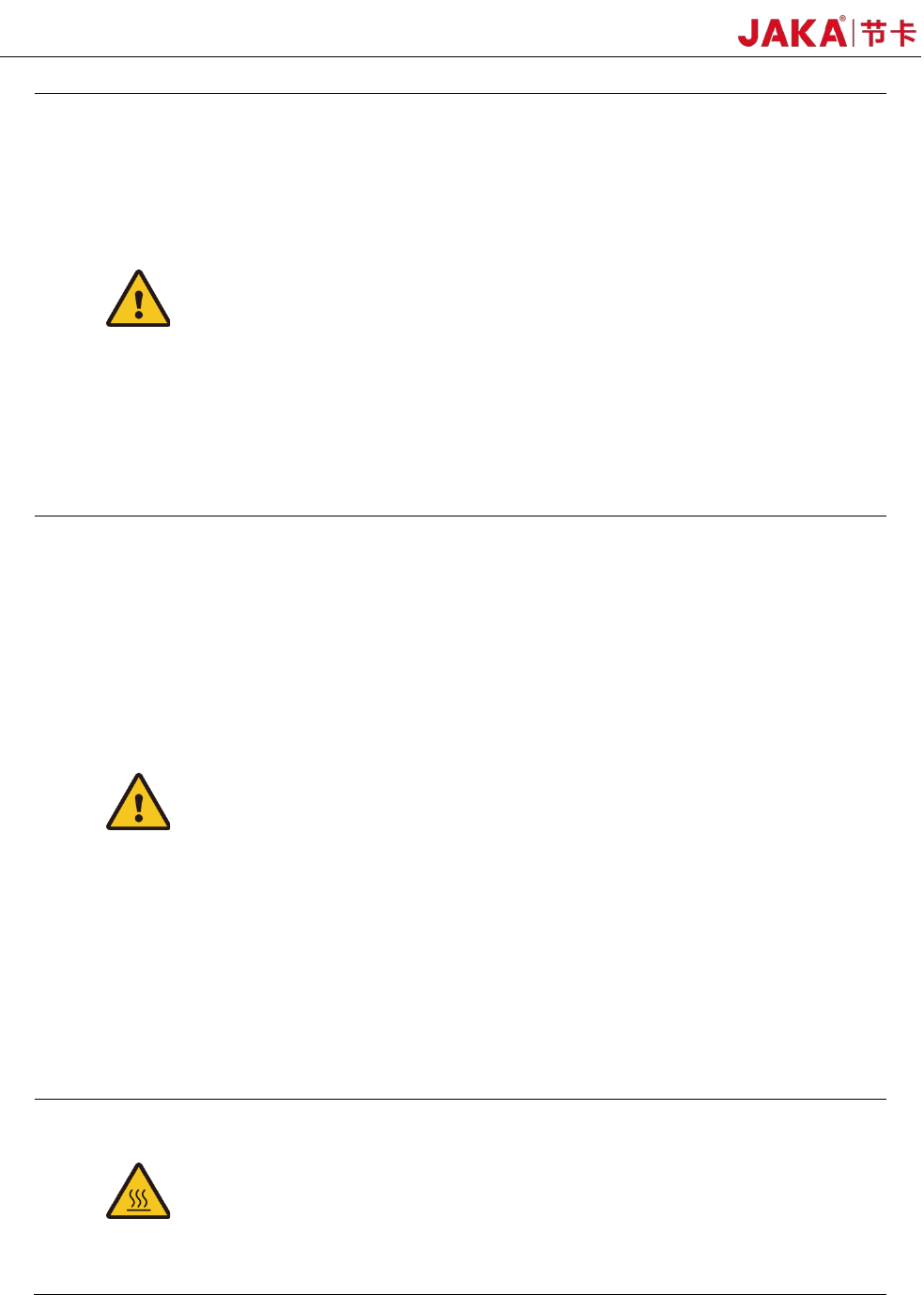
1.Professional commissioning personnel are required to install
and debug the robot according to the specifications.
2.The setting and modification of the safety parameters must be
carried out by a licensed person. Unauthorized personnel must not
change the parameters.
3.Do not switch the power supply system frequently. The JAKA
Zu
®
12 has a brake in each joint to hold position when the power is
off.
4.When the external force exceeds the satety value, the robot will
stop moving to prevent damage to the robot or operator injury. This is
because JAKA Zu
®
12 has a collision detection function. If the
operator uses controllers not approved by JAKA, the potential risks
are to be borne by himself.
1. Make sure the robot and tool are properly and securely bolted
in place.
2. Make sure the robot arm has ample space to operate freely.
3. Do not connect any safety equipment to normal I/O. Use
safety-related interfaces only.
4. Make sure to use the correct installation settings (e.g. Robot
mounting angle, weight in TCP, TCP offset, safety configuration).
Save and load the installations file along with the program.
5. Tools and obstacles shall not have sharp edges or pinch
points. Make sure that all people keep their heads and faces outside
the reach of the robot.
6. Combining different machines might increase hazards or
create new hazards. Always make an overall risk assessment for the
complete installation.
7. Never modify the robot. A modification might create hazards
that are unforeseen by the integrator. JAKA
DISCLAIMS ANY
LIABILITY IF THE PRODUCT IS CHANGED OR MODIFIED IN ANY
WAY.
1. The robot and electrical cabinet generate heat during
operation. Do not handle or touch the robot while in operation or
immediately after operation. To cool the robot down, power off the
robot and wait one hour.
2. Never put hand behind the internal cover of the electrical
cabinet.
JAKA Zu 12 v1.0 7
1. When the robot is combined with or working with machines
capable of damaging the robot, it is highly recommended to test all
functions and the robot program separately. It is recommended to test
the robot program using temporary way points outside the workspace
of other machines.
2. Do not expose the robot to permanent magnetic fields. Very
strong magnetic fields can damage the robot.
1.4 General Warnings and Cautions
1.Do not wear loose clothing or jewellery when working with the robot.
Make sure long hair is tied back when working with the robot.
2. During the operation, even if the robot seems to have stopped, it may
be because the robot is waiting for the start signal and is about to move.
Even in such a state, the robot should be considered to be in motion.
3. During the operation, make sure the power cables of the electrical
cabinet and robot are reliably connected. Do not plug or unplug the
power cables or terminals in the working mode.
4. A warning line should be drawn on the floor to identify the working
range of the robot, so that the operator can understand the working
range of the robot with the end effector (gripper, tool, etc.) mounted.
5. Make sure that safety measures and/or robot safety configuration
parameters have been set up to protect both programmers, operators
and bystanders, as defined in the risk assessment. The lock should be
set as needed so that the non-operator cannot access the robot power
supply.
6. In emergency situations such as when a person is caught or
surrounded by the robot, the robot can be forced to move by pushing or
pulling the robot arm. Moving the robot manually without power is for
emergency use only, and may damage the robot。
1.5 Liabilities and Risks
Liabilities
This manual does not cover all applications for designing, installing and operating robots, nor does it cover
all peripheral equipment that may affect the safety of the robot system.
JAKA's integrators are responsible for ensuring compliance with applicable national laws and regulations
to ensure that there are no major hazards in the complete robotic application.
All safety information contained in this manual shall not be considered as a guarantee of JAKA. Even if all
safety instructions are observed, the injury or damage caused by the operator may still occur.

8 JAKA Zu 12 v1.0
JAKA constantly strives to improve the performance and reliability of our robots. JAKA is not responsible
for any errors or omissions in this manual, and reserves the right of final interpretation of this manual.
Risks
A direct or indirect physical contact relationship exists when there an interaction between the operator and
the robot exists. Operators must have sufficient self-protection awareness when contacting, and integrators
need to carefully consider the use conditions when using the company's robots. The following are possible
dangerous situations:
①Injury caused by the robot dropping during handling;
②Injury caused by the loosening of the robot fixing screw;
③Finger-pinching and collision injury during the operation;
④Injury caused by the unrepaired malfunction robot;
⑤Danger caused by the usage of a sharp end effector or tool connection;
⑥Injury caused by the operation in a toxic or corrosive environment.
1.6 Usage
JAKA Zu
12 is an industrial collaborative robot suitable for use in industrial environments, for example, for
handling tools and fixtures, or for processing or transferring components or products. JAKAZu
12 is only
allowed to be used under specified environmental conditions.
JAKA Zu
12 is equipped with special safety-related features, which are purposely designed for
collaborative operation, where the robot operates without fences and/or together with a human. Collaborative
operation is only intended for non-hazardous applications, where the complete application, including tool, work
piece, obstacles and other machines, is without any significant hazards according to the risk assessment of the
specific application.
Any use or application deviating from the intended use is deemed to be impermissible misuse. This
includes, but is not limited to the following:
①Use in potentially explosive environments ;
②Use in medical and life critical applications ;
③Use before performing a risk assessment ;
④Use where the rated performance levels are insufficient ;
⑤Operation outside the permissible operating parameters.
1.7 Emergency Stop
When an emergency occurs, press the emergency stop button to stop all movement of the robot
immediately. Emergency stop cannot be used as a risk reduction measure, but as a secondary protective
device.