KE-2030使用说明书.pdf - 第81页
3 − 16 3.5 M enu Organiz ation 3.5.1 Main Menu Pwb Production Tr ial Run Dry Run Warm ing Up Idle m ode Self-Ca libration Machine Management inform ation Mech-Param eter Set ting MS P t S t ti File [F] Editor [E] Product…
3 − 15
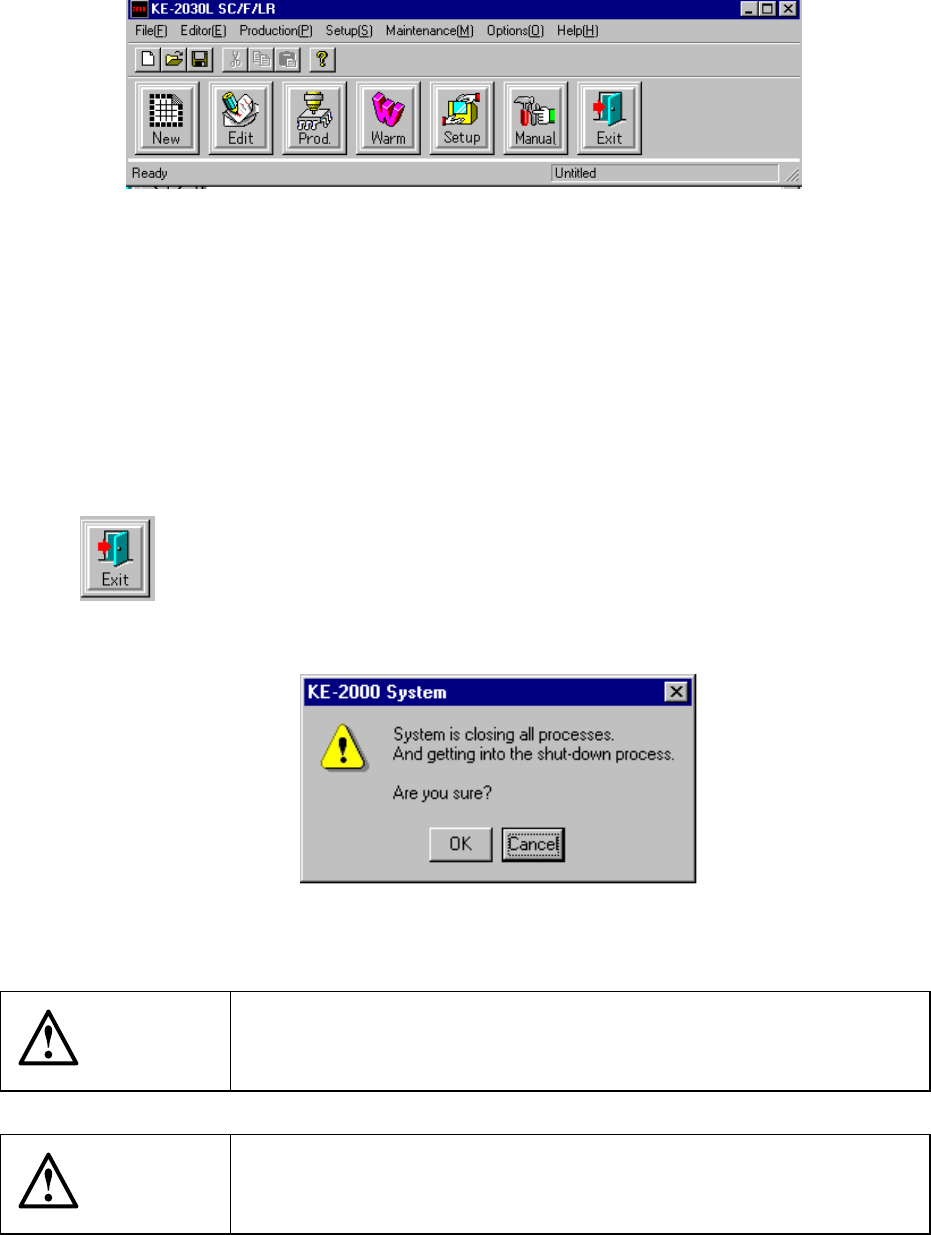
Figure 3.4.4 Main window
To terminate the system, click the <Exit> command button. When you click the <Exit>
button, the confirmation dialog box appears on the screen. When you click the <OK>
button displayed on this dialog box, the shut down process starts, then the system
terminates. If you click the <Cancel> button on this dialog box, the main menu
reappears.
When you click the <Exit> button, the shut-down process confirmation
dialog box opens.
Figure 3.4.5 shut-down process confirmation dialog box
CAUTION
If you turn off the machine without performing the shut-down process,
you may not be able to restart the machine. Be sure to perform the
shut-down process to terminate the system.
CAUTION
When you start up the main unit, two consol screens (under DOS) are
started up at the same time. These consol screens are necessary to
control the system. Never close them.
3 − 16
3.5 Menu Organization
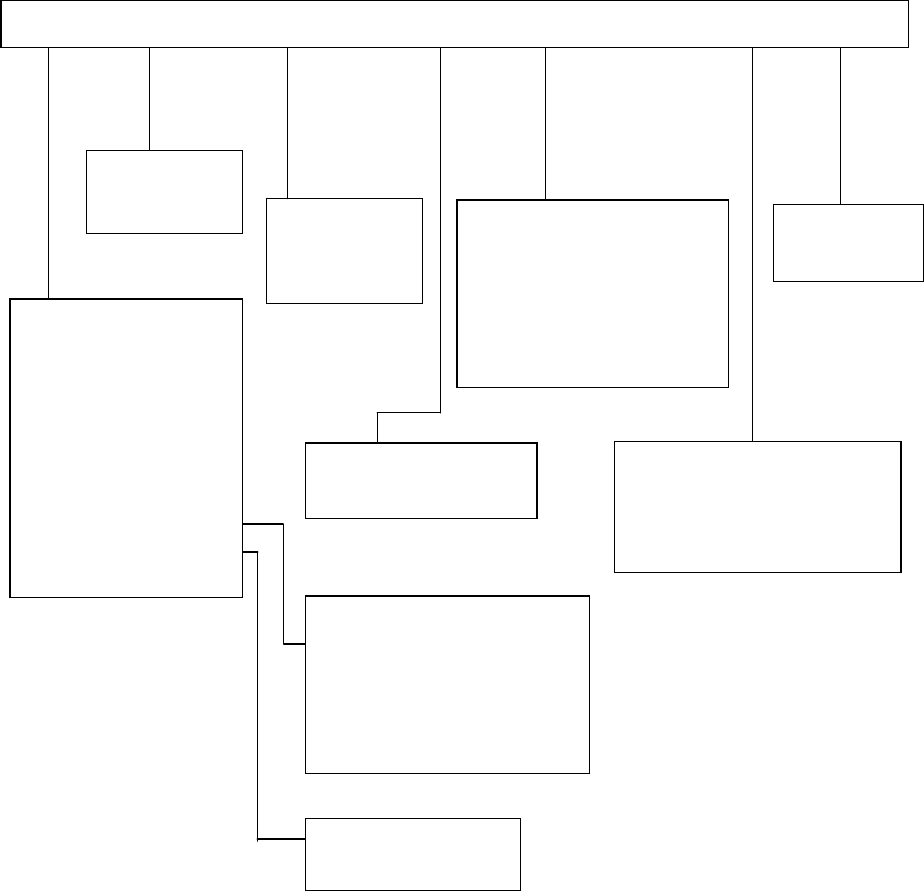
3.5.1 Main Menu
Pwb Production
Trial Run
Dry Run
Warming Up
Idle mode
Self-Calibration
Machine Management
information
Mech-Parameter Setting
MS P t S tti
File [F] Editor [E] Production [P] Setup [S] Maintenance [M] Options [O] Help [H]
Machine Set up
Manual Operation
Program Editor
Database Editor
Change User Group
User Group Environmental Settings
Option Setting
Environment Setting
Control Data File Storage
Data Manager
New [N] Ctrl + N
Open [O] Ctrl + O
Save [S] Ctrl + S
Save as [A]
File Management [Explorer]
Default Folder
Printer Setup
Print
Control Data Management
Exit [X]
Production Program List
Retry List
Production Management Data
Machine Management information
Machine Setup Data
Option Setting Data
KE-2000 Help
About Programs
3 − 17
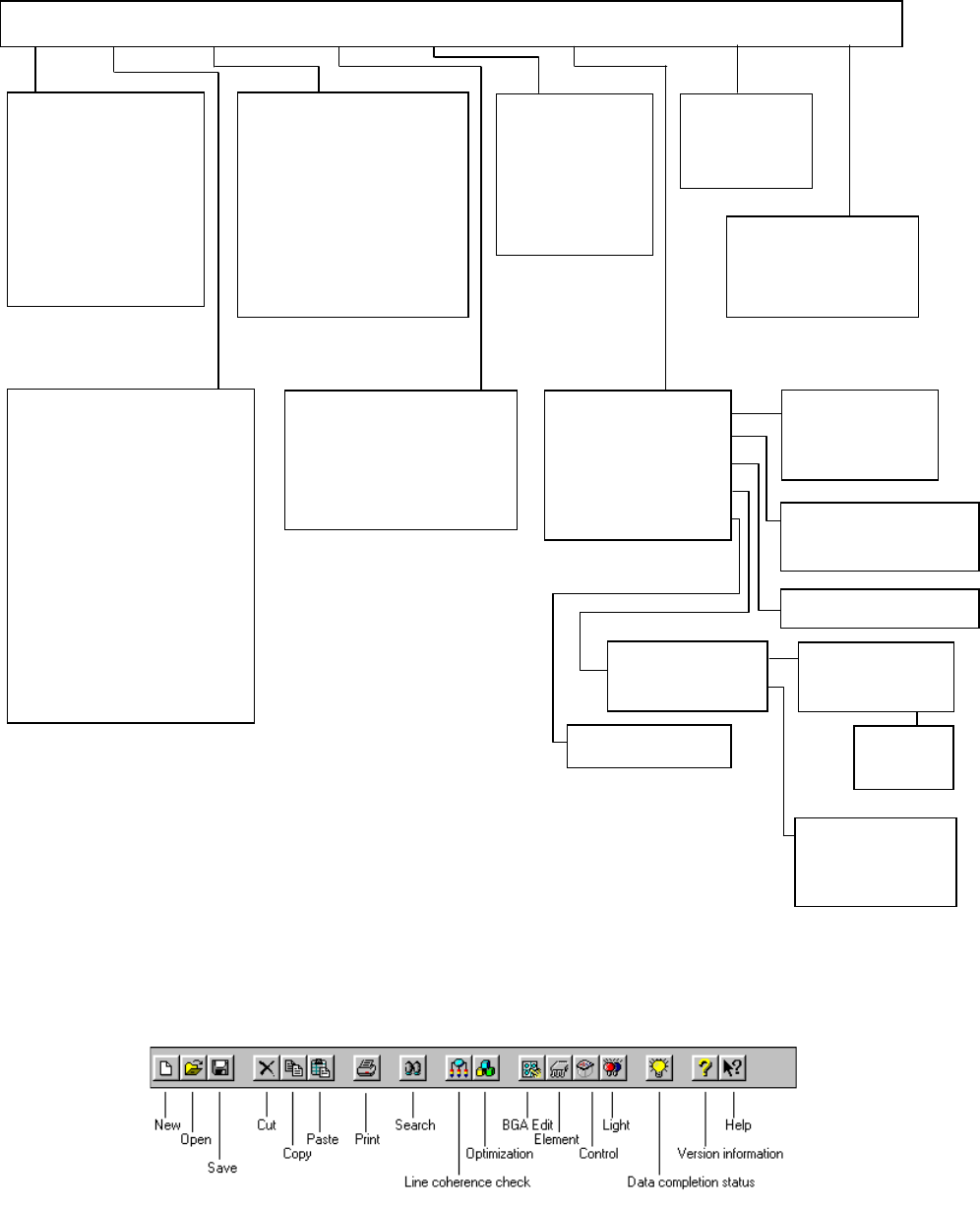
3.5.2 Program Editing local menu
This section describes the commands to be used for editing a production program.
Command list
Tool bar
The figure below indicates the contents of the tool bar displayed when you edit a
production program.
Register [B]
Call list [C]
Re-Search [R]
Command [C]
How to use help [H]
Version information [A]
New [N] Ctrl + N
Open [O] Ctrl + O
Save [S] Ctrl + S
Save as [A]
File Information [I]
Print [P]
Environment setting [C]
Exit [E]
PWB data [B]
Placement data [P]
Component data [C]
Pick data [I]
Vision data [V]
Data completion stalus [S]
Station data [E]
Data cohevvvence chack [L]
Cut [T] Ctrl + X
Copy [C] Ctrl + C
Paste [P] Ctrl + V
Insert Line [U]
Jump [J] Ctrl + G
Search [S] Ctrl + F
Search the next item [N] F7
Replacement [L]
Cel copy [O] Ctrl +E
Cel Paste [P] Ctrl +R
Change component Name [H]
Matrix copy [M]
Vision copy [V]
Optimization [G]
Divided placement Data [P]
Nozzle layout [N]
Component supply count [S]
Status Display [D]
File [F] Edit [E] Data[C] Optimization [O] Display [V] Machine operation [M] Data Base[D] Help
[H]
PWB load [L]
PWB eject [E]
Auto conveyor [A]
Current component [C]
All component [A]
Mark [M] >>
Coordinate
[
C
]
>>
BOC [B]
Feeder Bank [F]
Front [F]
Rear [R]
Place tracking [P]
Pick tracking [I]
Height tracking [H]
Transport [T] >>
Measurement [M] >>
Inspection [I] >>
Confirmation [C] >>
Management [A] >>
Vision recognition [I]
Mark Database [M]
Component form
Component list
Feeder layout
Tool bar
Vision Form
Vision List