D3操作手册.pdf - 第22页
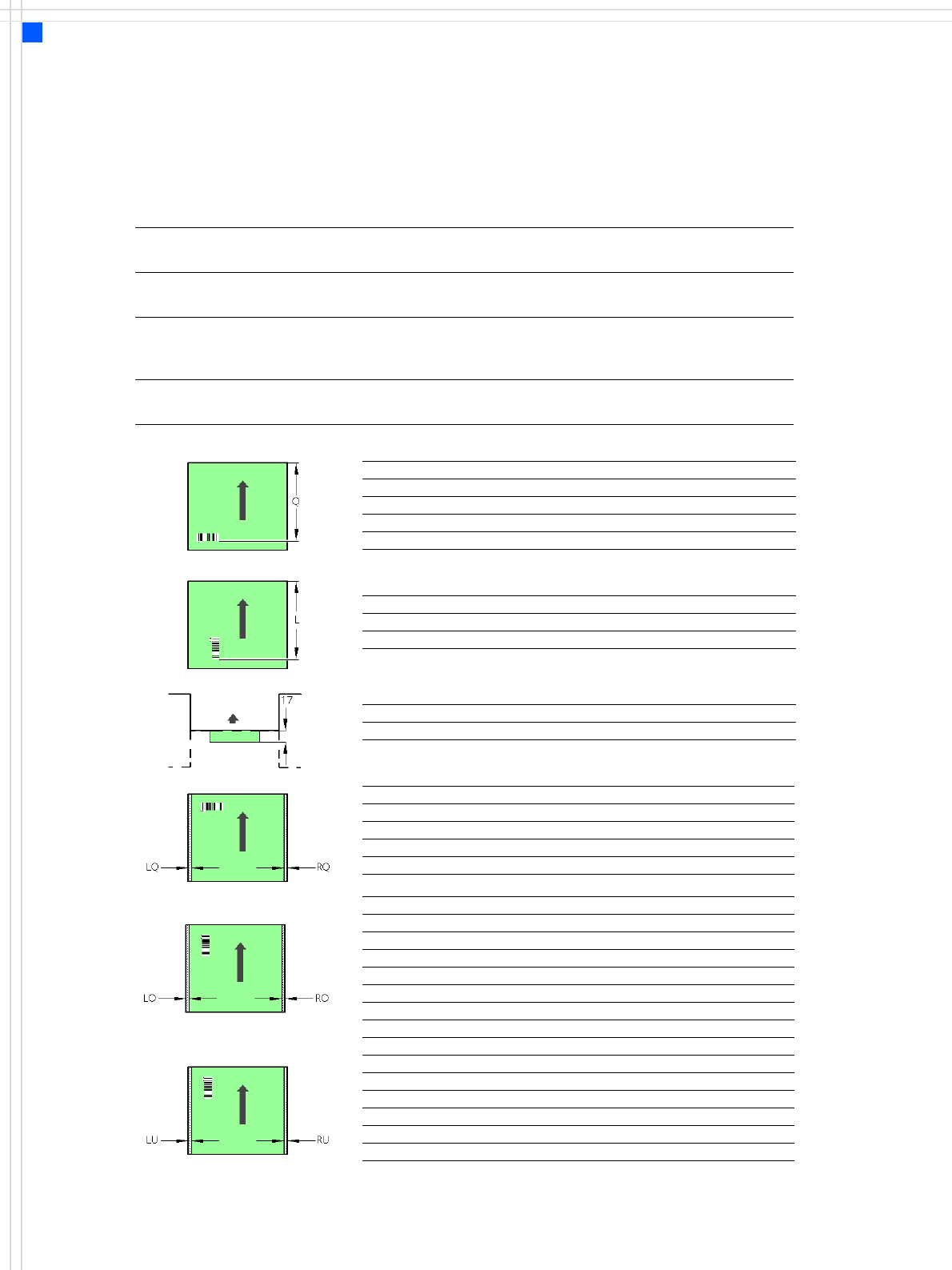
22 PCB Conveyor SIPLACE PCB Barcode for Product-Controlled Production (Option) Label dimensions Str oke width (W): 0.19 < W ≤ 0.3 mm (corresponds to high and medium den- sity), stroke len gth: ≥ 4 mm, len gth of the b…

21
PCB Conveyor
Flexible Dual Conveyor
Technical Data for the Dual Conveyor
Stationary conveyor side Right or left
PCB format
Standard (length x width)
Wide board configuration
Long board option
Long board option in Wide board configuration
Dual conveyor in Single conveyor mode
Standard
Wide board configuration
Long board option
Long board option in Wide board configuration
50 x 50 mm² to 450 x 216 mm²
50 x 50 mm² to 450 x 250 mm²
50 x 80 mm² to 610 x 216 mm²
50 x 80 mm² to 610 x 250 mm²
50 x 50 mm² to 450 x 380 mm²
50 x 50 mm² to 450 x 450 mm²
50 x 80 mm² to 610 x 380 mm²
50 x 80 mm² to 610 x 450 mm²
PCB thickness
Standard 0.3 mm to 4.5 mm (± 0.2 mm)
(thicker PCBs on request)
Max. PCB warpage
(pass-through height)
Up: 6 mm - PCB thickness
Down: 0.3 mm + PCB thickness
PCB weight max. 3 kg
Clearance on PCB underside
Standard
Option
25 mm ± 0.2 mm
max. 40 mm ± 0.2 mm
PCB transport height 830mm ± 15mm (standard)
900mm ± 15mm (optional)
930mm ± 15mm (optional)
950mm ± 15mm (SMEMA: optional)
Type of interface SMEMA / SIEMENS
Component-free PCB handling edge 3 mm
PCB changeover time 2.5 s
PCB positioning accuracy ± 0.5 mm
Conveyor mode synchronous or asynchronous
Components on each conveyor same or different
PCB width on each conveyor same or different
Bad fiducial detection synchronous: not possible, asynchronous: possible
Automatic width adjustment synchronous: possible, asynchronous: possible
22
PCB Conveyor
SIPLACE PCB Barcode for Product-Controlled
Production (Option)
Label dimensions Stroke width (W): 0.19 < W ≤ 0.3 mm (corresponds to high and medium den-
sity), stroke length: ≥ 4 mm, length of the barcode template window: ≤ 90 mm
Recommended label
colors
Coding: black, dark green, dark blue, background: white, beige, yellow, orange
(contrast ratio > 70% to DIN 66236
Code types Code 39, Code 128 / EAN 128, Codabar, 2/5 IATA 2/5 industrial, 2/5 interleaved,
UPC, EAN, Pharma Code, EAN Addendum (others available on request),
max. 25 digits, a barcode filter may be defined
Laser scanner safety Laser diode 670 nm (red) / 1.2 mW
Laser protection class 2, degree of protection IP65
PCB barcode reader Q [mm]
2D on top 390
1D on top 390
2D on bottom 430
1D on bottom 430
PCB barcode reader L [mm]
1D on top 320 - 350
1D on bottom 380 - 410
PCB barcode reader PCB rear projection [mm]
2D on bottom (dual conveyor) 17
PCB barcode reader LQ [mm] RQ [mm]
2D on top 3 3
1D on top 3 3
2D on bottom 5 5
1D on bottom 5 5
PCB dimensions/conveyor LO [mm] RO [mm]
460 mm SC 3 20
508 mm SC 3 44
216 mm DC1 3 24
250 mm DC1, 450 mm SM1 3 58
216 mm DC2 3 3
250 mm DC2, 450 mm SM2 3 3
PCB dimensions/conveyor LU [mm] RU [mm]
460 mm SC 20 3
508 mm SC 44 3
216 mm DC1 3 3
250 mm DC1, 450 mm SM1 3 3
216 mm DC2 24 3
250 mm DC2, 450 mm SM2 58 3
SC - Single conveyor, DC1/2 - Dual conveyor, track 1/2, SM1/2 - Dual conveyor in Single conveyor mode, track 1/2
Downstream
machine
Upstream
machine
PCB
PCB barcode scanner 1D on top
PCB barcode scanner 1D on bottom
23
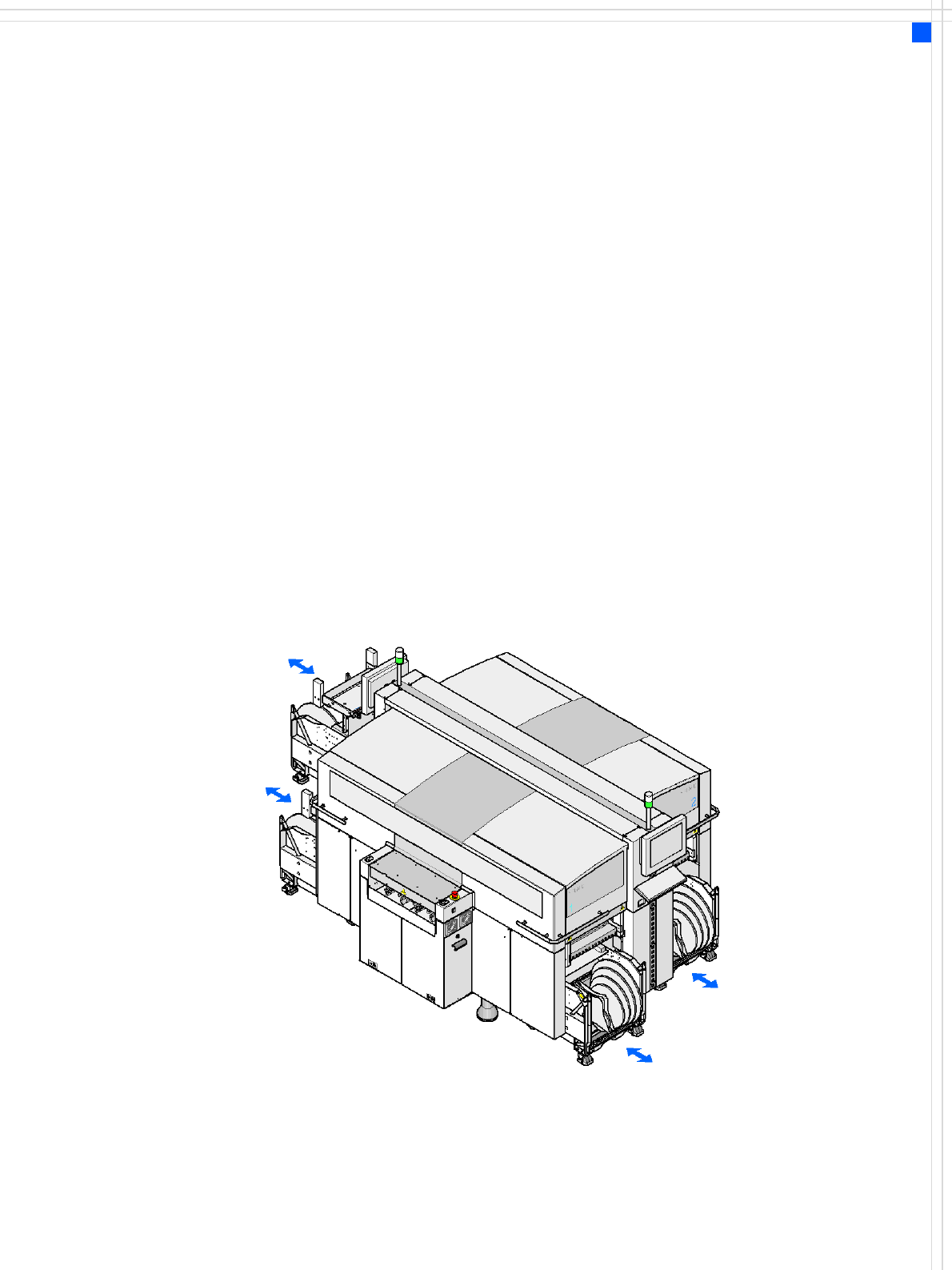
Location 1
Location 2
Location 3
Location 4
Component Feeding
Component Changeover Table
Description
Up to four component
changeover tables may be
docked in the machine.
Optionally, a matrix tray
changer may be installed at
location 2. The component
changeover tables are stand-
alone modules that can be
set up at an external set-up
area with feeder modules. In
this way, changes only inter-
rupt the production process
for a short time. The chassis
runs smoothly and is easy to
maneuver.
The component table has a
capacity of up to 15 locations
for 30 mm tape feeder mod-
ules. The total capacity with
four component changeover
tables is thus 180 x 8 mm
tracks.
Bulk case feeder modules,
linear vibratory feeders, Surf-
tape feeder modules, dipflux
modules, component dis-
posal modules and waffle-
pack trays can all be set up in
addition to the tape feeder
modules. Dummy feeder
modules are used at un-
assigned locations to protect
the operators.
The communication unit
sends the necessary voltages
and control signals to the
feeder modules.
The component feeders are
at rest during the placement
process, which means that
components can be refilled
(in sticks, for example) and
tapes may be spliced without
stopping the machine.
An optional component bar-
code reader can be used to
scan and check the barcodes
on the tape reels, thus guar-
anteeing that the compo-
nents are allocated to the
correct tracks.