E4416A_E4417A EPM-P Series Power Meters and E-Series E9320 Peak and Average Power Sensors.pdf
Find us at www.keys i ght.com Page 1 E4416A/E44 17A EPM - P Series Power Meters and E - Series E9 320 Peak and A verage Pow er Sensors
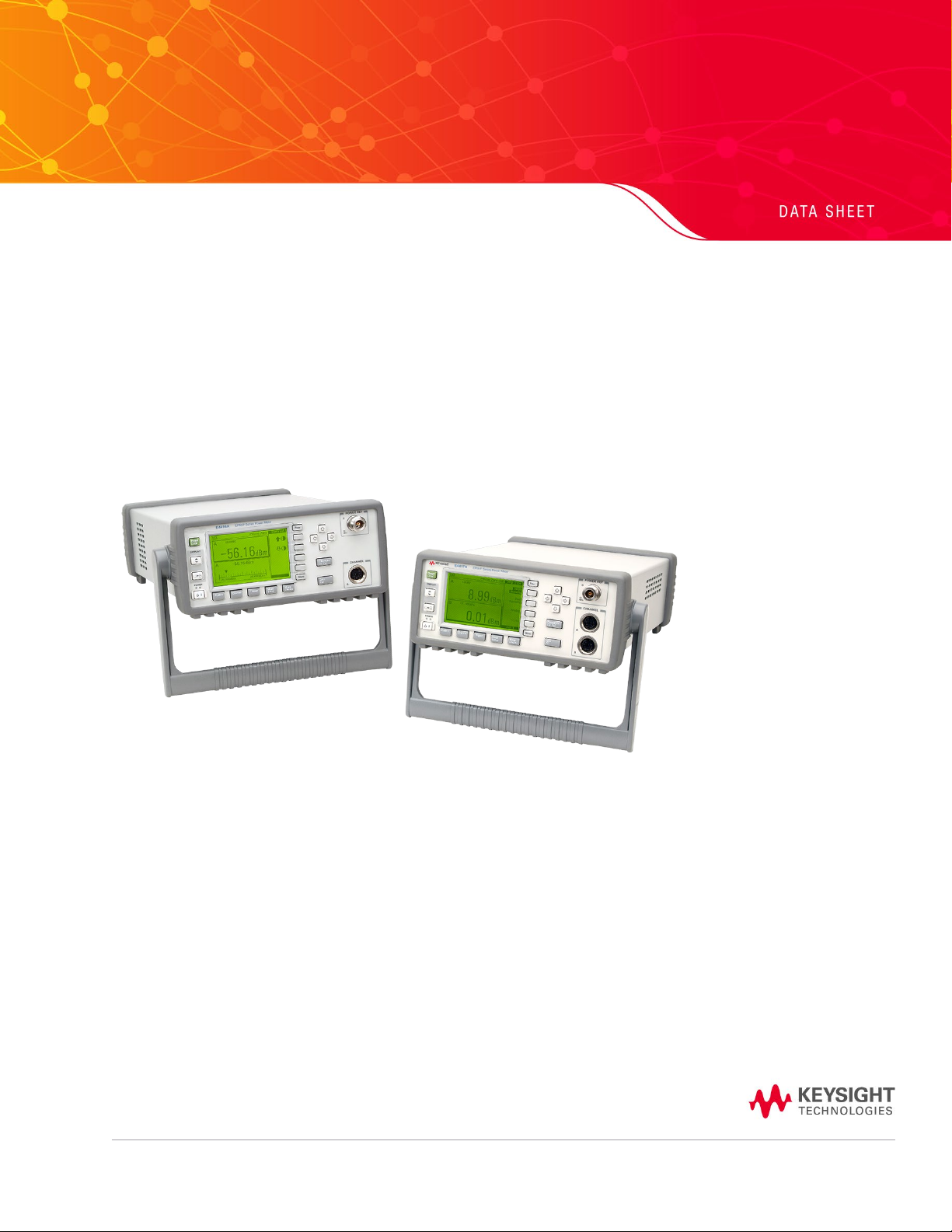
Find us at www.keysight.com Page 1
E4416A/E4417A EPM-P Series
Power Meters and E-Series E9320
Peak and Average Power Sensors

Find us at www.keysight.com Page 2
EPM-P Power Meter Specifications
Specifications describe the instrument’s warranted performance and apply after a 30 minute warm-up.
These specifications are valid over its operating and environmental range unless otherwise stated and
after performing a zero and calibration procedure.
Supplemental characteristics are intended to provide additional information; useful in applying the
instrument by giving typical (expected), but not warranted performance parameters. These
characteristics are shown in italics
or labeled as ‘typical’, ‘nominal’ or ‘approximate’.
Measurement uncertainties information can be found in, Fundamentals of RF and Microwave Power
Measurements, Application Note, literature number 5965-6630E.
Compatibility, the EPM-P series power meters operate with the E-series E9320 family of power sensors
for peak, average and time-gated power measurements. The EPM-P series also operates with the
existing 8480 and N8480 series, E-series CW and the E9300 range of power sensors for average power
measurements. For specifications pertaining to the 8480 and E-series CW and E9300 power sensors,
please refer to the EPM Series Power Meters, E-Series and 8480 Series Power Sensors, Technical
Specification, literature number 5965-6382E. For specifications pertaining to the N8480 series power
sensors, please refer to the N8480 Series Thermocouple Power Sensors, Technical Specification,
literature number 5989-9333EN.
Measurement modes, the EPM-P series power meters have two measurement modes:
•
Normal mode (default mode using E9320 sensors) for peak, average and time-related
measurements, and
•
Average only mode. This mode is primarily for average power measurements on low-level
signals, when using E9320 sensors, and is the mode used with 8480 and N8480 series
sensors, E-series CW sensors and E-series E9300 sensors.
Frequency range: 9 kHz to 110 GHz, sensor dependent
Power range: –70 to +44 dBm, sensor dependent

Find us at www.keysight.com Page 3
Single Sensor Dynamic Range
E-series E9320 peak and average
power sensors
70 dB maximum (normal mode)
85 dB maximum (average only mode)
E-series CW power sensors
90 dB
E-series E9300 average power
sensors
80 dB maximum
8480 series sensors
50 dB maximum
N8480 series sensors
55 dB maximum
Display units
Absolute
Watts or dBm
Relative
Percent or dB
Display resolution Selectable resolution of 1.0, 0.1, 0.01, 0.001 dB in logarithmic mode,
or 1 to 4 significant digits in linear mode
Offset range
± 100 dB in 0.001 dB increments, to compensate for external loss or gain
Video bandwidth
5 MHz (set by meter and is sensor dependent)
Note that the video bandwidth represents the ability of the power sensor and meter to follow the power
envelope of the input signal. The power envelope of the input signal is, in some cases, determined by
the signal’s modulation bandwidth, and hence video bandwidth is sometimes referred to as modulation
bandwidth.
Video bandwidth/dynamic range optimization
The power measurement system, comprising the sensor and meter, has its maximum video bandwidth
defined by the E9320 sensor. To optimize the system’s dynamic range for peak power measurements,
the video bandwidth in the meter can be set to High, Medium and Low, as detailed in the following table.
The filter video bandwidths stated in the table are not the 3 dB bandwidths as the video bandwidths are
corrected for optimal flatness. Refer to Figures 6 to 8 for information on the sensor’s peak flatness
response. A filter OFF mode is also provided.
Table 1. Video bandwidth versus peak power dynamic range.
Sensor model Video bandwidth/Max peak power dynamic range
OFF
High
Medium
Low
E9321A
300 kHz/–40 dBm to +20 dBm 300 kHz/–42 dBm to +20 dBm 100 kHz/–43 dBm to +20 dBm 30 kHz/–45 dBm to +20 dBm
E9325A
E9322A
1.5 MHz/–37 dBm to +20 dBm 1.5 MHz/–38 dBm to +20 dBm 300 kHz/–39 dBm to +20 dBm 100 kHz/–39 dBm to +20 dBm
E9326A
E9323A
5 MHz/–32 dBm to +20 dBm 5 MHz/–32 dBm to +20 dBm 1.5 MHz/–34 dBm to +20 dBm 300 kHz/–36 dBm to +20 dBm
E9327A