User-Manual-NeoDen-IN12-Reflow-oven.pdf - 第12页
11 ♦Tem perature curve Connect the Temperature sensor to the SENS OR CONNECTOR, attach the sensor to PCB, and then cli ck "start" button i n the curve setti ng interface after PCB is put into the oven to get th…
10
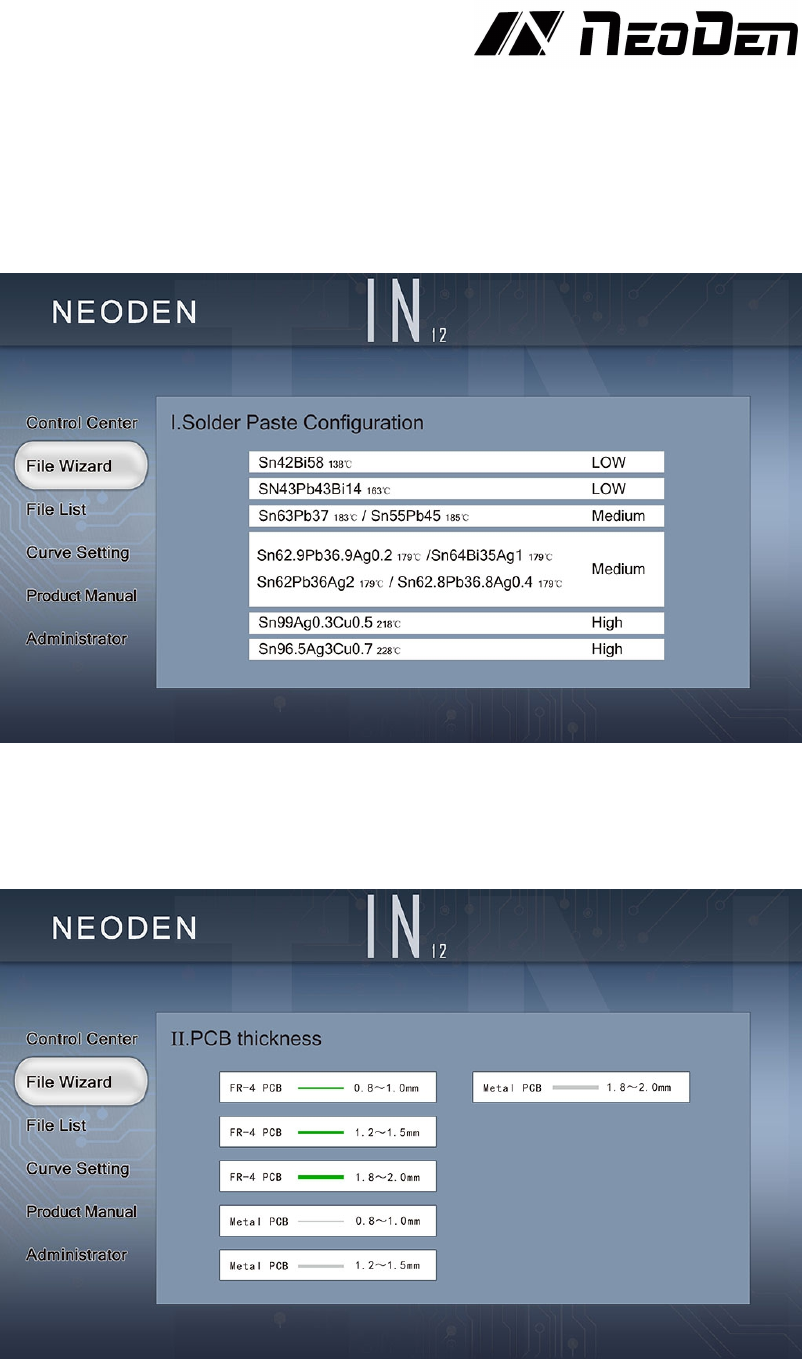
♦File generation Wizard
(Note: due to the great difference in complexity of each product, the temperature
parameters generated are only used as reference. In order to achieve the best solder
effect, it is necessary to measure the temperature curve and improve the parameters
after comparing with the temperature curve provided by the solder paste manufacturer.)
Step 1: select the type of solder paste to solder the product. If the model is not found in
the list, please go to search in the appendix, or ask the solder paste manufacturer about
the melting point, and then select the option with the closest melting point.
Step 2: select the material and thickness of PCB to be soldered.
After selection, the system will automatically generate the corresponding soldering
formula.
11
♦Temperature curve
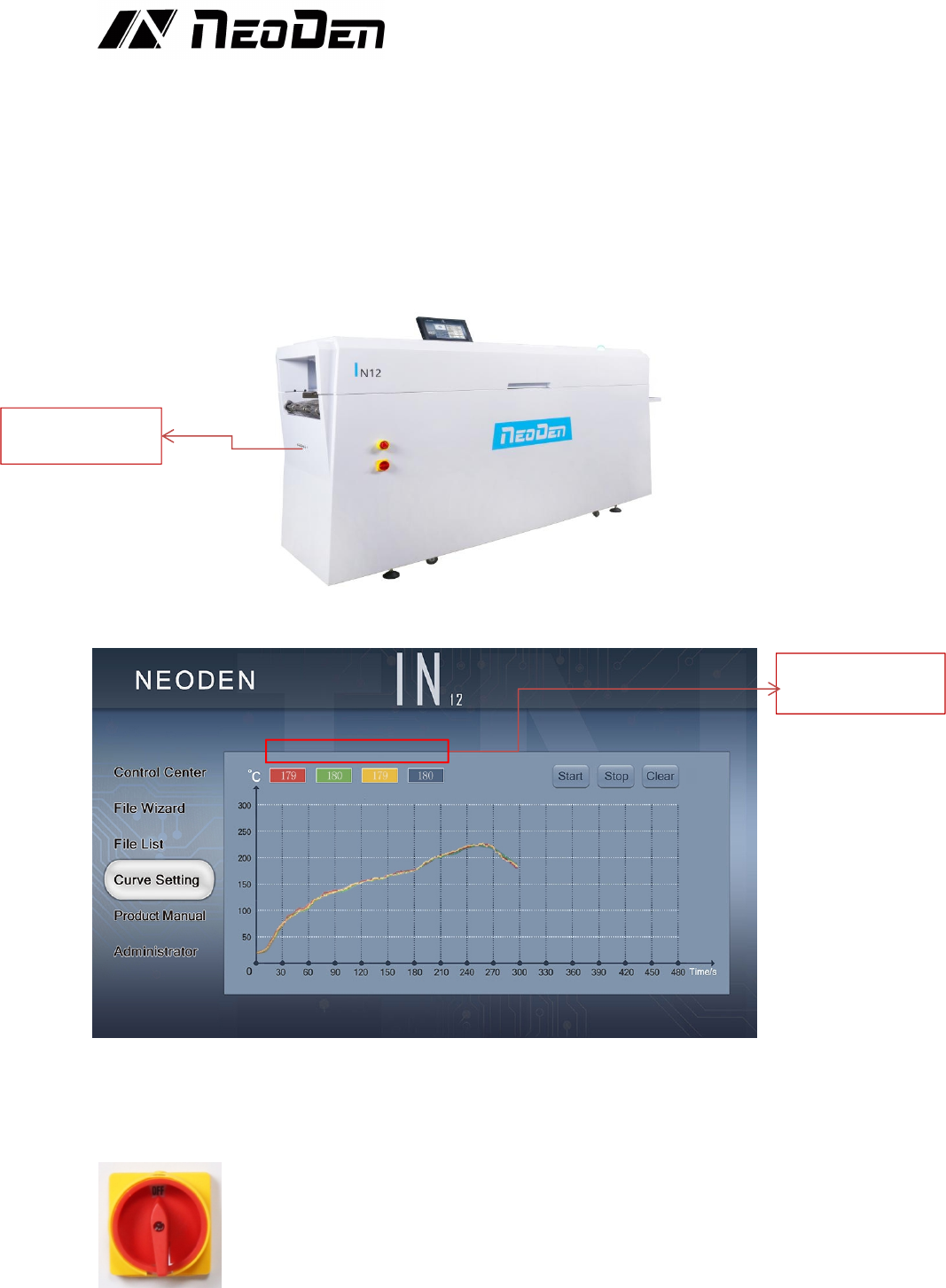
Connect the Temperature sensor to the SENSOR CONNECTOR, attach the sensor
to PCB, and then click "start" button in the curve setting interface after PCB is put
into the oven to get the temperature curve, click "stop" to pause the generation of
temperature curve, and click "clear" to clear the temperature curve record. The "red,
green, yellow and blue" sub table represents the real-time temperature of sensor on
four interfaces corresponding to the same color.
♦Power off
Click the temperature zone switch on the main control page to close the temperature
zone. Turn the switch to the off position, and the machine will turn off.
Real-time
temperature
Temperature sensor
connector

12
5.Temperature wave setting principle
5.10 what is the heating unit temperature?
the real-time temperature of the heating plate.
5.11 what is oven temperature?
the air temperature between the chain surface and the heating plate.
5.12 what is PCB surface temperature?
the temperature of component soldering feet when PCB is soldered. (the guide
temperature on the soldering wave provided by the solder paste manufacturer
refers to the PCB surface temperature.)
When working, the temperature displayed in the temperature zone on the panel is
the actual temperature of the heating unit, which does not represent the temperature
in the oven and the actual temperature of the plate surface. Therefore, the
temperature displayed will be about 20-40 degrees higher than the temperature in
the oven. The actual use is related to the chain speed, PCB size, thickness, material
and component density.
5.1 Principle of reflow soldering and temperature wave
When the PCB enters the heating zone (dry zone), the solvent and gas in the solder
paste evaporate. At the same time, the flux in the solder paste moistens the pad,
component ends and pins. The solder paste softens, collapses and covers the pad,
isolating the pad and component pins from oxygen. When the PCB enters the heat
preservation area, the PCB and components are fully preheated to prevent the
damage of PCB and components caused by the rapidly raise of temperature.When
the PCB enters into the soldering area, the temperature rises rapidly to make the
solder paste melt. The liquid soldering tin enters the cooling area to solidify the
solder joint and complete the reflow soldering. The temperature wave is the key to
ensure the soldering quality. The temperature rise slope and peak temperature of
the actual temperature wave and the solder paste temperature wave should be
basically consistent. Before 160 ℃, the heating rate should be controlled at about
1
℃
/ s. if the heating rate is too fast, on the one hand, the components and PCB
will be heated too fast, which will damage the components and easily cause PCB
deformation; on the other hand, the solvent in solder paste will volatilize too
quickly, which will easily splash metal components and produce solder balls. The
peak temperature is generally set at 20 ℃ - 40 ℃ higher than the melting
temperature of solder, and the reflow time is 10s-60s. If the peak temperature is
low or the reflow time is short, the soldering will not be sufficient, and in serious
cases, the solder paste will not melt; if the peak value is too high or the reflow time
is long, it will cause metal powder oxidation, affect the soldering quality, and even
damage the components and PCB.
5.2 Setting of temperature wave
Set according to the temperature wave of solder paste and the soldering principle
provided above. Solder paste with different metal content should have different
temperature wave, and the reflow temperature wave should be set according to the
temperature wave provided by the solder paste manufacturer. In addition, the
temperature wave is also related to the density and size of the heated PCB and