2500_Users_Manual-.pdf - 第398页
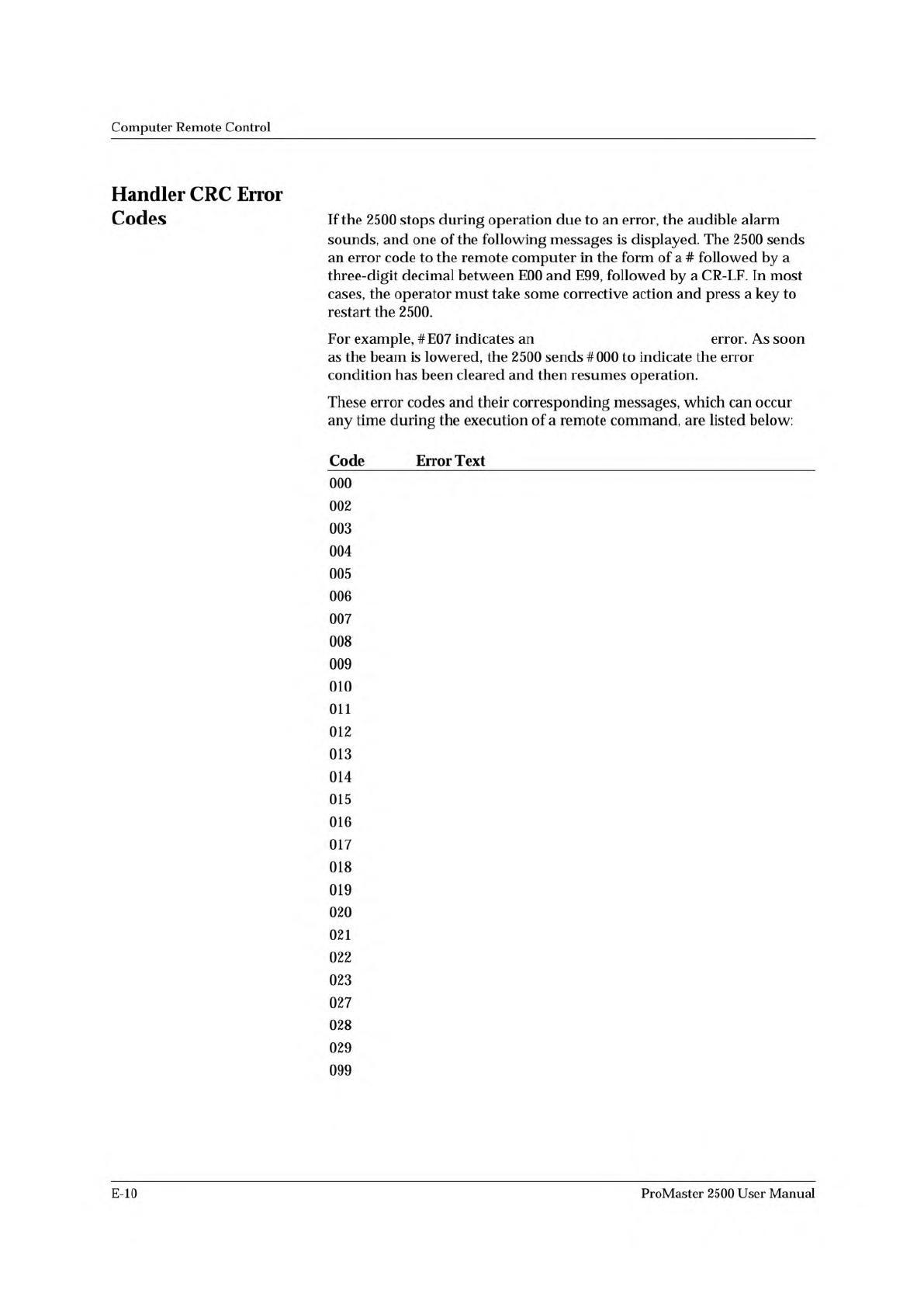
UN ABLE TO LO WER BEAM ERROR CLEARED. LABELS NOT CALIBRATED, PRESS START. ENTER DOT SPLIT VALUE. UNABLE TO PICK DEVICE, PRESS START. OUT OF LABELS, PRESS ST ART. TESTSITE CLAMP MALFUNCT ION, PRESS START. UNABLE TO LOWER …
Computer
Remote
Control
Response:
R16
(when
rotation
is
completed)
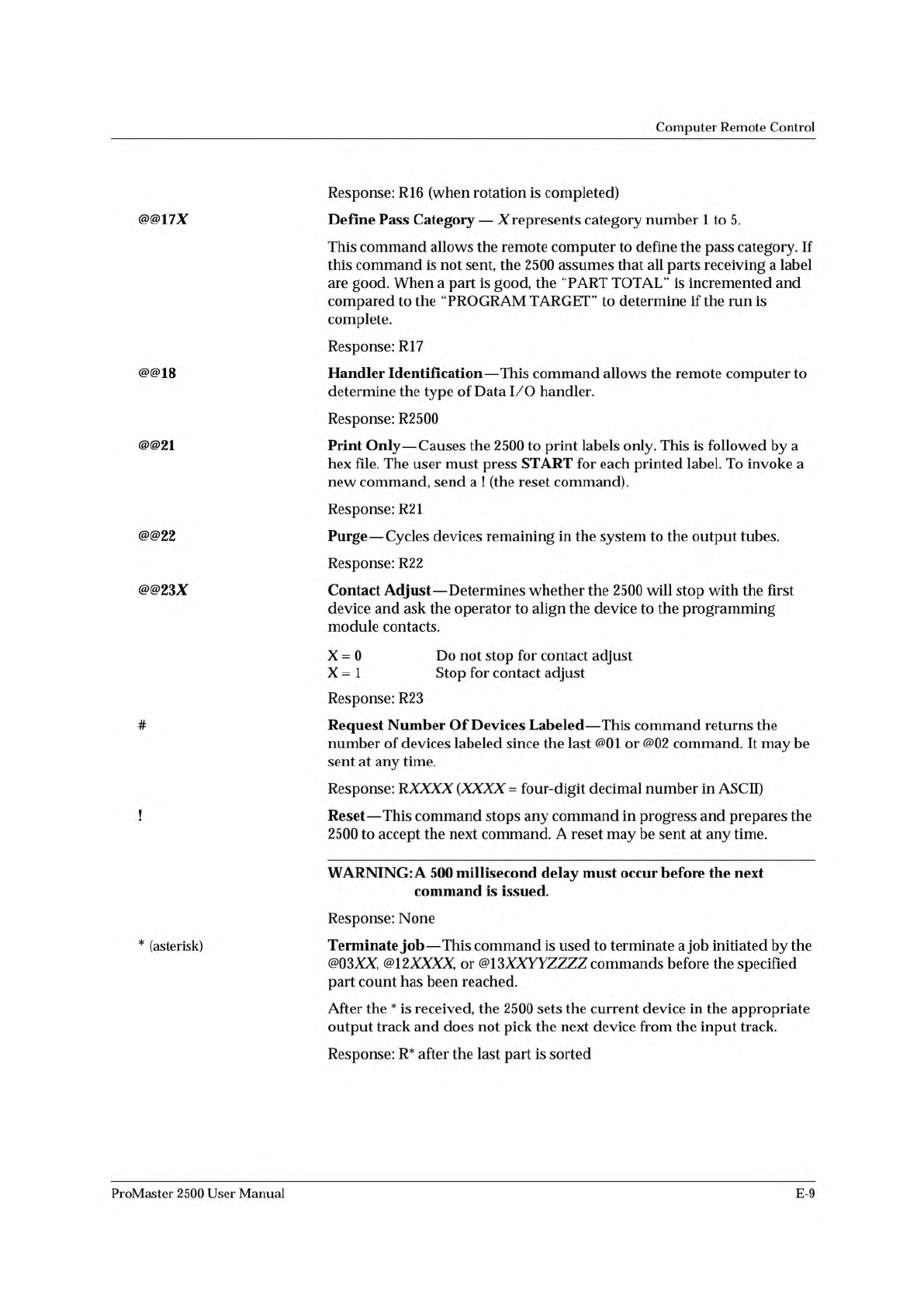
@@17X
Define
Pass
Category
—
X
represents
category
number
1
to
5.
This
command
allows
the
remote
computer
to
define
the
pass
category.
If
this
command
is
not
sent,
the
2500
assumes
that
all
parts
receiving
a
label
are
good.
When
a
part
is
good,
the
“PART
TOTAL”
is
incremented
and
compared
to
the
^PROGRAM
TARGET”
to
determine
if
the
run
is
complete.
Response:
R17
@@18
Handler
Identification
—
This
command
allows
the
remote
computer
to
determine
the
type
of
Data
I/O
handler.
Response:
R2500
@@21
Print
Only
—
Causes
the
2500
to
print
labels
only.
This
is
followed
by
a
hex
file.
The
user
must
press
START
for
each
printed
label.
To
invoke
a
new
command,
send
a
!
(the
reset
command).
Response:
R21
@@22
Purge
—
Cycles
devices
remaining
in
the
system
to
the
output
tubes.
Response:
R22
@@23X
Contact
Adjust
—
Determines
whether
the
2500
will
stop
with
the
first
device
and
ask
the
operator
to
align
the
device
to
the
programming
module
contacts.
X
=
0
Do
not
stop
for
contact
adjust
X
=
1
Stop
for
contact
adjust
Response:
R23
#
!
Request
Number
Of
Devices
Labeled
—
This
command
returns
the
number
of
devices
labeled
since
the
last
@01
or
@02
command.
It
may
be
sent
at
any
time.
Response:
RXXXX
(XXXX
=
four-digit
decimal
number
in
ASCII)
Reset
—
This
command
stops
any
command
in
progress
and
prepares
the
2500
to
accept
the
next
command.
A
reset
may
be
sent
at
any
time.
WARNING:
A
500
millisecond
delay
must
occur
before
the
next
command
is
issued.
Response:
None
*
(asterisk)
Terminate
job
—
This
command
is
used
to
terminate
a
job
initiated
by
the
@03XX,
@12XXXX,
or
@13XXYYZZZZ
commands
before
the
specified
part
count
has
been
reached.
After
the
*
is
received,
the
2500
sets
the
current
device
in
the
appropriate
output
track
and
does
not
pick
the
next
device
from
the
input
track.
Response:
R*
after
the
last
part
is
sorted
ProMaster
2500
User
Manual
E-9
UNABLE TO LOWER BEAM
ERROR CLEARED.
LABELS NOT CALIBRATED, PRESS START.
ENTER DOT SPLIT VALUE.
UNABLE TO PICK DEVICE, PRESS START.
OUT OF LABELS, PRESS START.
TESTSITE CLAMP MALFUNCTION, PRESS START.
UNABLE TO LOWER BEAM, PRESS START.
UNABLE TO RAISE BEAM.
BEAM MOTOR MALFUNCTION, PRESS KEY.
HANDLER PORT MALFUNCTION.
REMOTE COMPUTER NOT READY.
PROGRAMMER NOT READY.
INVALID PROGRAMMER RESPONSE, PRESS KEY.
PROGRAMMER NOT RESPONDING.
ERROR RECEIVED WHILE ATTEMPTING LOAD.
TARGET DEVICE COUNT ACHIEVED, PRESS KEY.
CHECKSUM ERROR.
INVALID DATA FORMAT.
DEVICE SIZE DATA RECORD IS MISSING.
DEVICE ROTATION DATA RECORD IS MISSING.
DEVICE ERROR CLEARED, PRESS START.
INPUT CAL ERROR, PRESS START.
OUTPUT CAL ERROR, PRESS START.
RECEIVING TUBE NOT AVAILABLE.
CATEGORY.
DEVICE JAM AT OUTPUT TUBE, PRESS START.
ILLEGAL REMOTE COMMAND.
Computer
Remote
Control
Handler
CRC
Error
Codes
If
the
2500
stops
during
operation
due
to
an
error,
the
audible
alarm
sounds,
and
one
of
the
following
messages
is
displayed.
The
2500
sends
an
error
code
to
the
remote
computer
in
the
form
of
a
#
followed
by
a
three-digit
decimal
between
E00
and
E99,
followed
by
a
CR-LF.
In
most
cases,
the
operator
must
take
some
corrective
action
and
press
a
key
to
restart
the
2500.
For
example,
#E07
indicates
an
error.
As
soon
as
the
beam
is
lowered,
the
2500
sends
#000
to
indicate
the
error
condition
has
been
cleared
and
then
resumes
operation.
These
error
codes
and
their
corresponding
messages,
which
can
occur
any
time
during
the
execution
of
a
remote
command,
are
listed
below:
Code
Error
Text
000
002
003
004
005
006
007
008
009
010
011
012
013
014
015
016
017
018
019
020
021
022
023
027
028
029
099
E-10
ProMaster
2500
User
Manual
Computer
Remote
Control
Hex
Label
Format
Label
Record
Content
Label
Record
Types
QO
Qi
The
Hex
Label
format
has
been
developed
to
encode
data
files
in
ASCII
format
to
transfer
between
the
Remote
RS
232c
port
on
the
2500
and
the
attached
computer
system.
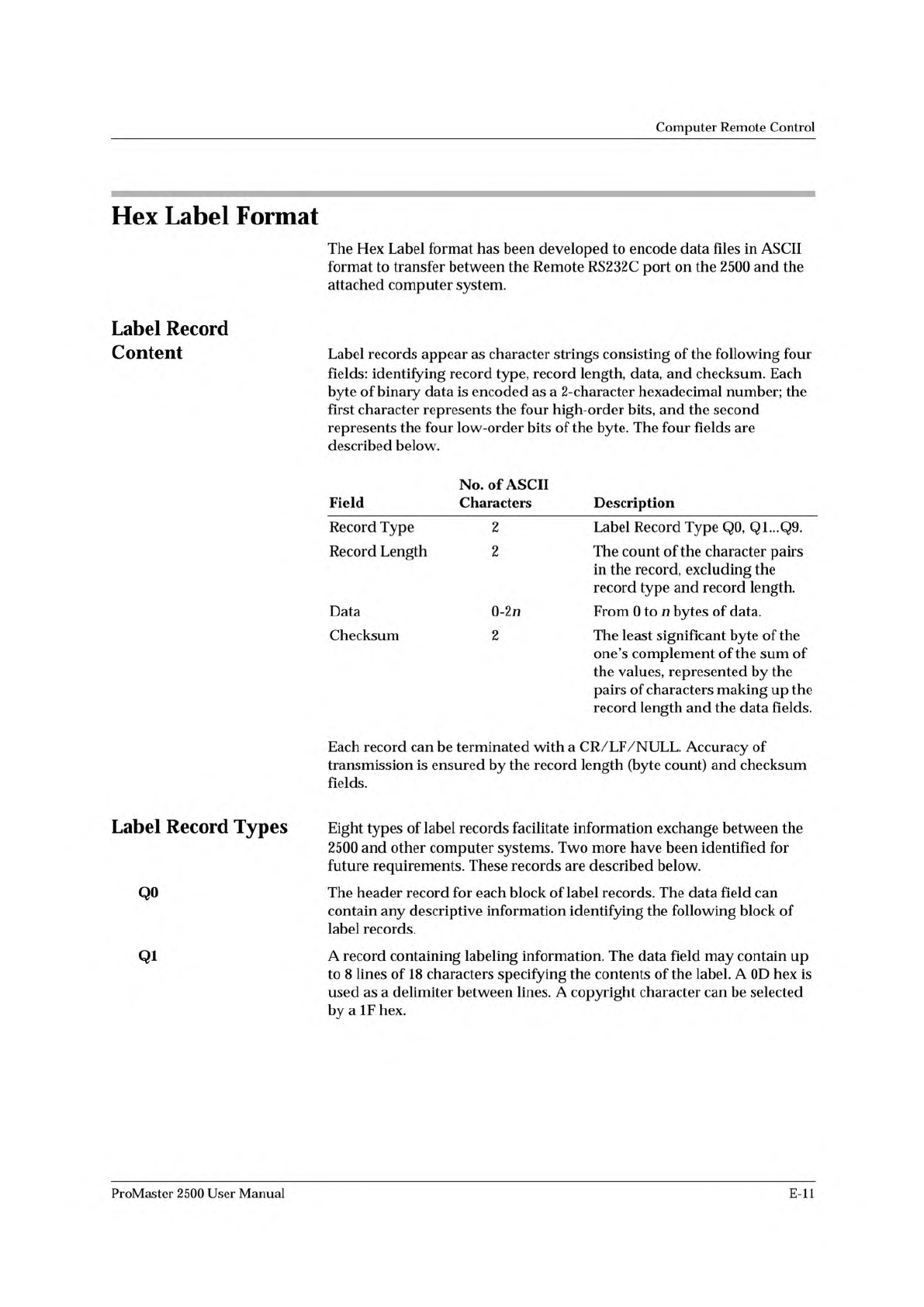
Label
records
appear
as
character
strings
consisting
of
the
following
four
fields:
identifying
record
type,
record
length,
data,
and
checksum.
Each
byte
of
binary
data
is
encoded
as
a
2-character
hexadecimal
number;
the
first
character
represents
the
four
high-order
bits,
and
the
second
represents
the
four
low-order
bits
of
the
byte.
The
four
fields
are
described
below.
Field
No.
of
ASCII
Characters
Description
Record
Type
2
Label
Record
Type
Q0,
Q1...Q9.
Record
Length
2
The
count
of
the
character
pairs
in
the
record,
excluding
the
record
type
and
record
length.
Data
0-2n
From
0
to
n
bytes
of
data.
Checksum
2
The
least
significant
byte
of
the
one's
complement
of
the
sum
of
the
values,
represented
by
the
pairs
of
characters
making
up
the
record
length
and
the
data
fields.
Each
record
can
be
terminated
with
a
CR/LF/NULL.
Accuracy
of
transmission
is
ensured
by
the
record
length
(byte
count)
and
checksum
fields.
Eight
types
of
label
records
facilitate
information
exchange
between
the
2500
and
other
computer
systems.
Two
more
have
been
identified
for
future
requirements.
These
records
are
described
below.
The
header
record
for
each
block
of
label
records.
The
data
field
can
contain
any
descriptive
information
identifying
the
following
block
of
label
records.
A
record
containing
labeling
information.
The
data
field
may
contain
up
to
8
lines
of
18
characters
specifying
the
contents
of
the
label.
A
0D
hex
is
used
as
a
delimiter
between
lines.
A
copyright
character
can
be
selected
by
a
IF
hex.
ProMaster
2500
User
Manual
E-ll