AQ-2 spec book LR.pdf - 第5页
Introducing the AQ-2 3 of 44 1.0 Introducing the AQ -2 F igure 1 With an equipment portfolio spanning semiconductor packaging, surface mount assembly and final assembly , Assembléon supplies equipment for the entire elec…

Contents
2 of 44
3.2 Toolbit Exchange Unit 24
3.3 Toolbits 25
3.3.1 Nozzles 25
3.3.2 Odd SMD Grippers 26
3.4 Reject Module 26
3.5 Accuracy Verification Set 26
3.6 Multi Language Support 27
3.7 Real Time MIS Data 27
3.8 Setup Verification System 27
3.9 BI/BTCO 29
3.10 Traceability 30
3.10.1 Board traceability 30
3.10.2 Batch traceability 31
3.11 Software interfacing 31
3.11.1 AQ Data interface 31
3.11.2 SECS/GEM 33
3.12 Production Preparation System (PPS-Pro) 33
4.0Technical Specifications 35
4.1 Placement Accuracy & Reliability 35
4.2Flexibility 35
4.3 Placement Output 36
4.4 Circuit Boards 36
4.5 Standards 37
4.6 Components 37
5.0Configuration 38
5.1Configuration Flexibility 38
5.2AQ-2 System tree 38
6.0 Installation requirements 42
6.1 Installation tooling 42
Introducing the AQ-2
3 of 44
1.0 Introducing
the AQ-2
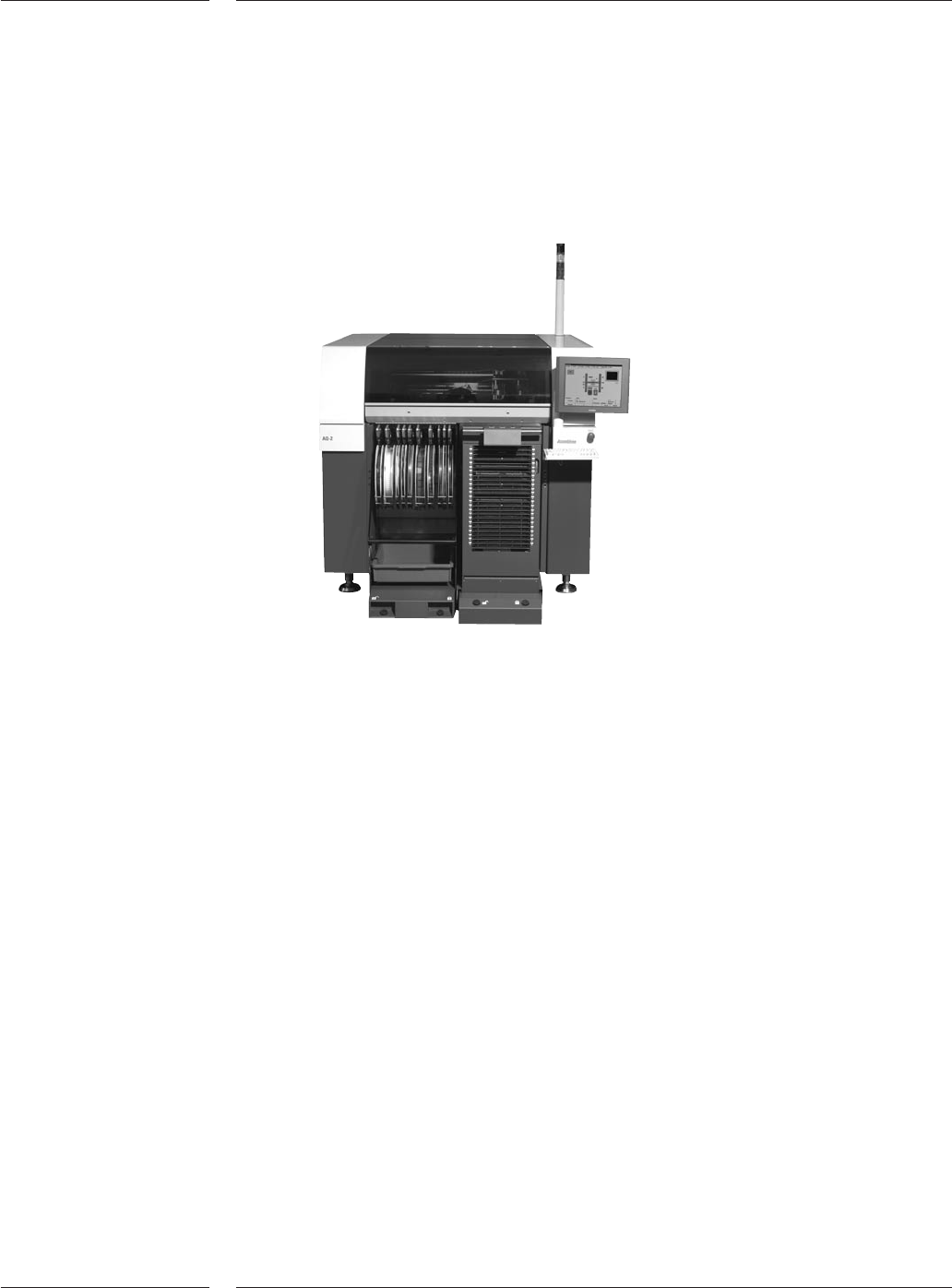
Figure 1
With an equipment portfolio spanning semiconductor packaging, surface mount
assembly and final assembly, Assembléon supplies equipment for the entire electronics
assembly marketplace. The AQ-2 offers superior placement accuracy, unchallenged
component range, and the lowest cost per placement. Supported by an award-winning
support infrastructure, Assembléon ensures a quick ramp with sustained performance
throughout the product lifecycle, anywhere in the world.
The AQ-2
Ideally suited for surface mount placement, the AQ-2 is a versatile machine rated at 5300
placements per hour in standard or unique applications including components ranging
from large ICs like PLCCs, QFPs, or BGAs, to thin, fine-pitch CSPs. The machine strength,
however, is its open architecture and modular construction, which allows the AQ-2 to
accommodate limitless applications. To strengthen a return on investment (ROI)
justification or to change the fundamental nature of the machine, a manufacturer can
easily add machine modules on the factory floor to enable 50mm (2.0”) tall, 165mm (6.5”)
long odd-shaped components such as snap-fit connectors for automotive sub-system or
computer motherboard applications.
Secured atop a rigid, vibration-free base frame designed for enduring accuracy and
stability, the AQ-2 features a patented “H-Drive” linear motor configured with dual
placement heads, which flank a digital downward looking board alignment vision
system. The H-Drive travels along the X-axis and Y-axis, while the substrate and feeders
remain stationary on the front-side of the machine. Assembléon has simplified product
changeover and off-line set-up with removable feeder and matrix tray trolleys, as well as
automatic board width adjustment from 50mm square (2”) up to 508 x 460 mm
(20” x 18”) (LxW).
Each closed-loop servo controlled placement head utilizes the patented “Duplo”
telescoping toolbit design, which features an inner and outer nozzle for handling small
and large components without visiting the automatic toolbit exchange unit. Although
the unique Duplo toolbit minimizes the need for toolbit changes, the AQ-2 easily swaps
nozzles anytime throughout a program. Complementing the array of standard and
specialized vacuum nozzles, the AQ-2 also supports an interchangeable mechanical
gripper suitable for use with the toolbit exchange unit.
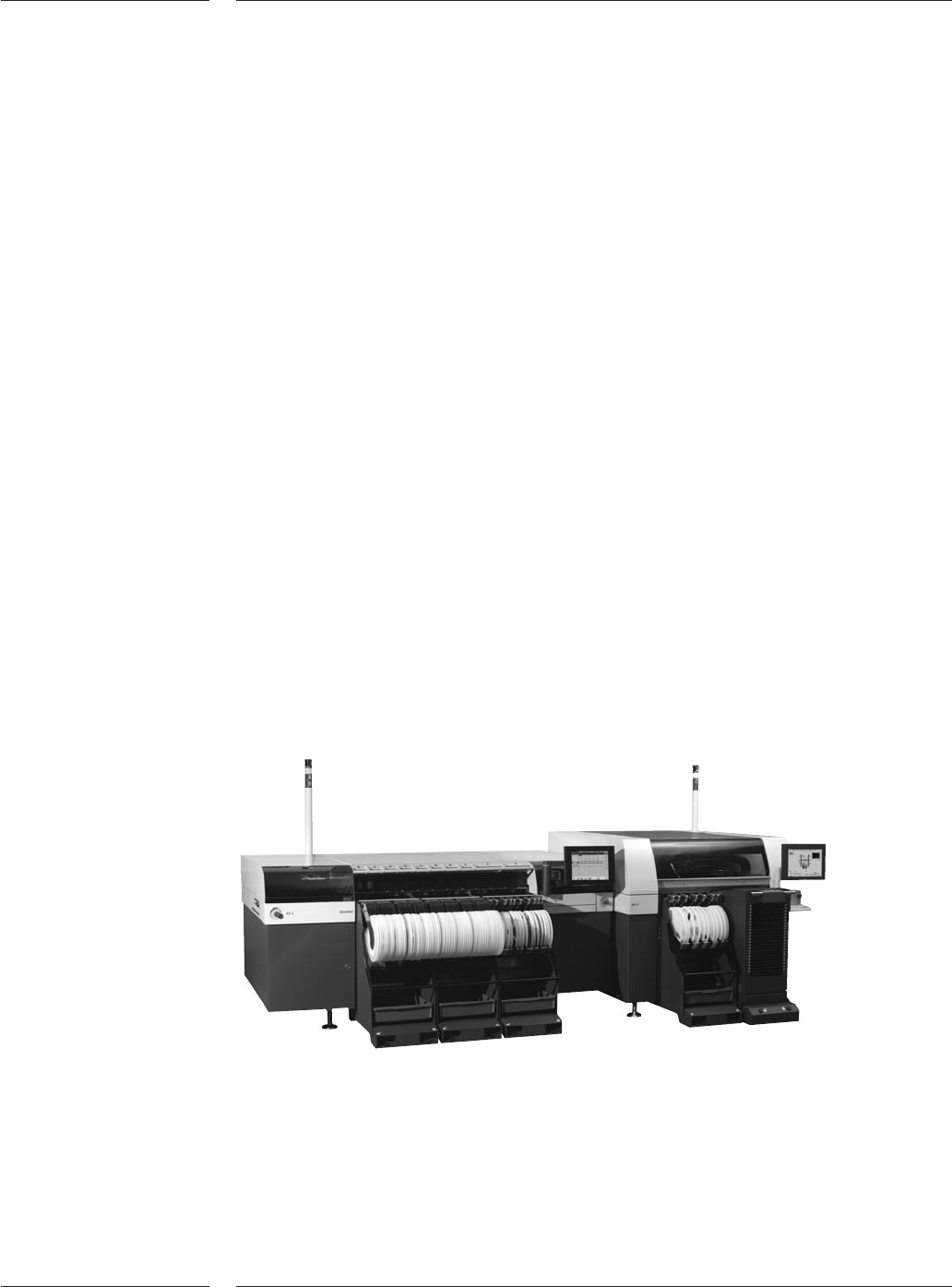
Figure 2
The AQ-2 digital vision system requires only two CCD-based component alignment
systems – LFOV and SFOV – to handle the entire range of components. Including light,
dark field, mid field and bright field illumination, the camera addresses the entire range
of leaded and array surface mount components. From a 45mm (1.8”) square IC with
0.15mm (0.006”) leads, to a 22mm (0.9”) square CSP with a bump diameter of 0.080mm
(0.003”) in a single field of view. Larger parts can also be mounted. The AQ-2 provides
unsurpassed vision capabilities. Considering the ability to combine the aforementioned
illumination styles with various levels of illumination intensity, the AQ-2 ensures the
optimal lighting scheme for any component from ceramic BGA to high reflective odd
components. Moreover, the component alignment system detects missing, bent, or
irregularly spaced leads and bumps; the machine places defective components into a
matrix reuse bin or simply dumps each into a bin.
Up to 94 8mm tapes in 48 twin tape feeders, or 188 JEDEC trays (or up to 376 other trays),
or a combination of 48 8 mm tapes and 94 JEDEC trays can be loaded on the AQ-2. The
open architecture allows the machine to employ feeders for tape, tube, tray and many
other feeder style, like GPAX feeders for odd form parts like USB Jacks or waffle pack
feeders for advanced array packages like CSPs. An off-line feeder set-up and rapid
product changeover is quickly achieved with the common A-Series feeder trolley system.
Operators easily exchange entire feeder banks to ensure a high level of machine
utilization. Additionally, the AQ-2 will automatically verify the trolley position and pick
height, then compensate accordingly to ensure repeatable positioning of the new feeder
module – another quick changeover and system stability feature of the AQ-2.
A controller, running a user-friendly Graphical User Interface allows manufacturers to
use the AQ-2 as a standalone machine or in-line with other production equipment. The
controller includes a Management Information System (MIS) that continuously gathers
production data for management feedback and performance tracking. The AQ-2 bad
mark sensing capabilities afford the use of board (global) and circuit (local) marks to
ensure that only good boards are populated.
A-Series flowline with AX-3 and AQ-2
The AQ-2 is fully compatible with the AX-series, which use the same feeder trolleys, tape
feeders and vision system. Ideally complementing the AX machine in medium to high
volume, low to high mix environment production, the A-Series line is suited for a wide
range of applications.
Introducing the AQ-2
4 of 44