00198654-01_UM_Nozzle_Cleaning_Station_EN.pdf - 第18页
2 Operational safety 2.5 Residual risks 18 User Manual SIPLACE Nozzle Cleaning Station 09/2019 2.5 Residual risks Residual risks occur through operating errors or the misuse of the machine by its operator. The highest ri…

2 Operational safety
2.4 Safety features
User Manual SIPLACE Nozzle Cleaning Station 09/2019 17
Start / stop button shaft cleaning, white
This button is used to start / stop the shaft cleaning process where a magazine was inserted.
► Press the button and then let go. The cleaning process is switched on.
► Press the button for at least 5 s to stop the cleaning process.
Start / stop buttons tip cleaning, white
These buttons are used to start / stop the tip cleaning process in the respective cleaning module.
► Press the button and then let go. The cleaning process is switched on.
► Press the button for at least 5 s to stop the cleaning process.
Reset button, blue
This button is used to activate the machines safety system.
EMERGENCY STOP button with forced locking
The EMERGENCY STOP button is red and latches in the ON position when pressed. When you
press the EMERGENCY STOP button, the message "EMERGENCY STOP pressed" appears on
the screen. The following modules are deactivated:
●
Pumps
●
Compressed air supply for the shaft cleaning modules
Position switches
This position switch check whether the protective circuit is open or closed. The position switches
trigger the safety cutoff (lock) when the protective cover or the doors at the back are opened. Indi-
vidual components are disabled or remain enabled.
Safety component inspection intervals and procedures
A check of all safety system components in the automatic and manual (service) modes is recom-
mended to be done by the operator at least once per working shift. The functional testing of the
ESS requires the machine operator to operate each ESS individually. Operating each ESS should
trip the machine's safety system and stop the entire machine. Next, turn the “mushroom button” of
the ESS which has been activated to release it and activate the safety system by pressing RESET.
If an ESS fails to trip the machine's safety system or the safety system cannot be activated once
the ESS has been released, the ESS has failed, and must be immediately replaced.
2 Operational safety
2.5 Residual risks
18 User Manual SIPLACE Nozzle Cleaning Station 09/2019
2.5 Residual risks
Residual risks occur through operating errors or the misuse of the machine by its operator. The
highest risk of hazard exists when the following prohibited actions are attempted:
●
Operating the machine contrary to its intended use
●
Unauthorized modifications or repairs to the machine
●
Operating the machine with faults or malfunctions
●
Safety requirements are disregarded
●
Recommended safety working garments are not worn
●
The machine is operated with its guards open or missing.
●
Compliance with these guidelines ensures effective residual risk reduction.
●
Read the Operating Instructions carefully.
●
Do not attempt any unauthorized modifications or repairs of the machine.
●
Have all repairs done by authorized personnel only.
●
Have the machine operated only by personnel who have read and understood the Operating
Instructions.
●
The personnel must be trained in health-and-safety rules and the application thereof at work.
●
Compliance with the guidance and warning messages shown by the safety symbols and
signs.
●
Barring access to and the operation of the machine by unauthorized personnel.
Any failure to comply with these guidelines can cause the following hazards.
●
Injury by burns
●
The operator’s tripping or falling
●
Electric shock or electrocution
●
Crush injuries
●
Injuries from the washing fluid at high pressure
DANGER
Failure to comply with the prohibitions and guidance provided herein can result in
residual risks!
2 Operational safety
2.6 Disabling the compressed air supply and discharging the pressure
User Manual SIPLACE Nozzle Cleaning Station 09/2019 19
2.6 Disabling the compressed air supply and discharging the
pressure
CAUTION
Risk of injury from compressed air!
Risk of injury when disconnecting the compressed air lines.
► Never disconnect compressed air lines while they are still pressurized.
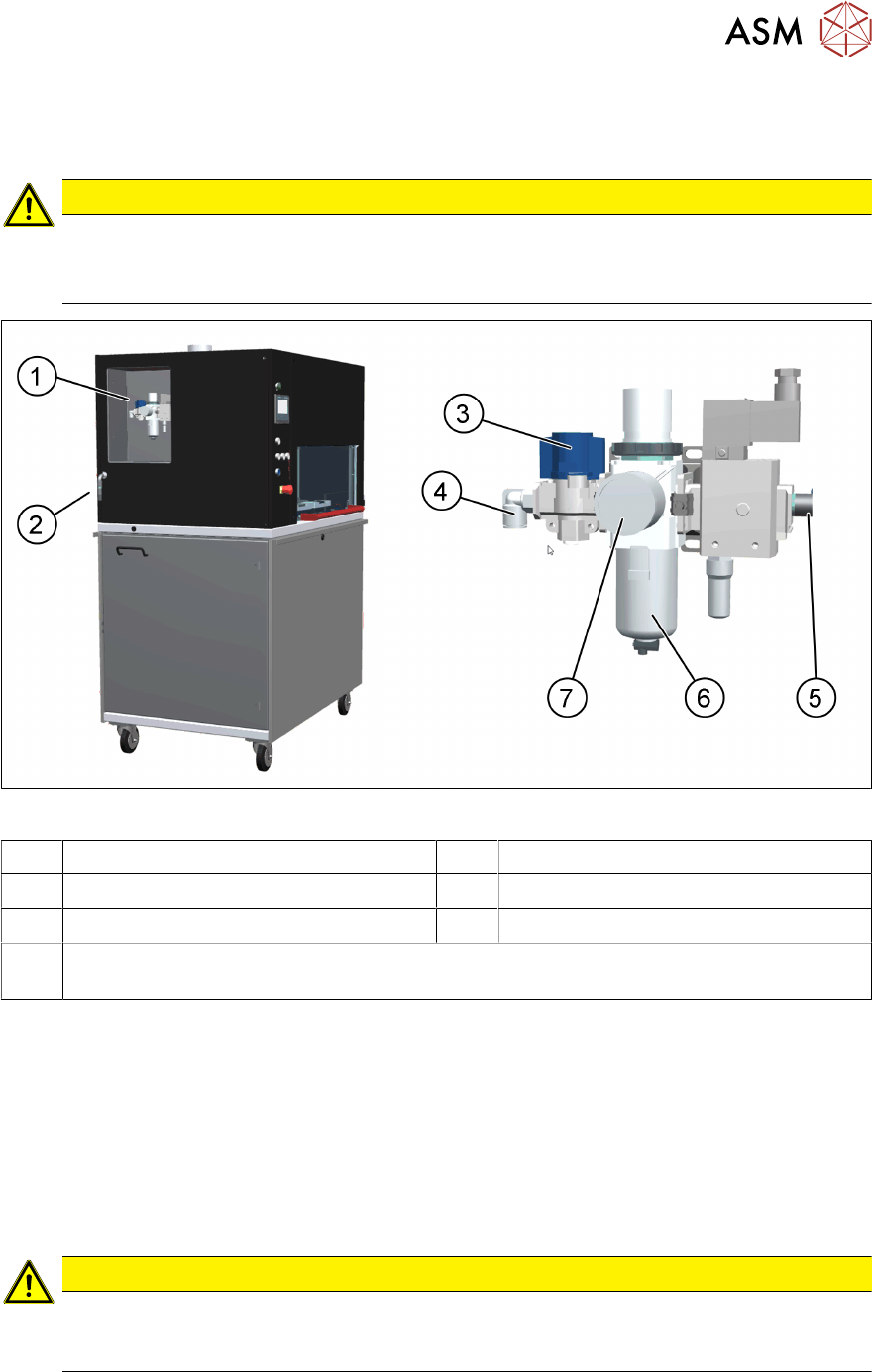
Fig.6: NCS - compressed air unit
1 Location of the compressed air unit 2 Compressed air connection
3 Stop valve in the "CLOSED" position 4 Compressed air supply
5 Compressed air supply for cleaning 6 Compressed air filter
7 Manometer for the nozzle cleaning station supply pressure
Target pressure: 0.50 ± 0.01MPa, 5.0 ± 0.1bar (display range 0–1.0MPa, 0–10bar)
The compressed air working pressure of the nozzle cleaning station is set to 0.51 ± 0.01 MPa (5.1
± 0.1bar). The position of the compressed air unit is shown below. The supply of compressed air to
the nozzle cleaning station can be interrupted with the shutoff valve(3).
► Turn the lever of the shutoff valve(3) to the right.
► Monitor the operating pressure manometer(5). When the nozzle cleaning station switched off,
the pressure discharges to 0MPa (0bar) within 1minute.
2.7 Safety instructions on hazardous materials
CAUTION
Observe the safety data sheets
Observe the applicable safety data sheet, when handling hazardous materials (e. g. Vigon
SC or KG15+).