00193891-0702_AI_LP_Barcode_DE+EN.pdf - 第256页
2 PCB barcode scanner assembly instructions SIPLACE 2.11 PCB barcode scanner configuration 10/2009 Edition 256 2.1 1.7.15 Possible sources of error 1. Problems establ ishing a connection – Check the port ID and add ress …
SIPLACE 2 PCB barcode scanner assembly instructions
10/2009 Edition 2.11 PCB barcode scanner configuration
255
: Click on OK.
: The FTP Image program does not have to be open - it can run in background mode.
Th
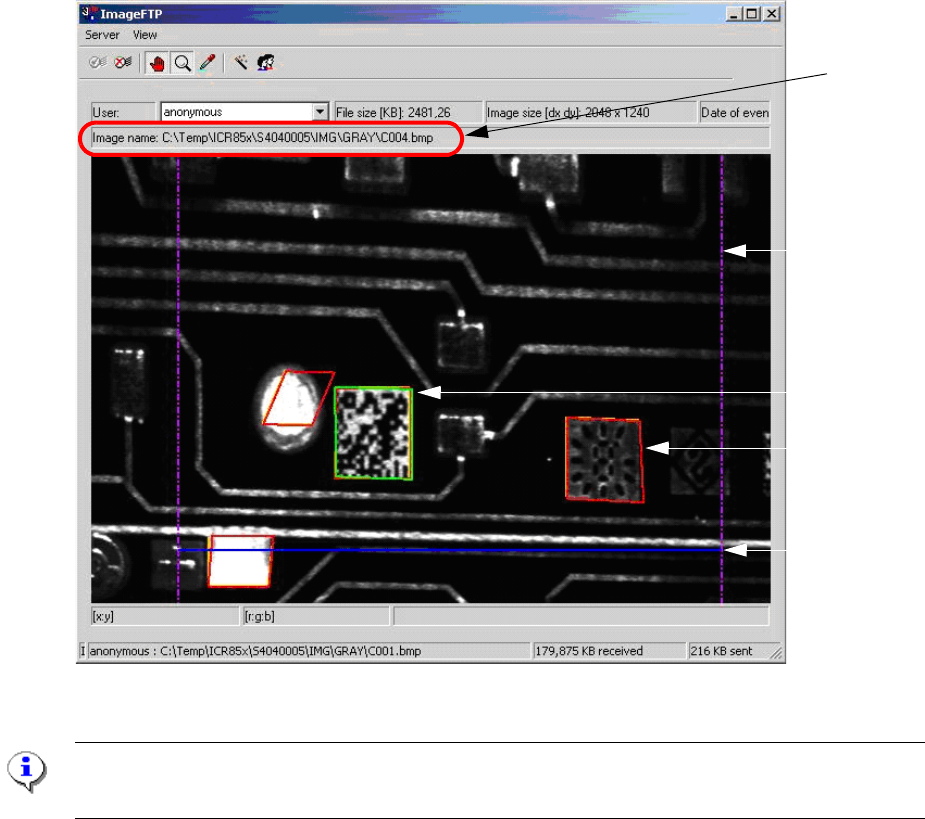
e "Diagnostic data" field in the "Image Acq." menu
can be activated for diagnostic purposes.
The analysis range (lilac lines), the invalid scan attempt
s (red lines) and the successful decoding
of the barcode (green line) are shown directly in the image.
The blue line indicates the end of the scanning process.
Blue line
Lilac line
Green line
Red line
Previously
set path
Fig. 2.11 - 51 Representation of a scanned barcode with diagnostic data
PLEASE NOTE:
The colored lines are only displayed i "Diagnostic data" was ticked under "Image request".

2 PCB barcode scanner assembly instructions SIPLACE
2.11 PCB barcode scanner configuration 10/2009 Edition
256
2.11.7.15 Possible sources of error
1. Problems establishing a connection
– Check the port ID and address
– Check cross-over cables
– With XP, deactivate and reactivate the network card (or reboot on an NT computer)
NOTE:
When you unplug the LAN cable, the connection on the CLV software remains "green".
When you plug in the LAN cable again, the connection must be established again.
Interface --> Options --> OK.
2.Problems snapping and assessing images
– The number of rows must be s
et to at least 4000
– Wait on external trigger
– The barcode to be read should be as close as possible to the beam
– Check the scanning distance if the image is fuzzy
3.Communication Monitor
– Host Interface: Set output to Ethernet. It is impo
rt
ant for production to reset it back to
Asynch. Host Interface.
– No result: Check the port ID or restart the program
– Quality assessment output
4.Barcode is not decoded
– Check the object velocity
– Check the cell size
5.Wrong or missing barcode in Sitest
– Enter /GN (enter again if you are in any do
ubt [se
lect from the list]) or check CR.
6.Auto Setup
– The barcode to be taught must be close to th
e scan
ning beam, as when snapping an image.
– The object velocity must b
e roughly correct
SIPLACE 2 PCB barcode scanner assembly instructions
10/2009 Edition 2.11 PCB barcode scanner configuration
257
7.General notes
– The beam hits the PCB at an angle of approx.15°
from the vertical if the scanner is installed
plane-parallel to the object surface. If the angle is less than 15°, the reflection is greater.
From around 5°, a total reflection occurs ==> And the barcode can no longer be read.
To minimize unwanted reflection
s, the barcode scanner should be fitted so that the scan-
ning beam hits at an angle of between 15° and 30°.
– The Sick programming software can be used to create an image of the barcode. This image
ca
n be used to assess whether the set speed is correct. If the speed set in the CLV software
is too fast, then the barcode will appear stretched on the image. If the speed is too slow,
then the barcode will appear squashed.
– With the recorded image, the minimu
m/maximum code position should be set as accurately
as possible to hide any unwanted structures (e.g.PCB conveyor side wall) and thus reduce
the analysis time of the barcode scanner.
– With Data Matrix code, the continuous delimiting line determines the size and angular po-
sition of the barcode. The opposite "black-white" pattern identifies the cell size and the num-
ber of cells. This edge area must not be disturbed or damaged. There must also be a "rest
zo
ne" one cell in size around the barcode. This zone must not contain any unwanted struc-
tures. (Otherwise the barcode position cannot be detected reliably).
There must only be one barcode in the template window (limit the template window) other-
wise you cannot be certain which barcode was found and decoded.
– Distribution board: Unwanted terminals (e.g. X2-
X4) must be bypassed by setting the
switch to ON.