00194932-20 User Manual CAN Test Box-Error Frame Diagnostic unit_en.pdf - 第14页
1 - 14 SIPLACE CAN Bus Edition 10/2018 14 2.3 CAN T est Box Connections Fig. 2.3 - 1 CAN T est Box connections (1) Switch for setting the bau d rate to 1 MBit or 500 kBit (2) Switch for enabling an additional 120 Ohm res…
1 - 13
Edition 10/2018 SIPLACE CAN Bus
13
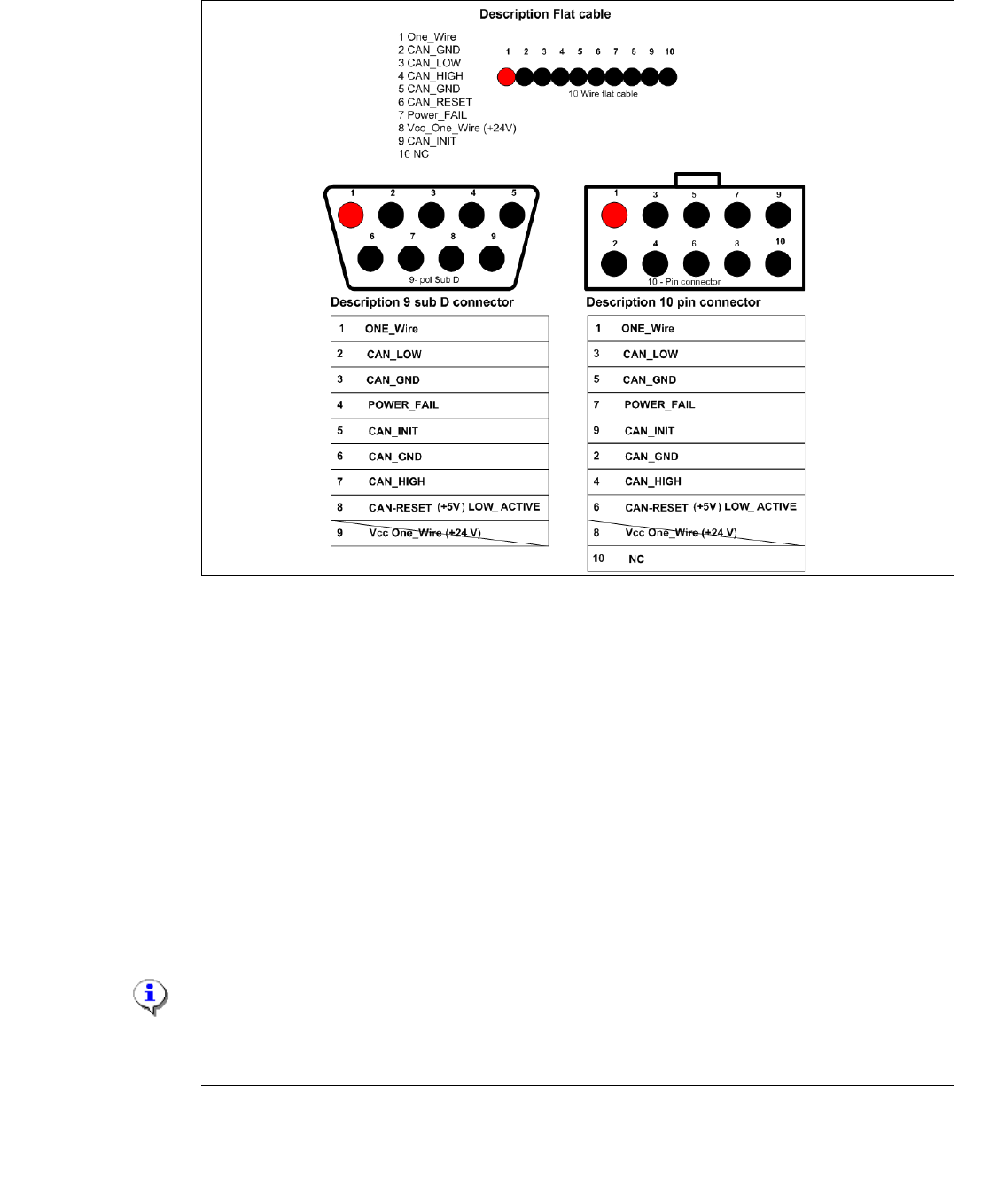
2.2 CAN Bus Signal Assignment
Fig. 2.2 - 1 Signal assignment at the different connectors
– CAN_INT – not in use (+5V)
– Power Fail – triggers recording of operating data at the placement head (+5V)
– CAN RESET – not in use (+5V) (HS50/60 use the signal for the Tape cutter and component
table)
– CAN HIGH - 2,5 +/– 0,3 V recessive level (machine in idle mode)
– CAN LOW - 2,5 +/– 0,3 V recessive level (machine in idle mode)
– CAN GND - Can bus ground
– Vcc 24V - for nozzle changers - no longer available after the above mentioned conversions
– One wire - only applies to HF series, in the machine CAN bus cable
Note:
Since the X-Series S and following (SX and TX), only the communication of the CAN bus takes
place via the CAN bus cable. That CAN_H and CAN_ L signal with CAN_GND, pin assignment
see picture above.
1 - 14
SIPLACE CAN Bus Edition 10/2018
14
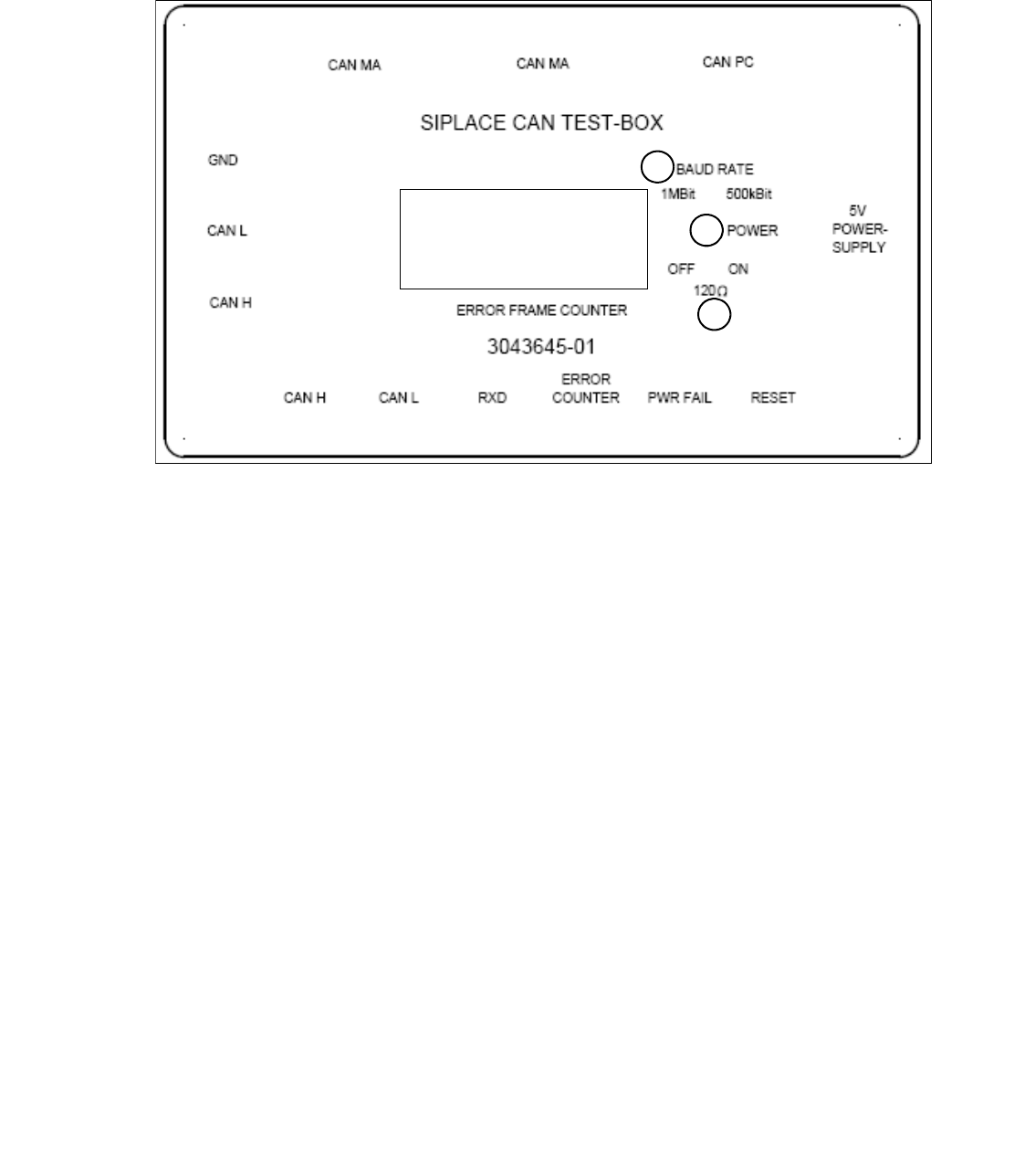
2.3 CAN Test Box Connections
Fig. 2.3 - 1 CAN Test Box connections
(1) Switch for setting the baud rate to 1 MBit or 500 kBit
(2) Switch for enabling an additional 120 Ohm resistance.
(3) Power LED to show the power supply state (green = power on)
– 5V voltage supply from the axis card or external power pack
– CAN BUS PC connection PC (Sub D female connector). Only the CAN High, CAN Low and
GND signals are run to the PC (Kvaser card), preventing PC-card corruption.
– CAN BUS_MA connection to the machine, COM assembly (Sub D female connector)
– CAN BUS_MA connection to the machine, COM assembly (Sub D male connector)
– Banana jack for CAN High measurement of recessive CAN bus level against CAN GND
– Banana jack for CAN Low measurement of recessive CAN bus level against CAN GND
– Banana jack for CAN GND ground CAN bus
– BNC socket for CAN High
– BNC socket for CAN Low
– BNC socket RxD shows the combination of CAN High and CAN Low signals to a TTL level, as
read by the CAN telegram processor.
– BNC socket for Error Counter from display
Error Frame Counter
Display
1
3
2
1 - 15
Edition 10/2018 SIPLACE CAN Bus
15
– BNC socket for power fail to check of the level in the line (4,0 - 5,0 V).
– BNC socket for CAN reset to check of the level in the line (4,0 - 5,0 V).
2.4 Checking the Terminating Resistors
To avoid reflection in the CAN lines, a 120 Ohm terminating resistor must be placed at each end
of the CAN bus wire, between CAN_H and CAN_L. A correctly closed CAN bus will have a resis-
tance value of 60 Ohm. An additional terminating resistor reduces the overall resistance to 40
Ohm.
If the resistors are not placed at the end points, the CAN lines will experience reflections. The ef-
fect of incorrect terminating resistors can be seen in the appropriate diagram in this chapter.
Step by step: 2
Attention: 2
When connecting the CAN Test Box, make sure the switches for the baud rate and terminating
resistors are set to the correct values (default setting for the terminating resistor is OFF)
(see Fig. 2.3 - 1 number 2).
Note:
Make sure that the machine is switched off before measurement is performed!
Attention: 2
Connection the CAN Test Box: To measure all signals on the CAN Test Box you have to use a
CAN Test cable connect directly on the COM board, connect the machine CAN cable on the
testing cable and then the CAN Test box.
On the Service connector are not all signals!
– Connect the CAN Test Box to the service plug (Note: Not all signals on the Service plug) of the
COM assembly.
– Measure the CAN bus resistance at the banana sockets between CAN H and CAN L, with the
help of a measuring device.
A correct CAN bus resistance will have a value of 60 Ohm.
If errors occur, check the resistors.
Note: