IPC-7721(S).pdf - 第25页
damage EOS sensitive components or could cause injury to personnel. Most ESD specifications also require these poten- tials to be electrically common. The use of ground fault inter- rupter (GFI) electrical outlets at EOS…

Static dissipative materials have enough conductivity to
allow applied charges to dissipate over the surface relieving
hot spots of energy. Parts leaving an EOS/ESD protected
work area must be overpacked in static shielding materials,
which normally also have static dissipative and antistatic
materials inside.
Do not be misled by the ‘‘color’’ of packaging materials. It is
widely assumed that ‘‘black’’ packaging is static shielding or
conductive and that ‘‘pink’’ packaging is antistatic in nature.
While that may be generally true, it can be misleading. In addi-
tion, there are many new clear materials now on the market
that may be antistatic and even static shielding. At one time,
it could be assumed that clear packing materials introduced
into the manufacturing operation would represent an EOS/
ESD hazard. This is not necessarily the case now.
Caution: Some static shielding and antistatic materials and
some topical antistatic solutions may affect the solderability of
assemblies, components, and materials in process. Select
only non-contaminating packaging and handling materials for
in-process assemblies and use them with regard for the ven-
dors instructions. Solvent cleaning of static dissipative or anti-
static surfaces can degrade their ESD performance. Follow
the manufacturers recommendations for cleaning.
2.1.3 Anti-Static Work Station
An EOS/ESD safe work station prevents damage to sensitive
components from spikes and static discharges while opera-
tions are being performed. Safe work stations should include
EOS damage prevention by avoiding spike generating repair,
manufacturing or testing equipment. Soldering irons, solder
extractors and testing instruments can generate energy of suf-
ficient levels to destroy extremely sensitive components and
seriously degrade others.
For ESD protection, a path-to-ground must be provided to
neutralize static charges that might otherwise discharge to a
device or assembly. ESD safe work stations also have static
dissipative or antistatic work surfaces which are connected to
a common ground. Provisions are also made for grounding
the worker’s skin, preferably via a wrist strap to eliminate
charges generated on the skin or clothing.
Provision must be made in the grounding system to protect
the worker from live circuitry as the result of carelessness or
equipment failure. This is commonly accomplished through
resistance in line with the ground path, which also slows the
charge decay time to prevent sparks or surges of energy from
ESD sources. Additionally, a survey must be performed of the
available voltage sources that could be encountered at the
work station to provide adequate protection from personnel
electrical hazards.
For maximum allowable resistance and discharge times for
static safe operations, see Table 3.
Note: the selection of resistance values are to be based on
the available voltages at the station to ensure personnel safety
as well as to provide adequate decay or discharge time for
ESD potentials.
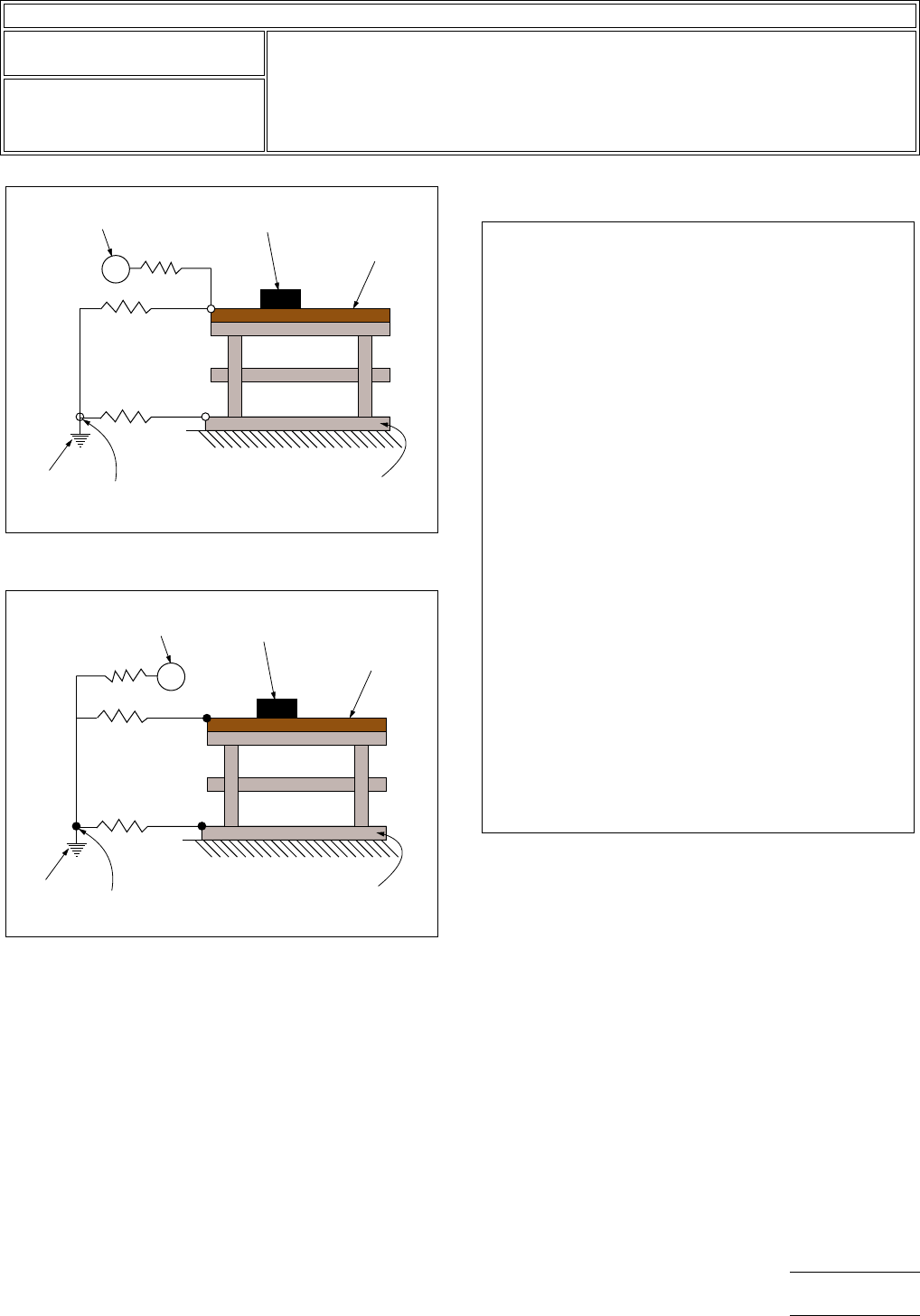
Examples of static safe work stations are shown in Figures 2
and 3. When necessary, air ionizers may be required for more
sensitive applications. The selection, location, and use proce-
dures for ionizers must be followed to ensure their effective-
ness.
Keep static dissipative or antistatic work station(s) free of
static generating materials such as styrofoam, plastic solder
removers, sheet protectors, plastic or paper notebook folders,
and employees personal items.
Periodically check EOS/ESD work stations to make sure they
work. EOS/ESD assembly and personnel hazards can be
caused by improper grounding methods or by an oxide
build-up on grounding connectors. Tools and equipment must
be periodically checked and maintained to ensure proper
operation.
Particular care must be given to ‘‘third wire’’ ground termina-
tions. Frequently, instead of being at workbench or earth
potential, the third wire ground may have a ‘‘floating’’ poten-
tial of 80 to 100 volts. This 80 to 100 volt potential between
an electronic assembly on a properly grounded EOS/ESD
work station and a third wire grounded electrical tool may
Table 3 Maximum Allowable Resistance and
Discharge Times for Static Safe Operations
Reading from
Operator
Through
Maximum
Tolerable
Resistance
Maximum
Acceptable
Discharge Time
Floor mat to
ground
1000 megohms Less than 1 sec.
Table mat to
ground
1000 megohms Less than 1 sec.
Wrist strap to
ground
100 megohms Less than 0.1 sec.
IPC-7721
Number: 2.1
Revision:
Date: 2/98
Subject: Handling Electronic Assemblies
Page4of8
damage EOS sensitive components or could cause injury to
personnel. Most ESD specifications also require these poten-
tials to be electrically common. The use of ground fault inter-
rupter (GFI) electrical outlets at EOS/ESD workstations is
highly recommended.
2.1.4 Physical Handling
Care must be taken during acceptability inspections to ensure
product integrity at all times. Table 4 provides general guid-
ance.
Physical Damage
Improper handling can readily damage components and
assemblies (e.g., cracked, chipped or broken components
and connectors, bent or broken terminals, badly scratched
board surfaces and conductor lands). Physical damage of this
type can ruin the entire assembly or attached components.
Contamination
Contamination by handling with bare hands or fingers without
some form of protection causes soldering and coating prob-
lems; body salts and oils, and unauthorized hand creams are
typical contaminants. Body oils and acids reduce solderability,
promote corrosion and dendritic growth. They can also cause
poor adhesion of subsequent coatings or encapsulates.
Lotion formulated specifically for use in solder assembly areas
is available. Normal cleaning procedures will not always
IPC-610-002
Figure 2 Target condition EOS/ESD Workstation
Building Floor
Common
Ground Point
Ground
Personal
Wrist Strap
EOS Protective
Trays, Shunts, etc.
EOS Protective
Table Top
EOS Protective
Floor or Mat
1 M Ohm 10%
1 M Ohm 10%
1 M Ohm 10%
IPC-610-003
Figure 3 Acceptable EOS/ESD Workstation
Building Floor
Common
Ground Point
Ground
Personal
Wrist Strap
EOS Protective
Trays, Shunts, etc.
EOS Protective
Table Top
EOS Protective
Floor or Mat
1 M Ohm 10%
1 M Ohm 10%
1 M Ohm 10%
Table 4 General Rules for
Handling Electronic Assemblies
1. Keep work stations clean and neat. There must not be
any eating, drinking, or use of tobacco products in the
work area.
2. Minimize the handling of electronic assemblies and
components to prevent damage.
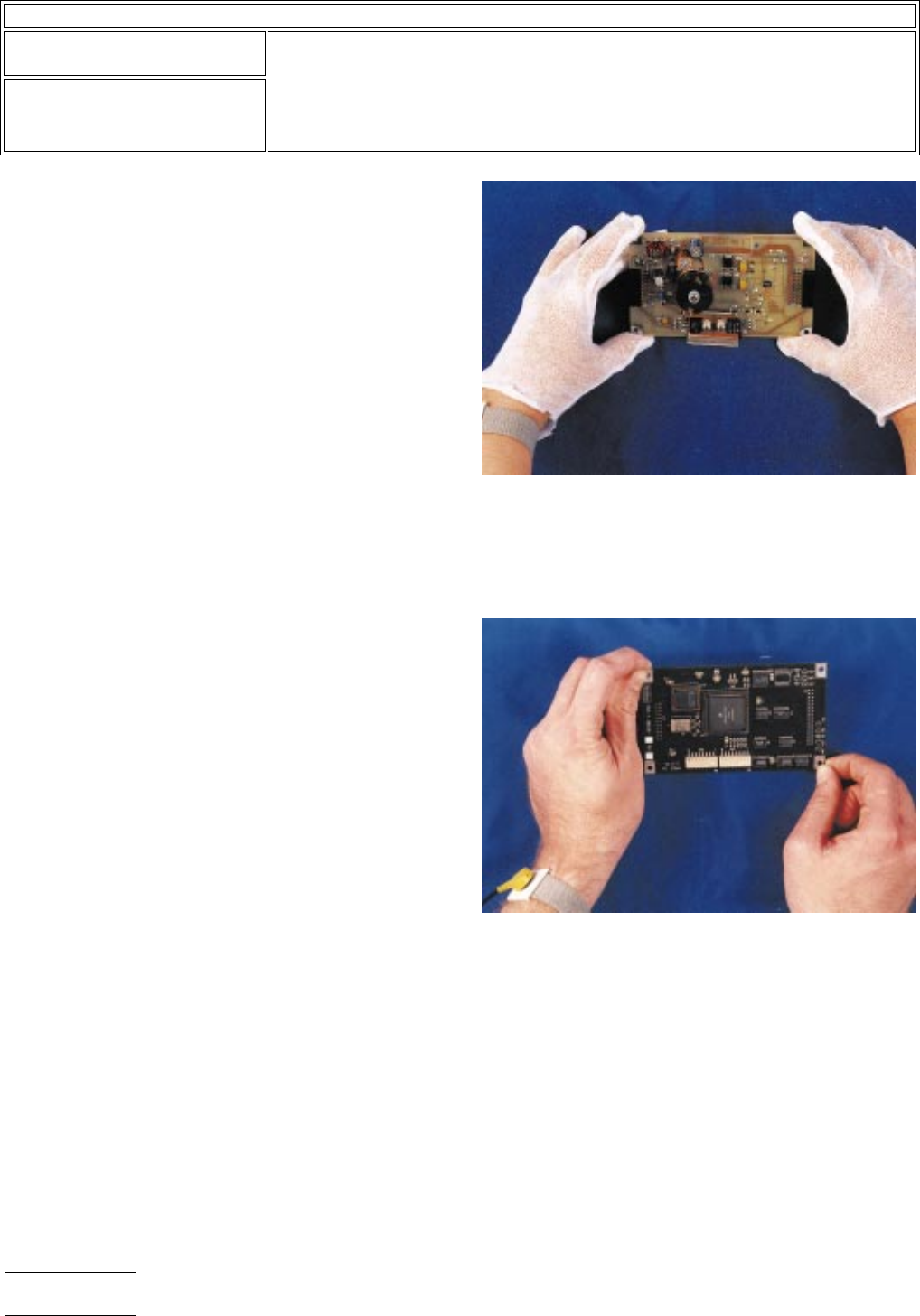
3 When gloves are used, they need to be changed as fre-
quently as necessary to prevent contamination from
dirty gloves. (See Figure 4).
4. Solderable surfaces are not to be handled with bare
hands or fingers. Body oils and salts reduce solderabil-
ity, promote corrosion and dendritic growth. They can
also cause poor adhesion of subsequent coatings or
encapsulates.
5. Do not use hand creams or lotions containing silicone
since they can cause solderability and conformal coat-
ing adhesion problems..
6. Never stack electronic assemblies or physical damage
may occur. Special racks need to be provided in
assembly areas for temporary storage.
7. Always assume the items are ESDS even if they are not
marked.
8. Personnel must be trained and follow appropriate ESD
practices and procedures.
9. Never transport ESDS devices unless proper packaging
is applied.
IPC-7721
Number: 2.1
Revision:
Date: 2/98
Subject: Handling Electronic Assemblies
Page5of8
remove such contaminants. The best solution is to prevent
contamination.
Handling Electronic Assemblies
If no ESDS markings are on an assembly, it still needs to be
handled as if it were an ESDS assembly. However, ESDS
components and electronic assemblies need to be identified
by suitable EOS/ESD labels (see Figure 1). Many sensitive
assemblies will also be marked on the assembly itself, usually
on an edge connector. To prevent ESD and EOS damage to
sensitive components, all handling, unpacking, assembly and
testing must be performed at a static controlled work station
(See Figures2&3).
Avoid contaminating solderable surfaces prior to soldering.
Whatever comes in contact with these surfaces must be
clean. When boards are removed from their protective wrap-
pings, handle them with great care. Touch only the edges
away from any edge connector tabs. Where a firm grip on the
board is required due to any mechanical assembly procedure,
gloves meeting EOS/ESD requirements need to be worn.
These principles are especially critical when no-clean pro-
cesses are employed.
Handling After Solder
After soldering and cleaning operations, the handling of elec-
tronic assemblies still requires great care. Finger prints are
extremely hard to remove and will often show up in confor-
mally coated boards after humidity or environmental testing.
Gloves or other protective handling devices need to be used
to prevent such contamination. Use mechanical racking or
baskets with full ESD protection when handling during clean-
ing operations.
Common Tools and Equipment
Work environments require tools and equipment to conduct
electronic assembly operations. The following information is
provided as guidance regarding the use of common equip-
ment. EIA-625 provides more specific information.
Gloves and Finger Cots
The use of gloves or finger cots may be required under con-
tract to prevent contamination of parts and assemblies.
Gloves and finger cots must be carefully chosen to maintain
EOS/ESD protection.
• Handling with clean gloves and full EOS/ESD protection
• Handling during cleaning procedures using solvent resistant
gloves meeting all EOS/ESD requirements.
• Handling with clean hands by board edges using full EOS/
ESD protection
Figure 4 Target Condition - Class 1,2,3
Figure 5 Acceptable - Class 1,2,3
IPC-7721
Number: 2.1
Revision:
Date: 2/98
Subject: Handling Electronic Assemblies
Page6of8