IPC-7721(S).pdf - 第94页
NOTES IPC-7721 Number: 4.2.4 Revision: Date: 2/98 Subject: Conductor Repair , Surface Wire Method P a g e4o f4

CAUTION
Some components may be sensitive to high temperature.
17. Cure the epoxy per the manufacturers instructions.
18. After the epoxy has cured clean the area.
EVALUATION
1. Visual examination for alignment and overlap of wire.
2. Electrical tests as applicable.
IPC-7721
Number: 4.2.4
Revision:
Date: 2/98
Subject: Conductor Repair, Surface Wire Method
Page3of4

NOTES
IPC-7721
Number: 4.2.4
Revision:
Date: 2/98
Subject: Conductor Repair, Surface Wire Method
Page4of4
OUTLINE
This method is used on printed wiring boards to replace damaged or missing con-
ductors on the printed wiring board surface. A length of standard insulated or non-
insulated wire is used to repair the damaged conductor.
CAUTION
The conductor widths, spacing and current carrying capacity must not be reduced
below allowable tolerances.
REFERENCES
2.1 Handling Electronic Assemblies
2.2 Cleaning
2.5 Baking and Preheating
TOOLS AND MATERIALS
Cleaner
Knife
Liquid Flux
Dental Style Drill
Microscope
Solder
Soldering Iron with Tips
Wipes
Solid Wire
PROCEDURE
1. Clean the area.
2. Remove the damaged section of conductor using the knife. The damaged con-
ductor should be trimmed back to a point where the conductor still has a good
bond to the printed wiring board surface.
NOTE
Heat can be applied to the damaged conductor using a soldering iron to allow
the conductor to be removed more easily.
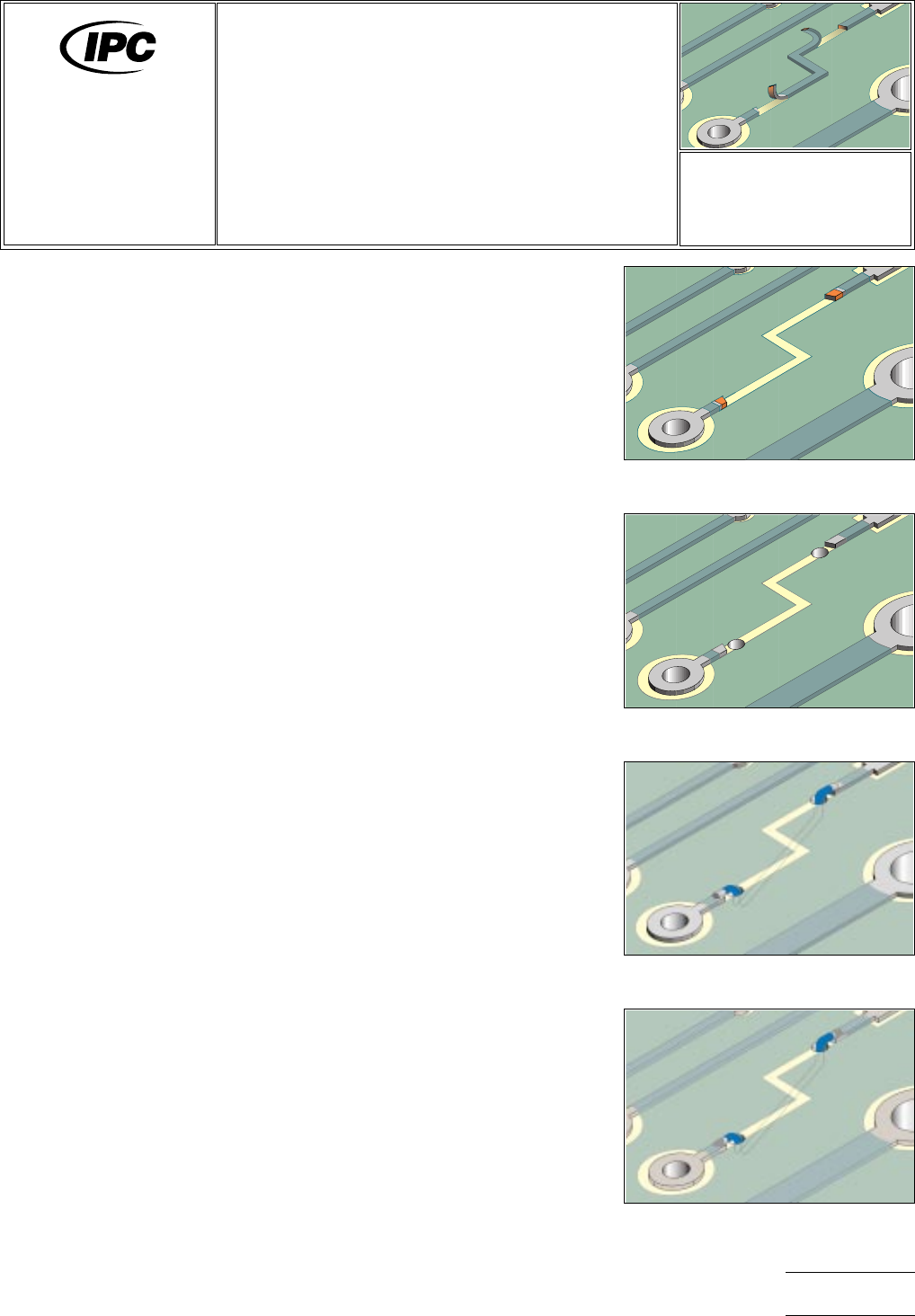
3. Use a knife and scrape off any solder resist or coating from the ends of the
remaining conductor. (See Figure 1.)
4. Remove all loose material. Clean the area.
5. Apply a small amount of liquid flux to the ends of the remaining conductor. Tin
the exposed end of each conductor using solder and a soldering iron.
6. Clean the area.
7. Select a wire to match the width and thickness of the conductor to be replaced.
Cut a length approximately as needed. See Table 1 for Solid Wire Equivalents.
8. Strip the wire and tin the ends if needed. Non-insulated wire may be used for
short repairs if conductors are not crossed.
9. Clean the wire.
Figure 1 Scrape off any coating from
ends of remaining conductors.
Figure 2 Drill through board adjacent
to conductor.
Figure 3 Drill through board, through
conductors.
Figure 4 Lap solder wire to
conductor.
7721
Repair and
Modification of
Printed Boards and
Electronic Assemblies
Revision:
Date: 2/98
Conductor Repair,
Through Board
Wire Method
Number: 4.2.5
Product Class: R
Skill Level: Advanced
Level of Conformance: Medium
Material in this manual was voluntarily established by Technical Committees of the IPC. This material is advisory only and its
use or adaptation is entirely voluntary. IPC disclaims all liability of any kind as to the use, application, or adaptation of this
material. Users are also wholly responsible for protecting themselves against all claims or liabilities for patent infringement.
Equipment referenced is for the convenience of the user and does not imply endorsement by the ipc.
Page1of4