IPC-7721(S).pdf - 第27页
NOTE: Any assembly related component if handled without EOS/ESD protection may damage electrostatic sensitive com- ponents. This damage could be in the form of latent failures, or product degradation not detectedable dur…
remove such contaminants. The best solution is to prevent
contamination.
Handling Electronic Assemblies
If no ESDS markings are on an assembly, it still needs to be
handled as if it were an ESDS assembly. However, ESDS
components and electronic assemblies need to be identified
by suitable EOS/ESD labels (see Figure 1). Many sensitive
assemblies will also be marked on the assembly itself, usually
on an edge connector. To prevent ESD and EOS damage to
sensitive components, all handling, unpacking, assembly and
testing must be performed at a static controlled work station
(See Figures2&3).
Avoid contaminating solderable surfaces prior to soldering.
Whatever comes in contact with these surfaces must be
clean. When boards are removed from their protective wrap-
pings, handle them with great care. Touch only the edges
away from any edge connector tabs. Where a firm grip on the
board is required due to any mechanical assembly procedure,
gloves meeting EOS/ESD requirements need to be worn.
These principles are especially critical when no-clean pro-
cesses are employed.
Handling After Solder
After soldering and cleaning operations, the handling of elec-
tronic assemblies still requires great care. Finger prints are
extremely hard to remove and will often show up in confor-
mally coated boards after humidity or environmental testing.
Gloves or other protective handling devices need to be used
to prevent such contamination. Use mechanical racking or
baskets with full ESD protection when handling during clean-
ing operations.
Common Tools and Equipment
Work environments require tools and equipment to conduct
electronic assembly operations. The following information is
provided as guidance regarding the use of common equip-
ment. EIA-625 provides more specific information.
Gloves and Finger Cots
The use of gloves or finger cots may be required under con-
tract to prevent contamination of parts and assemblies.
Gloves and finger cots must be carefully chosen to maintain
EOS/ESD protection.
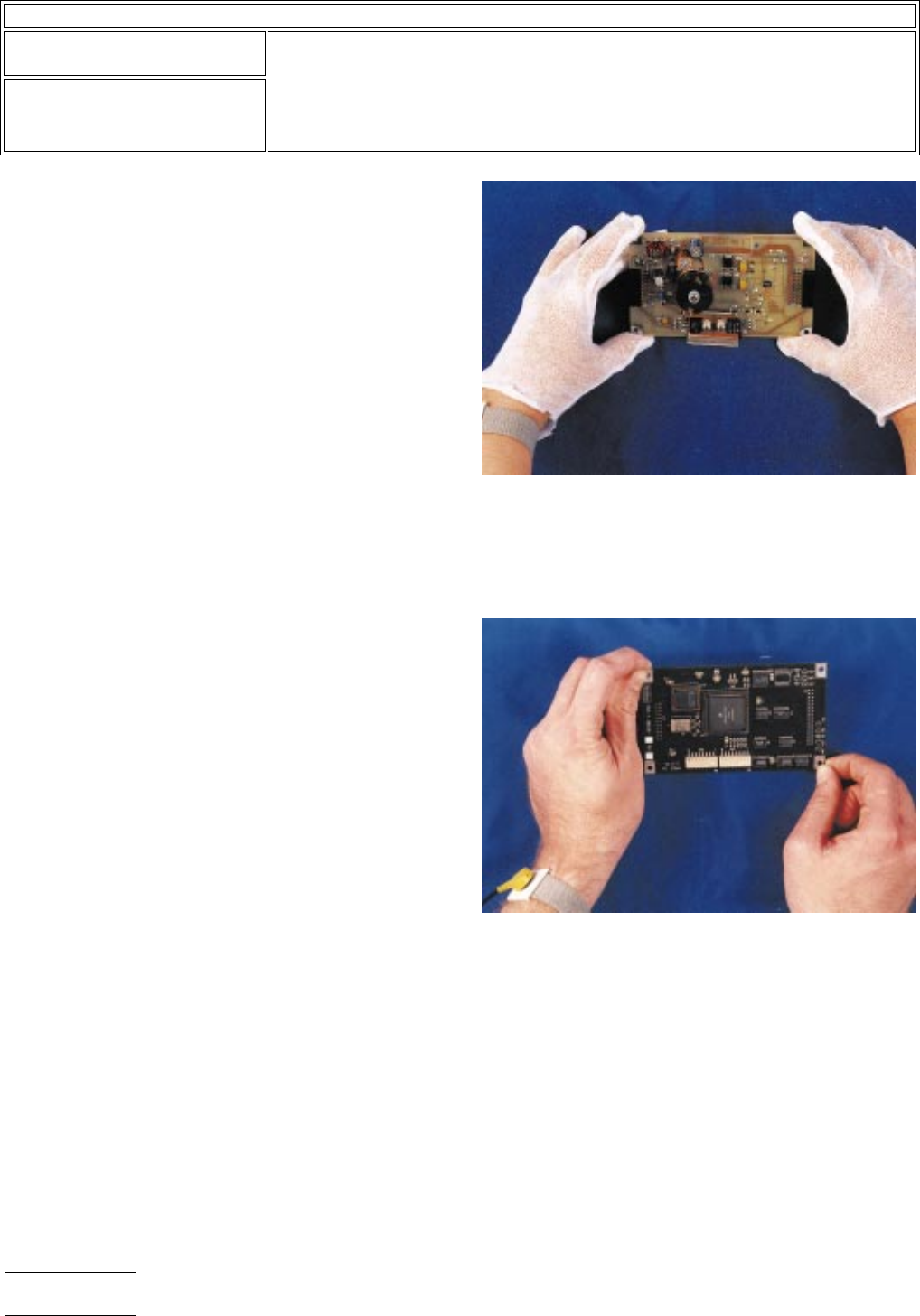
• Handling with clean gloves and full EOS/ESD protection
• Handling during cleaning procedures using solvent resistant
gloves meeting all EOS/ESD requirements.
• Handling with clean hands by board edges using full EOS/
ESD protection
Figure 4 Target Condition - Class 1,2,3
Figure 5 Acceptable - Class 1,2,3
IPC-7721
Number: 2.1
Revision:
Date: 2/98
Subject: Handling Electronic Assemblies
Page6of8
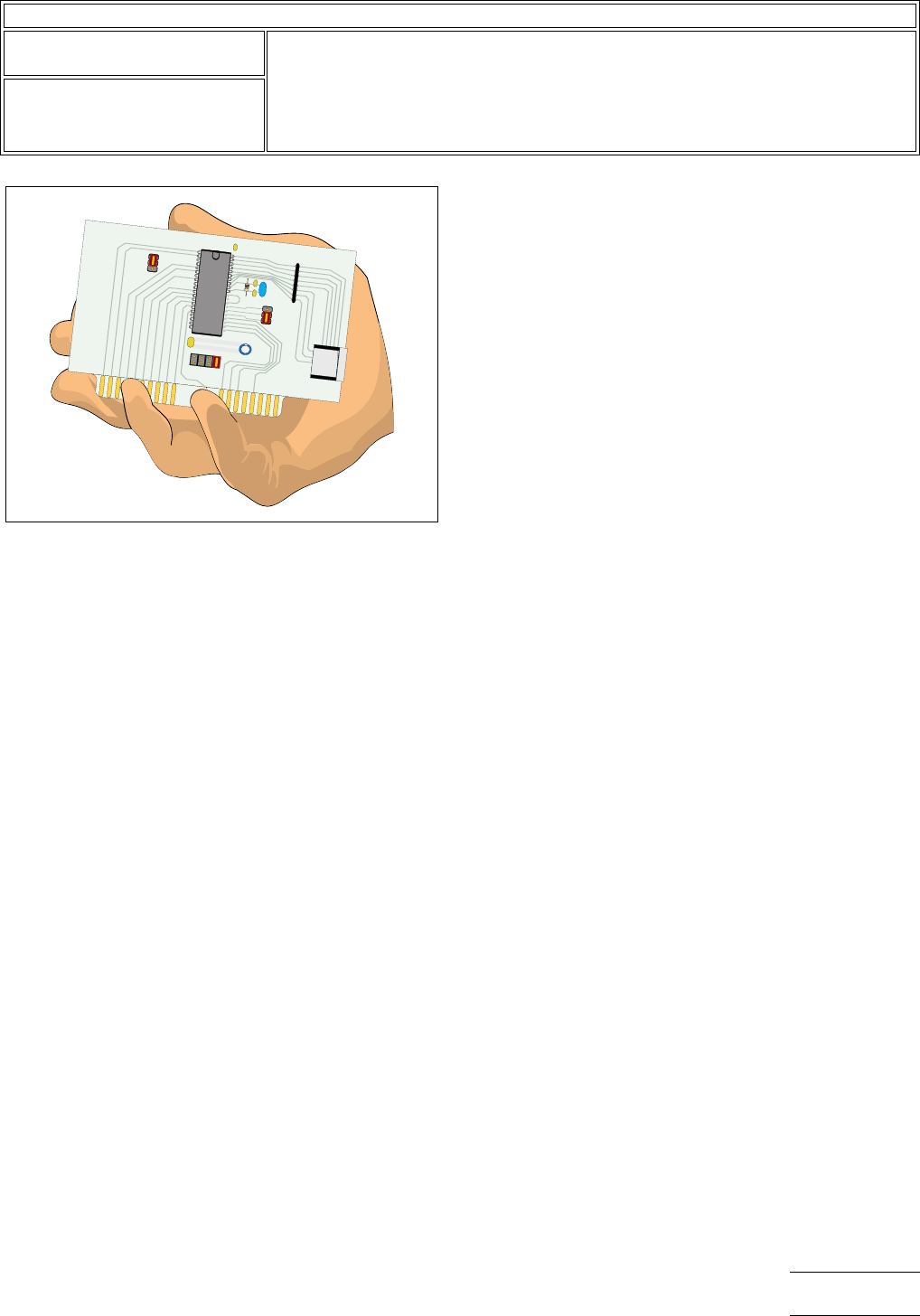
NOTE: Any assembly related component if handled without
EOS/ESD protection may damage electrostatic sensitive com-
ponents. This damage could be in the form of latent failures,
or product degradation not detectedable during initial test or
catastrophic failures found at initial test.
IPC-2-1-1
Figure 6
IPC-7721
Number: 2.1
Revision:
Date: 2/98
Subject: Handling Electronic Assemblies
Page7of8

NOTES
IPC-7721
Number: 2.1
Revision:
Date: 2/98
Subject: Handling Electronic Assemblies
Page8of8