JAKA Zu 7电控柜V2.1-硬件手册(英文版).pdf - 第10页
8 JAKA constantly str ives to impr ove the per formanc e and reliability of our robots. JAKA is not responsible for any errors or om issions in this m anual, and reserves the right of f inal interpreta tion of this manua…
7
1. When the robot is combined with or working with machines
capable of damaging the robot, it is highly recommended to test all
functions and the robot program separately. It is recommended to test
the robot program using temporary way points outside the workspace
of other machines.
2. Do not expose the robot to permanent magnetic fields. Very
strong magnetic fields can damage the robot.
1.4 General Warnings and Cautions
1.Do not wear loose clothing or jewellery when working with the robot.
Make sure long hair is tied back when working with the robot.
2. During the operation, even if the robot seems to have stopped, it may
be because the robot is waiting for the start signal and is about to move.
Even in such a state, the robot should be considered to be in motion.
3. During the operation, make sure the power cables of the electrical
cabinet and robot are reliably connected. Do not plug or unplug the
power cables or terminals in the working mode.
4. A warning line should be drawn on the floor to identify the working
range of the robot, so that the operator can understand the working
range of the robot with the end effector (gripper, tool, etc.) mounted.
5. Make sure that safety measures and/or robot safety configuration
parameters have been set up to protect both programmers, operators
and bystanders, as defined in the risk assessment. The lock should be
set as needed so that the non-operator cannot access the robot power
supply.
6. In emergency situations such as when a person is caught or
surrounded by the robot, the robot can be forced to move by pushing or
pulling the robot arm. Moving the robot manually without power is for
emergency use only, and may damage the robot。
1.5Liabilities and Risks
Liabilities
This manual does not cover all applications for designing, installing and operating robots, nor does it cover
all peripheral equipment that may affect the safety of the robot system.
JAKA's integrators are responsible for ensuring compliance with applicable national laws and regulations
to ensure that there are no major hazards in the complete robotic application.
All safety information contained in this manual shall not be considered as a guarantee of JAKA. Even if all
safety instructions are observed, the injury or damage caused by the operator may still occur.
JAKA Zu 7 v2.5

8
JAKA constantly strives to improve the performance and reliability of our robots. JAKA is not responsible
for any errors or omissions in this manual, and reserves the right of final interpretation of this manual.
Risks
A direct or indirect physical contact relationship exists when there an interaction between the operator and
the robot exists. Operators must have sufficient self-protection awareness when contacting, and integrators
need to carefully consider the use conditions when using the company's robots. The following are possible
dangerous situations:
①Injury caused by the robot dropping during handling;
②Injury caused by the loosening of the robot fixing screw;
③Finger-pinching and collision injury during the operation;
④Injury caused by the unrepaired malfunction robot;
⑤Danger caused by the usage of a sharp end effector or tool connection;
⑥Injury caused by the operation in a toxic or corrosive environment.
1.6 Usage
collaborative operation, where the robot operates without fences and/or together with a human. Collaborative
operation is only intended for non-hazardous applications, where the complete application, including tool, work
piece, obstacles and other machines, is without any significant hazards according to the risk assessment of the
specific application.
Any use or application deviating from the intended use is deemed to be impermissible misuse. This
includes, but is not limited to the following:
①Use in potentially explosive environments ;
②Use in medical and life critical applications ;
③Use before performing a risk assessment ;
④Use where the rated performance levels are insufficient ;
⑤Operation outside the permissible operating parameters.
1.7 Emergency Stop
When an emergency occurs, press the emergency stop button to stop all movement of the robot
immediately. Emergency stop cannot be used as a risk reduction measure, but as a secondary protective
device.
JAKA Zu
®
7 is an industrial collaborative robot suitable for use in industrial environments, for
example, for handling tools and fixtures, or for processing or transferring components or products. JAKA Zu
®
7
is only allowed to be used under specified environmental conditions.
JAKA Zu 7 V2.5
JAKA Zu
®
7 is equipped with special safety-related features, which are purposely designed for
9
1.8 Movement without Drive Power
In the unlikely event of an emergency situation where robot power is either not possible or unwanted, the
robot joint can be forced to move in two ways:
1. Forced manual drive: By pushing or pulling the robot arm, it can force the joint to rotate. The brake of
each joint has a friction clutch. When the joint is subjected to a torque greater than the friction torque of the
friction clutch, the joint rotates.
2. Manual brake release: Remove the joint cover by removing the screws (four for big joints and three for
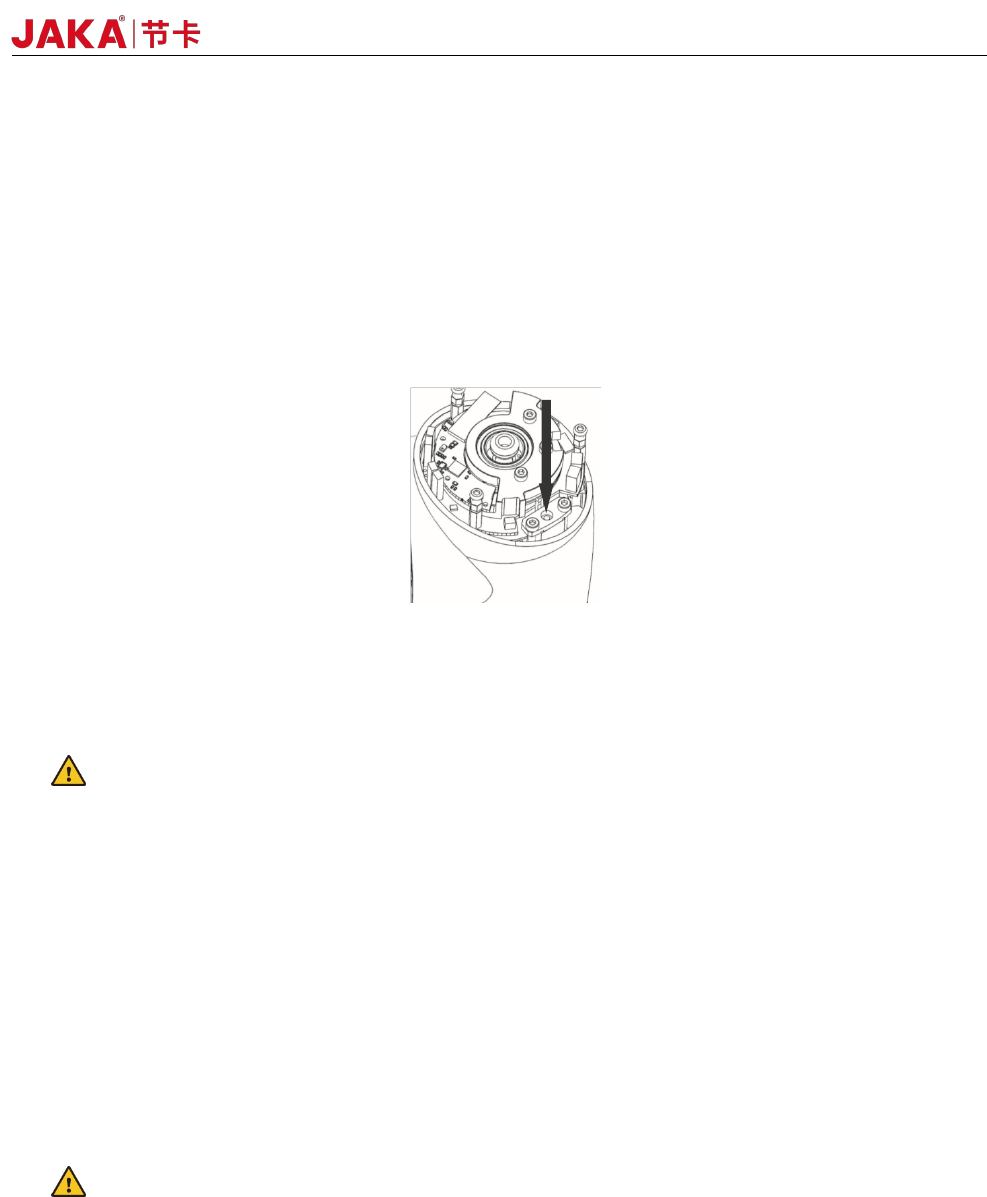
small joints) that fix it. Press the plunger on the small electromagnet (shown below) to release the brake.
Fig
1-1
Warnings:
1. Moving the robot arm manually is intended for urgent emergencies only and might damage the joints.
2. If the brake is released manually, gravitational pull can cause the robot arm to fall. Always support the
robot arm, tool and work item when releasing the brake.
1.9 Precautions for Transportation and Handling
Transport the robot in the original packaging. Save the packaging material in a dry place; you may need to
pack down and move the robot later on.
Lift both tubes of the robot arm at the same time when moving it from the packaging to the installation
place. Hold the robot in place until all mounting bolts are securely tightened at the base of the robot.
Cautions:
1. Make sure not to overload your back or other bodyparts when the equipment is lifted. Use proper lifting
equipment. All regional and national guidelines for lifting shall be followed. JAKA cannot be held responsible for
any damage caused by transportation of the equipment.
2. Make sure to follow the installation instructions when installing the robot.
JAKA Zu 7 v2.5