00196784-02_VD_Traceability_3.3_DE_EN.pdf - 第41页
Existing Restrictions Traceability SIPLACE Traceability 3.3 41 7 Existing Restrictions 7.1 Traceability ▪ SIPLACE Trace Host is no longer part of the Traceability 3.3 p roduct CD. The datab ase option is now made availab…
Fixed Defects
40 SIPLACE Traceability 3.3
Existing Restrictions
Traceability
SIPLACE Traceability 3.3 41
7 Existing Restrictions
7.1 Traceability
▪ SIPLACE Trace Host is no longer part of the Traceability 3.3 product CD. The database option is
now made available via the SIPLACE Trace Service and can be configured with the Trace Service
Manager.
▪ SIPLACE Trace Service 3.3 supports SIPLACE Trace Host 3.2. This support could be removed in
future versions of SIPLACE Trace Service.
▪ Traceability 3.3 does not support archiving. We recommend that you periodically create a new data-
base and manually archive older versions of Trace database. The Trace Service Manager has a
range of database operations for backing up a non-productive (to be archived) database in the file
system and to then delete this on the SQL server.
▪ Nonobservance of the restrictions specified in the SIPLACE Setup Center 4.2 software version de-
scription can lead to incorrect traceability data.
▪ The following features of SIPLACE Setup Center 4.2 are supported in station based traceability
mode only:
– Alternative Components
– Random Setup on Feeder Tables
▪ The component level indicator in connection with setup verification should always be run with acti-
vated stop thresholds.
▪ When downloading a new setup in line-based traceability, the conveyors must be empty. If this is not
the case, the traceability data may be incorrect.
▪ Line-based traceability does not support station-wise downloads.
▪ Station software version 408 is not supported.
▪ If a track is not fitted with splice detection, the reliability of the traceability data depends on the ac-
curacy of the component levels. The packaging unit change is therefore logged according to the re-
spective component level.
▪ The logging of detected splice points for X feeders (so-called "Splice Events") in the traceability XML
files is no longer performed by SIPLACE Trace Service 3.3 in its default configuration. Customers
who have connected their target system (e.g. "MES") via the XML file interface to traceability (and
not via the database interface), and who evaluate splice events in their application, will need to man-
ually reactivate this data generation via a button in the "ApplicationConfig.xml" - Trace Service file.
For further information about this, contact your local customer support. We reserve the right to no
longer provide the generation of splice data within traceability data in future releases.
▪ The renaming or moving of lines within the programming system "Siplace Pro Desktop" during pro-
duction operations is not supported. To avoid data loss and/or faulty data, the following procedures
should be followed for renaming or moving the Siplace Pro line
name:
– All conveyor lanes in the line must be run empty
– After this, rename the line on the SIPLACE Pro desktop
– Configure the new line name in Setup Center (delete old line, add new one)
– Configure the new line name in Trace Service (delete old line, add new one, apply configuration)
– The production job to be produced needs to be reconfigured at the line, using the SIPLACE Pro
LineControl function.
▪ Traceability data of bulk case feeders, linear feeders and LED feeders can only be used if the oper-
ator makes sure that the feeder is completely empty before each refill.
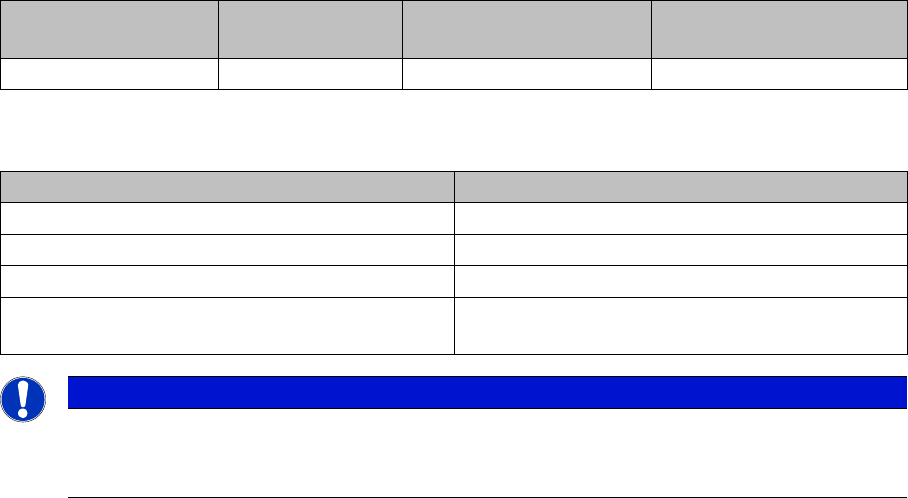
▪ The following maximum lengths (characters) for the PCB barcode are available if the PCB barcode
is read in the SIPLACE machine:
Existing Restrictions
Trace Service
42 SIPLACE Traceability 3.3
▪ The length of the setup name is limited to 20-50 characters, i.e. only the first 20 to 50 characters will
be taken into account during setup changeovers.
▪ If you change the configuration of the Traceability system the SIPLACE line has to be empty. Other-
wise Traceability data may be incomplete.
▪ Station based and line based traceability cannot run simultaneously in the same line.
▪ If a station is part of several lines (SIPLACE Pro configuration), there are the following restrictions
for line based traceability:
– Only one of the lines may be active at the same time.
– If an external PCB barcode reader is allocated to more than one line then the PCB barcodes are
assigned to the line which is active in Trace Service. If multiple lines are active with the same
external barcode scanner, the Trace Service will issue an error message.
▪ In case of line based traceability the sequence of the boards may only be changed (e.g. by a pro-
ductivity lift) if there are external PCB barcode readers in front of AND at the end of the line.
For 407
▪ When using a synchronous dual conveyor, traceability data can only be generated to a limited de-
gree. The restriction is based on the fact that both boards are seen as one panel and that the trace-
ability data is therefore stored in one data package. The board barcode used is always the barcode
read at conveyor 1.
7.2 Trace Service
▪ Network connection
To enable SIPLACE Trace Service to import the traceability data from stations with station software
<70x, you need to configure the relevant network connections (e.g. if files need to be imported from
another host). The non-availability of configured import paths and network connections is recorded
in the log file.
▪ We recommend that you limit the size of the Trace database to 20 GB. If the database has reached
this size, it should be archived in a backup and the production should be continued with a newly cre-
ated Trace database.
Station software Single conveyor Synchronous dual convey-
or
Asynchronous dual convey-
or
407 / 505 / 605 / 701 40 40 / 40 40
Station software Max. length of setup names
407 20 characters exc. path
505 50 characters exc. path
605 256 characters inc. path
70x 256 including the path designation (limitation in the
Trace Host database)
NOTICE
Station and line name
The station name must be unique in the line. The line name must be unique throughout the
traceability system.