TM2248_Explanation Document of DualLane MachineYS24(DL)YS24X(DL).pdf - 第20页
MDOC - SOFT50073 20 4. The detail of machine workings • In this chapter, the diffe rences of machine workings fr om the conve n tional sing le lan e m ach ine is explain e d.
MDOC
-
SOFT50073
19
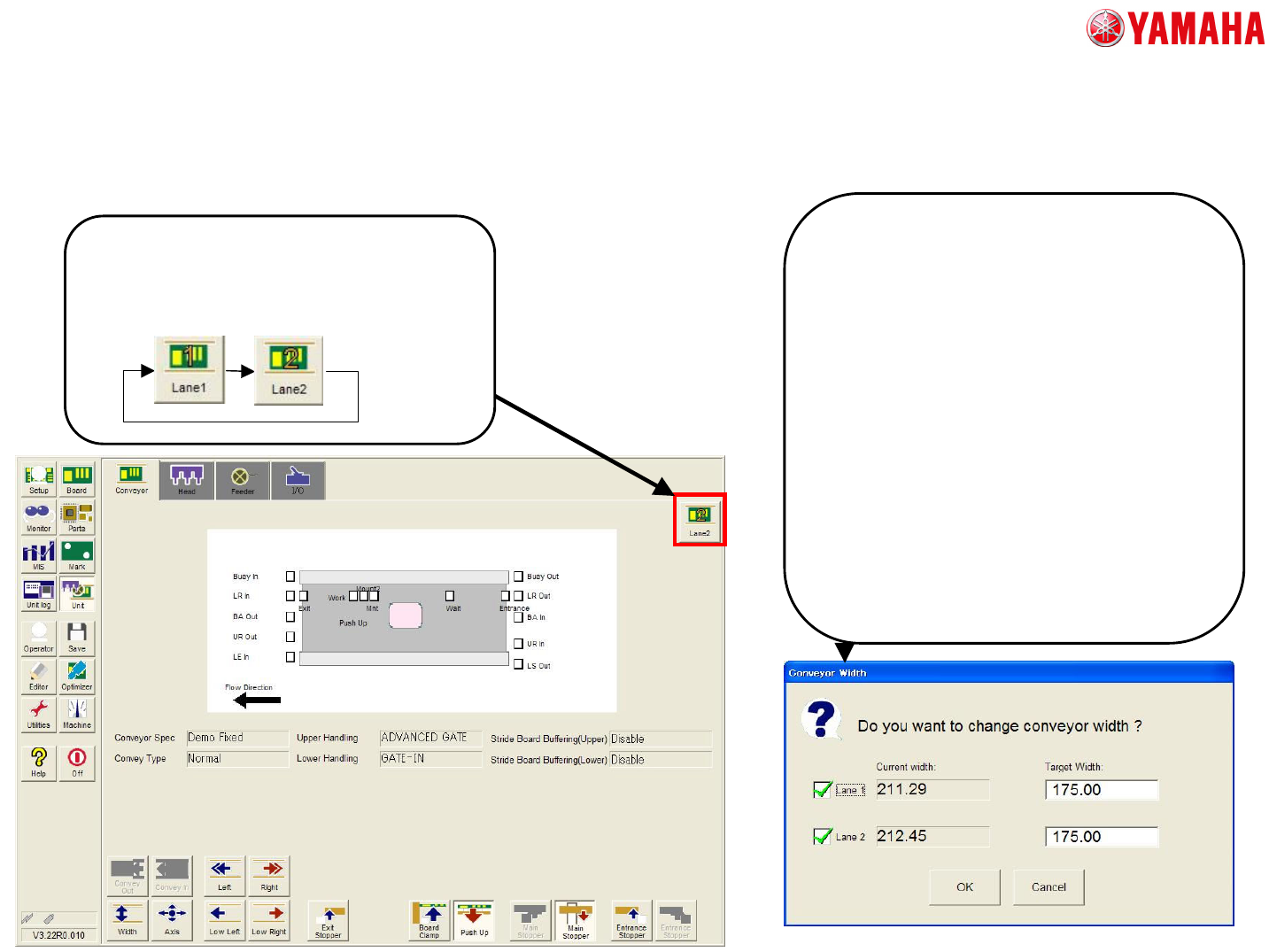
• “Unit” button -> “Conveyor” tab and “Conveyor Width” screen
[Lane select button]
This button is newly added, the
information of a chosen lane is
displayed.
[“Conveyor Width” screen]
The conveyor width of each lane can be
set each other.
The range which can be input to every
lane is limited. When only one side lane
is used, please set the check box of the
unused lane to “unchecked state”.
Example)
In the case of both check box is “checked
state”, when 175mm is input into Lane1,
it can be input up to 264mm at Lane2.
In the case of the check box of Lane1 is
unchecked, it can be input up to 390mm.
3. The detail of each screen

MDOC
-
SOFT50073
20
4. The detail of machine workings
• In this chapter, the differences of machine workings from the
conventional single lane machine is explained.
MDOC
-
SOFT50073
21
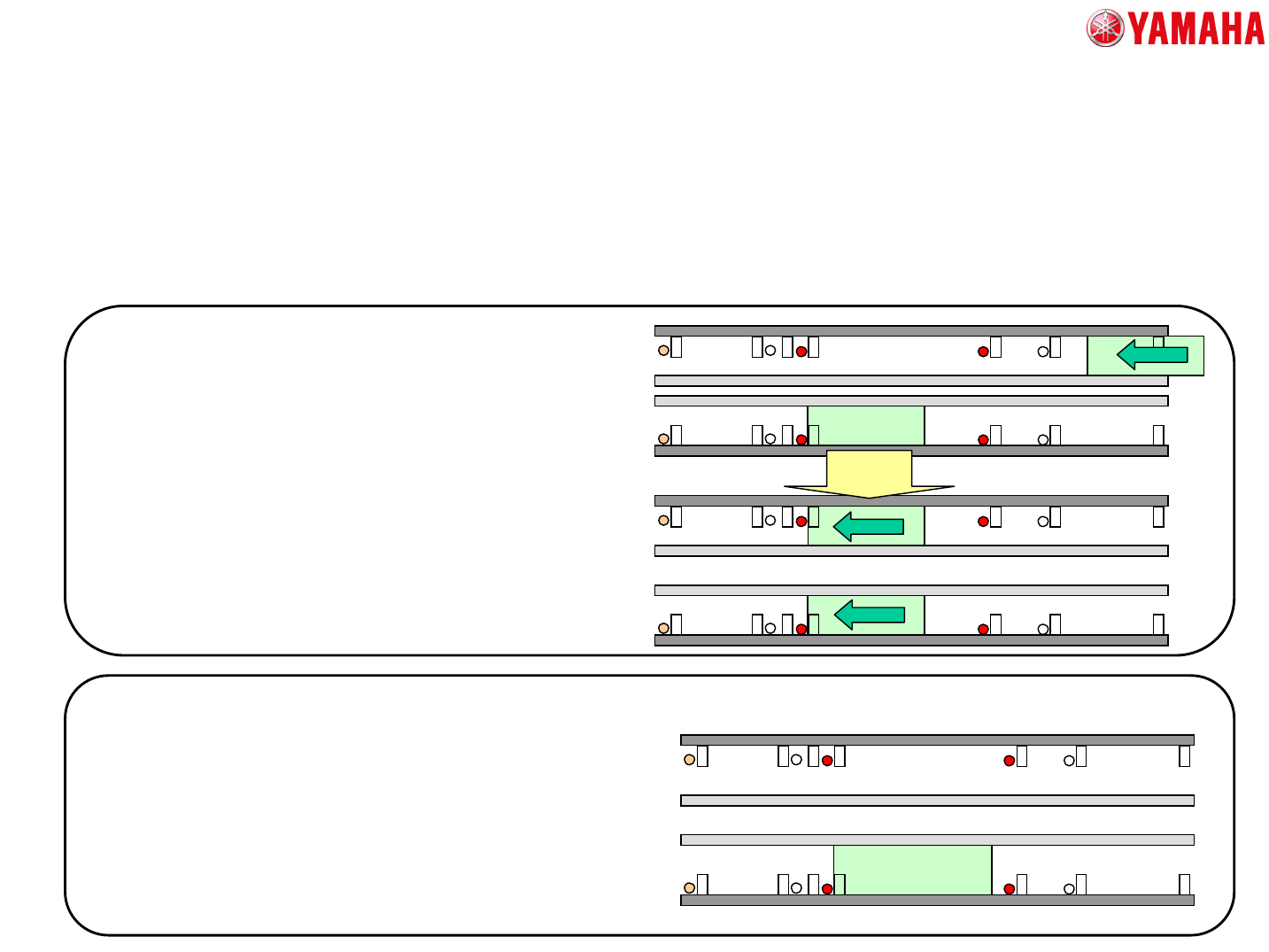
• About the setting of “Transfer Mode”
– When “Synchronous Transfer” is chosen, the mount start timing and the mount finish
timing synchronizes in both lanes. Transfer timing does not synchronize in both lanes.
– In the basic operation, “Asynchronous Transfer” mode is used for the production of
same side of boards, “Synchronous Transfer” mode is used for the production of both
sides of boards.
Lane 1
Lane 2
Lane 1
Lane 2
Lane 1
Lane 2
Mount Completed
4. The detail of machine workings
[Case 1]
Situation:
The board of Lane1 is transferred to the machine, and fixed. At that time,
the board of Lane2 is started transferring to the machine.
Movement:
The sequence of Lane1 is waiting and don’t start mounting until the
board in Lane2 is fixed because the board in Lane2 is now being carried
in. When board fixation of Lane2 is completed, the mount of both lanes
is started.
Afterwards, the start of transfer to downstream is carried out after the
mount completed in both lanes.
[Case 2]
Situation:
The board of Lane1 is transferred to the machine, and fixed. And the board
of Lane2 does not exist.
Movement:
Mount start in only Lane1. If the board in Lane2 is carried in during
mounting in Lane1, mount in Lane2 doesn’t start and wait until the next
synchronous timing.