forte_en.pdf - 第13页
Page 13 High Speed Compared to th e PREST O prog rammer, FORT E features an embedded processor making it possible to perform complex operations with the device b eing program med as well as offering a sign ificantly fast…

Page 12
2.3
Quick Start
Please install the drivers and the UP software prior to the
first use of FORTE.
2.3.1 Windows
Administrator rights are required to run the software
for the first time.
Start with installing the UP program. Its installer installs
the USB driver for FORTE, too. You can download the
installer from
www.asix.tech/prg_up_en.html.
Once the installation is complete, connect the FORTE
programmer to your computer.
The driver contained in the UP installer is intended for
Windows 7 and later. For older Windows operating system
versions the driver has to be downloaded from
www.asix.net, from download section of the programmer
and unpacked somewhere. After the programmer has
been connected, the operating system asks for the driver.
In "Found New Hardware" dialog the path to the
unpacked driver has to be set.
The green ON-LINE LED should turn on after a few
moments and the Windows Device Manager should
present the programmer as correctly installed.
2.4
Use
FORTE is a fast and flexible High-Speed USB programmer
suitable for programming of a range of devices such as
microcontrollers, EEPROM or Flash serial memory chips,
CPLD, FPGA and many others. It is equipped with
overcurrent protection at the VDD and VPP sources and
with overvoltage protection at the VDD pin.
The programmer is powered via USB. It can feed the
application to be programmed with a voltage of 1.8V to
5.5V or it can utilize an external application’s voltage
during programming.
The programmer may run under Windows XP or later.
Numerous Supported Devices
The list of supported devices includes:
• Microchip PIC microcontrollers – devices with serial
programming, which include all PIC and dsPIC devices
with the exception of several obsolete types.
• Microcontrollers with ARM core – such as ATSAM3N2A
or LPC2148.
• Atmel AVR microcontrollers – all devices supporting
"SPI Low Voltage Serial Downloading" such as
ATtiny12, AT90S8535 or ATmega128.
• Atmel ATxmega microcontrollers – devices
programmable via JTAG or PDI interface such as
ATxmega32D4 or ATxmega128B1.
• Atmel AVR32 microcontrollers – AT32UC3A1256, for
example.
• Atmel 8051 microcontrollers – devices that support
ISP programming such as AT89S8253, AT89LP4052,
AT89LP216 or AT89S2051.
• Texas Instruments microcontrollers – 16-bit MSP430,
CC430 and CCxxxx with a flash memory, including
their fuse programming.
• Cypress – PSoC microcontrollers.
• Serial EEPROM and Flash memory chips - I2C
(24LCxx), Microwire (93LCxx) and SPI (25Cxx).
• Devices with JTAG interface, for which an SVF or an
XSVF file can be created. These include CPLD (such as
Xilinx XC95xx and CoolRunner), configuration memory
for FPGA (such as Xilinx XC18Vxx and XCFxxS),
microcontrollers (such as ATmega128) and others.
This, however, is not an exhausting list of possibilities.
Additional types are regularly supplemented in response
to customers’ interest. New software versions are
downloadable from the Internet for free.

Page 13
High Speed
Compared to the PRESTO programmer, FORTE features an
embedded processor making it possible to perform
complex operations with the device being programmed as
well as offering a significantly faster output interface. Due
to this, devices may be programmed up to the limits of
their theoretical performance.
USB Connection
FORTE is controlled and powered through a USB port. It
communicates in the High-Speed mode (480Mbps) /
connected to a USB 2.0 port and in the Full-Speed mode /
connected to a USB 1.1 port. This means that connecting
the programmer is fast and easy, requiring only a single
cable.
Programming of Placed Devices
ISP (In-System Programming) or the special ICSP (In-
Circuit Serial Programming) for the PIC microcontrollers is
currently replacing the traditional method in which
devices were first programmed and only then placed on a
PCB (printed circuit board). Thanks to ISP even SMD
devices with an extremely narrowly spaced pins can
easily be programmed and their firmware upgraded in
already assembled and finished devices.
Programming of Autonomous Devices
Those who still need to program autonomous devices, i.e.
devices not yet placed on a PCB can use the ISP2ZIF
adapter featuring a ZIF (zero insertion force) socket.
Programming Interface
The FORTE programmer features 8 independent I/O pins
with individually configurable pull-up/down resistors.
Devices to be programmed are connected through a
16-pin ISP connector, which is backward compatible with
the 8-pin ICSP connector for PIC microcontrollers. VPP can
be set to any value between 6.5 V and 17 V.
Connection to a remote application through a 16-wire
ribbon cable has been improved by interleaving its
individual signals with ground.
Power Supply From Application
The VDD output can serve as an input using the power
from the application for feeding the output buffers, or it
can become an output and as such to provide voltage for
the application.
FORTE can power applications with a voltage from 1.8V
to 5.5V. A controlled discharge resistor is incorporated
for faster transitions between different programming
phases when capacitors in the application need to be
discharged all the way down to 0V.
FORTE includes a built-in “voltmeter” at pins P and VDD.
Overcurrent Protection
FORTE includes a fast-responding hardware overcurrent
protection at pins P and VDD, which is independent of the
state of the controlling PC.
User Interface
The programmer status is clearly indicated by two LEDs.
ON-LINE (green LED) informs of connecting to USB while
ACTIVE (two-state yellow/red LED) signals an activity or a
faulty state (error) of the programming interface.
The GO button significantly increases the operator’s
comfort in repeated programming. It starts programming
or other user-defined commands
Software
The UP program is a basic software tool for working with
FORTE, also compatible with the PRESTO programmer.
Apart from standard commands, UP provides numerous
above-standard functions, which broaden the
programmer’s applications and simplify its operation.
These include the possibility to define projects, existence
of adjustable parameters when running from the
Page 14
command line providing for unattended programmer
operation in routine programming, environment
personalization incl. keyboard shortcuts, automatic
generation of serial numbers, etc.
UP has been developed for Windows XP or later.
Modified drivers developed by FTDI are used for
communication through USB.
Devices with the JTAG interface, for which an SVF or an
XSVF file can be created, can be programmed by means
of the JTAG SVF Player software.
The voltage at the VDD pin is permanently displayed in
UP for greater comfort and for monitoring of the
operation. The reset signal is conveniently controlled by a
single button.
2.5
Controls and
Connectors
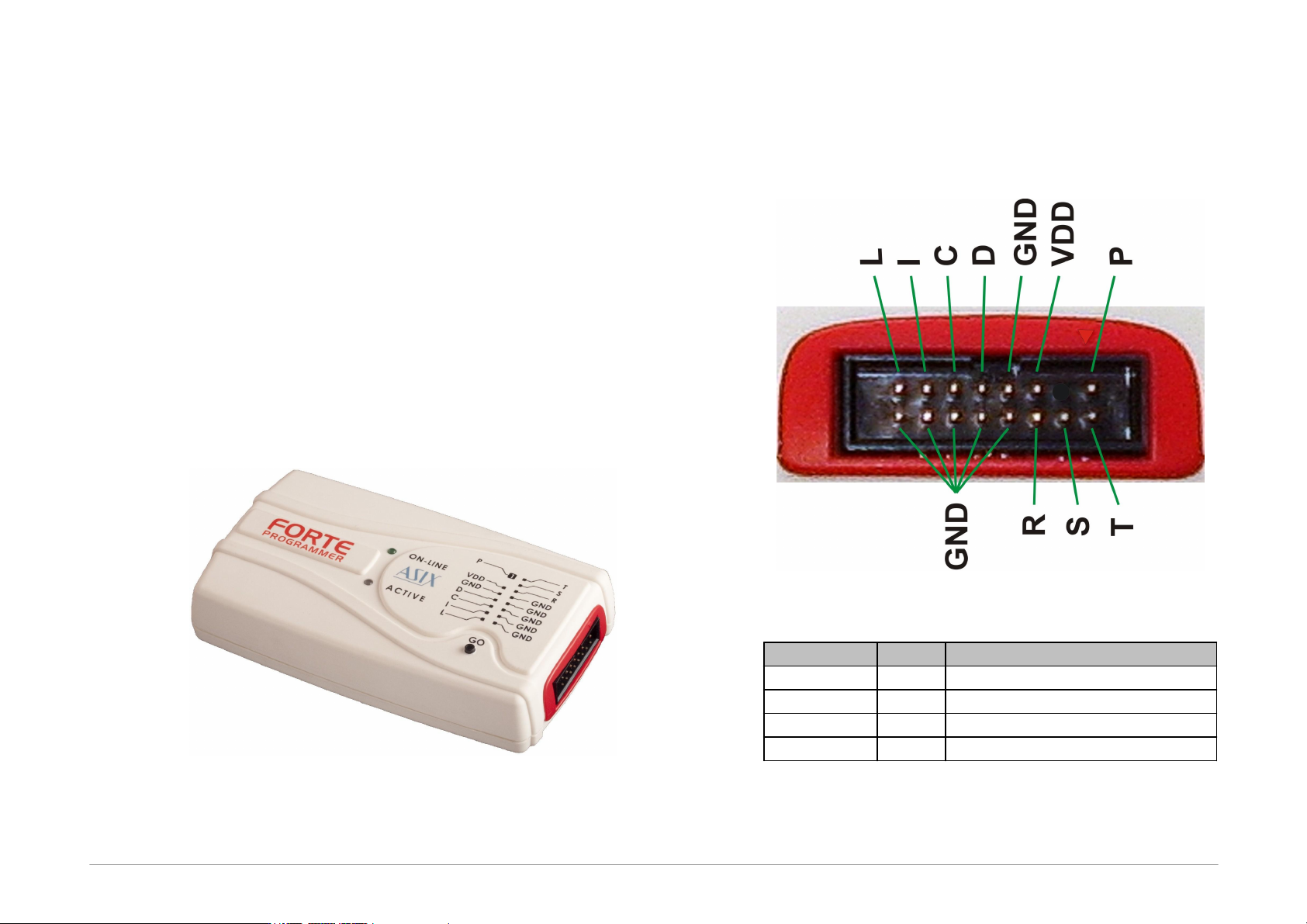
Fig.2: The FORTE programmer
FORTE features two LEDs, a button, a connector for
linking to USB and a programming connector.
2.5.1 Programming
Connector
The programming connector is a 16 way double row plug
with pin No. 3 (in standard numbering) missing. Spacing
between pins is 2.54mm.
Fig.3: Programming connector
Pin
Type
Description
P
I/O, VPP
signal input/output or VPP output
VDD
PWR
power input/output
GND
PWR
signal grounding
D, C, I, L, T, S, R
I/O
signal input/output
Table1: programming connector