s26030829.pdf - 第10页
Sensors 2026 , 26 , 829 10 of 21 ( a ) ( b ) ( c ) ( d ) ( e ) ( f ) ( g ) ( h ) Iteration# F4 PSO MOGGO GWO WO A NSGAII DBO Iteration# F5 PSO MOGGO GWO WO A NSGAII DBO Iteration# F9 PSO MOGGO GWO WO A NSGAII DBO Iterati…

Sensors 2026, 26, 829
9 of 21
Table 4. CEC Function Test Results.
Function PSO NSGAII GWO WOA DBO MOGGO
F4
Mean
1.83 × 10
8
9.87 × 10
6
1.30 × 10
7
4.23 × 10
7
3.02 × 10
8
6.62 × 10
4
Std
6.78 × 10
8
9.83 × 10
6
7.06 × 10
7
9.44 × 10
7
2.10 × 10
8
3.91 × 10
4
F5
Mean
3.78 × 10
7
1.62 × 10
6
3.37 × 10
6
7.36 × 10
5
1.06 × 10
5
8.5 × 10
3
Std
5.25 × 10
7
7.19 × 10
6
4.56 × 10
6
6.15 × 10
6
2.12 × 10
6
9.47 × 10
3
F9
Mean −557.91 −557.61 −556.16 −556.8 −557.27 −558.48
Std 2.6599 1.8035 2.2561 1.8668 1.8109 3.6466
F14
Mean
1.97 × 10
4
1.11 × 10
3
9.82 × 10
3
9.93 × 10
3
7.41 × 10
3
7.95 × 10
3
Std
1.25 × 10
4
4.59 × 10
3
3.28 × 10
3
3.16 × 10
3
4.12 × 10
3
871.7893
F15
Mean
2.05 × 10
4
1.24 × 10
4
9.4 × 10
3
8.76 × 10
3
9.21 × 10
3
7.35 × 10
3
Std
1.13 × 10
4
4.50 × 10
3
2.52 × 10
3
3.12 × 10
3
2.26 × 10
3
1.08 × 10
3
F16
Mean 204.0242 203.6665 203.8356 204.1670 203.9555 203.9054
Std 0.6995 0.3577 0.3197 0.3353 0.4455 1.3284
F21
Mean
7.54 × 10
5
1.38 × 10
5
4.06 × 10
4
5.70 × 10
5
8.94 × 10
4
2.98 × 10
3
Std
7.43 × 10
5
3.44 × 10
5
2.18 × 10
5
2.52 × 10
5
2.76 × 10
5
249.0022
F23
Mean
2.14 × 10
4
1.24 × 10
4
1.09 × 10
4
1.09 × 10
4
1.09 × 10
4
9.63 × 10
3
Std
1.26 × 10
4
4.13 × 10
3
2.91 × 10
3
2.37 × 10
3
1.96 × 10
3
819.0361
It should be noted that the proposed Multi-Objective Gray Goose Optimization
(MOGGO) algorithm is an improved version of the original GGO algorithm. In this study, a
Logistic chaotic map is introduced to enhance the diversity of the initial population, while a
Gaussian (normal) disturbance mechanism is incorporated during the optimization process
to improve global exploration ability and avoid premature convergence. In addition, the
original single-objective GGO framework is extended to handle multi-objective optimiza-
tion, making it suitable for solving the dual-objective vibration suppression trajectory
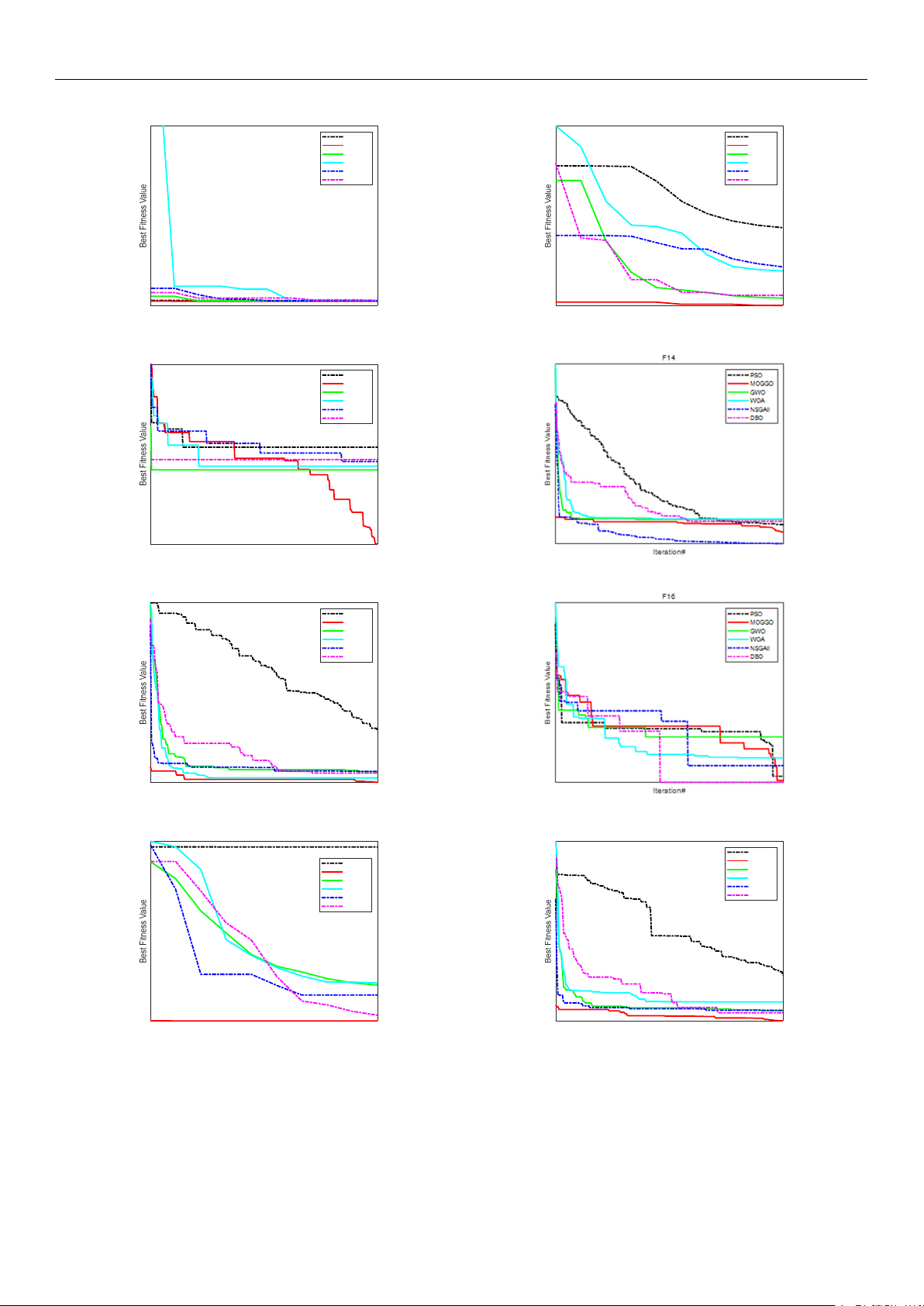
planning problem. The results of the CEC2013 test set are shown in Figure 4. The results
indicate that MOGGO performs the best overall on the CEC2013 test functions, significantly
outperforming the comparison algorithms in terms of convergence speed, solution accuracy,
and stability.
As shown in Figure 4a–h, the convergence behaviors of different algorithms are
compared on benchmark functions F4, F5, F9, F14, F15, F16, F21, and F23. Overall, MOGGO
demonstrates faster convergence speed and better solution accuracy across most test
functions. In unimodal functions, the MOGGO rapidly reaches the optimal region, while in
multimodal and complex functions, it maintains stable convergence and effectively avoids
premature stagnation. In contrast, PSO, WOA, GWO, and NSGA-II generally exhibit
slower convergence or are more prone to local optima. These results indicate that MOGGO
achieves a better balance between global exploration and local exploitation.
(1) Set the forearm to rotate 120
◦
, with the motor’s starting acceleration at 20 deg/s
2
.
On the MATLAB platform, set the population size and number of iterations, define the
main loop function of the algorithm and the displacement equation, and establish it as a
fitness function according to the strict constraint t
1
< t
2
< t
3
. The fitness function can be
expressed as:
F = ω
1
t
3
+ ω
2
E
vib
+ ε (19)
Among them,
1
and
2
are the target weight values, and e is the penalty value. In Equa-
tion (19), w1 and w2 denote the weighting coefficients for motion time and residual vibration
energy, respectively, satisfying w
1
+ w
2
= 1. These parameters allow flexible trade-offs be-
tween efficiency and vibration suppression according to different operational requirements.
https://doi.org/10.3390/s26030829
Sensors 2026, 26, 829
10 of 21
(a) (b)
(c) (d)
(e) (f)
(g) (h)
Iteration#
F4
PSO
MOGGO
GWO
WOA
NSGAII
DBO
Iteration#
F5
PSO
MOGGO
GWO
WOA
NSGAII
DBO
Iteration#
F9
PSO
MOGGO
GWO
WOA
NSGAII
DBO
Iteration#
F15
PSO
MOGGO
GWO
WOA
NSGAII
DBO
Iteration#
F21
PSO
MOGGO
GWO
WOA
NSGAII
DBO
Iteration#
F23
PSO
MOGGO
GWO
WOA
NSGAII
DBO
Figure 4. Convergence Curves for a Subset of the CEC2013 Test Functions.
It is triggered when an individual does not satisfy the condition t
1
< t
2
< t
3
, and is
randomly assigned a larger value to make the individual enter the exploration group to
perform a deep search.
https://doi.org/10.3390/s26030829
Sensors 2026, 26, 829
11 of 21
(2) Establish the relationship between t
1
, t
2
, and total time t
3
, and use the central dif-
ference method to derive the acceleration of the forearm. Construct an energy cost function.
By combining this function with the displacement equation and assigning weight values, a
composite multi-objective function is obtained. Through global search by the exploration
group and local optimization by the utilization group, the current optimal solution is
determined. If the maximum preset number of iterations is reached, the iteration stops.
(3) Using the proposed GGO-based optimization under the prescribed constraints,
the optimal switching times t
1
and t
2
were determined. The resulting kinematic profiles
(velocity, displacement, acceleration, and jerk versus time) were then generated in MATLAB
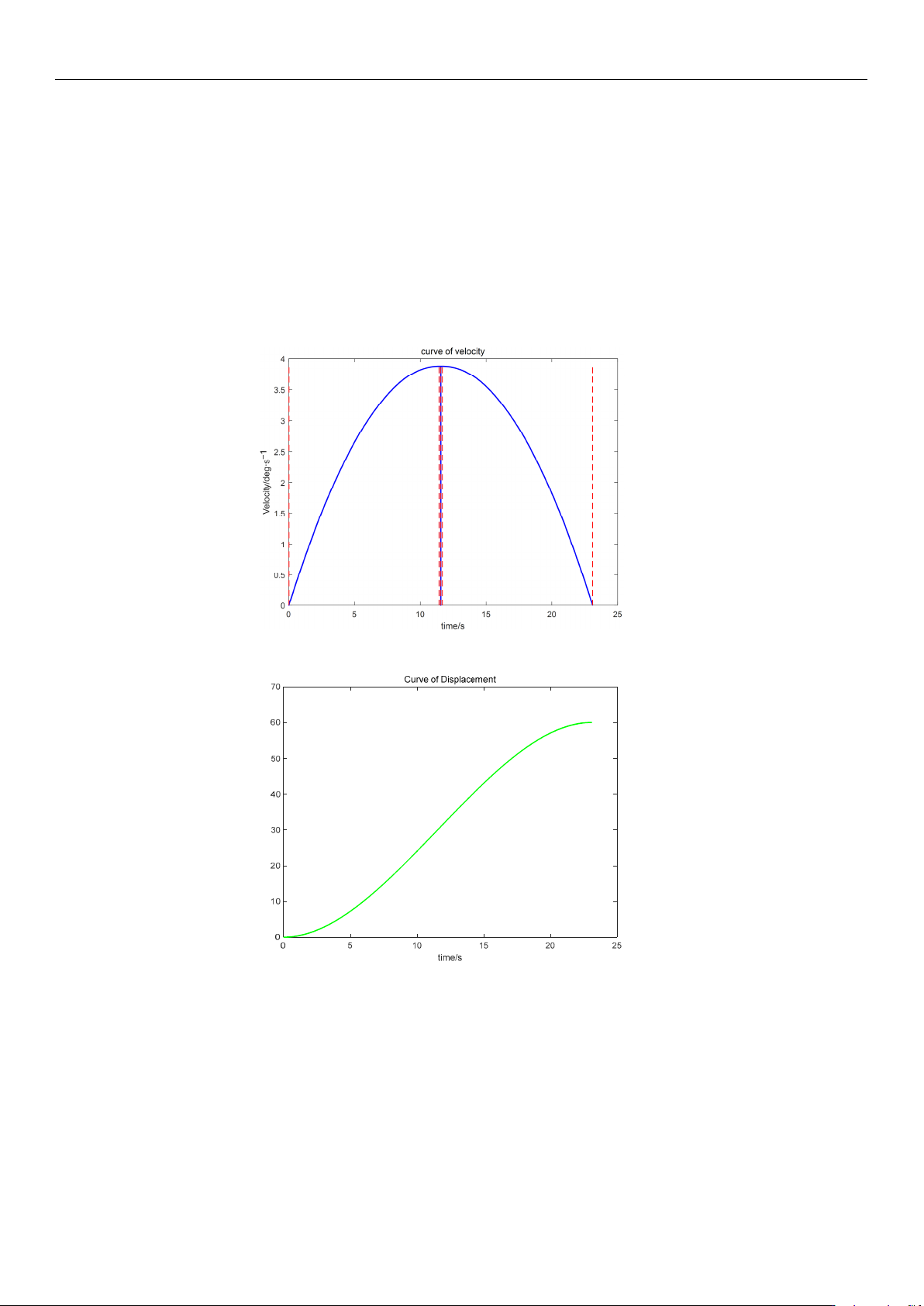
for subsequent analysis, as presented in Figures 5–7.
Figure 5. Velocity trajectory planning profile.
Position/deg
Figure 6. Displacement–time trajectory profile.
The simulation results indicate that the proposed polynomial interpolation–based
trajectory planning method enables the manipulator’s angular velocity to vary continu-
ously and smoothly throughout the entire motion. This significantly mitigates mechanical
vibration and impact induced by abrupt velocity variations, thereby helping to reduce os-
cillations of the end-effector. Moreover, the method imposes a lower computational burden
on the control system, and the acceleration variation can be interpreted more intuitively
substituting the optimal solution t
3
into the energy cost function, the optimal vibration
energy index under the prescribed weight constraint can be obtained. The double-parabola–
trapezoidal velocity planning profile derived from the Graylag Goose Optimization (GGO)
https://doi.org/10.3390/s26030829