s26030829.pdf - 第7页
Sensors 2026 , 26 , 829 7 of 21 Optimization is the process of finding the best solution to a pr oblem among all possible alternatives [ 36 – 38 ]. The Graylag Goose Optimization (GGO) algorithm, as an emer ging metaheuri…
Sensors 2026, 26, 829
6 of 21
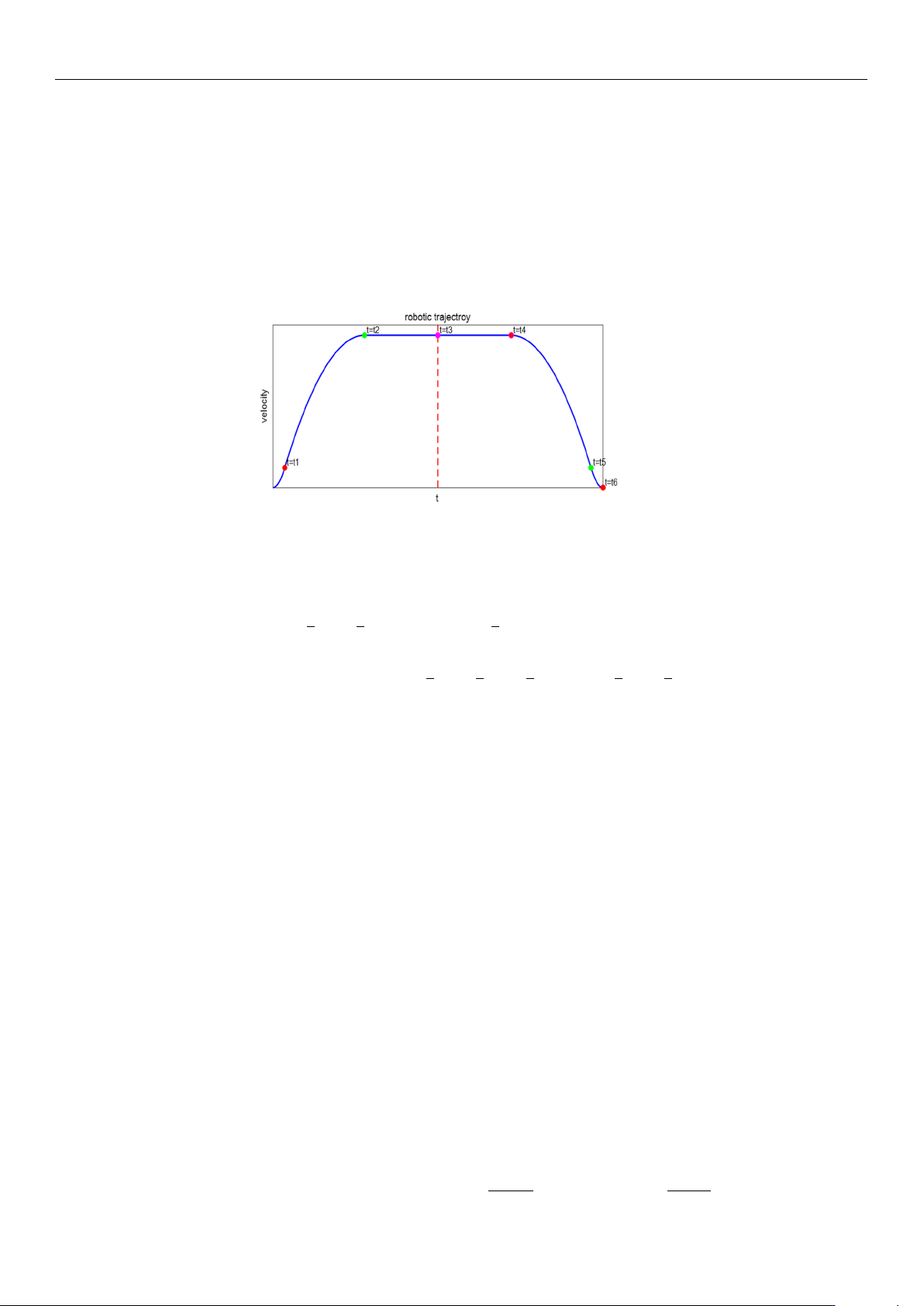
velocity at time t
2
. If t = t
4
, the speed begins to decelerate until it reaches 0 at t
6
, achieving a
smooth stop. The trajectory expression is given in Equation (8).
.
q =
at
2
, 0 < t < t
1
bt
2
+ ct + d, t
1
< t < t
2
bt
2
2
+ ct
2
+ d, t
2
< t < t
4
b
′
t
2
+ c
′
t + d
′
, t
4
< t < t
5
a(t − 2t
3
)
2
, t
5
< t < t
6
(8)
Figure 2. Velocity planning S-shaped curve.
Let the angular displacement of the wafer transport robotic arm be A, then its dis-
placement equation can be expressed in Equation (9).
2
3
at
3
1
+
2
3
bt
3
2
+ ct
2
2
+ 2dt
2
−
2
3
bt
3
1
− ct
2
1
− 2dt
1
+ 2(t
3
− t
2
)(bt
2
2
+ ct
2
+ d) = A (9)
P =
1
3
at
3
1
+
1
3
bt
3
2
+
1
2
ct
2
2
+ dt
2
−
1
3
bt
3
1
−
1
2
ct
2
1
− dt
1
(10)
Q = bt
2
2
+ ct
2
+ d (11)
For the convenience of deriving the formula, we replace part of the polynomial in the
displacement formula with P and Q, as shown in Equations (10) and (11).
The rate of change in jerk directly affects the efficiency of these energy losses, espe-
cially during the initial impact or rapid change stages. In a vibration system, the integral
over time of the square of the jerk reflects the residual vibration energy of the system
during rapid start-stop processes. To quantitatively evaluate vibration suppression per-
formance, Equation (12) defines the residual vibration energy as the time integral of the
squared jerk. Since jerk represents the rate of change in acceleration, minimizing this index
effectively suppresses high-frequency excitation and residual oscillations during rapid
start–stop motions.
In this study, the planned velocity profile is designed to be symmetric with respect
to the mid-time instant t
3
. As a result, the jerk-related vibration energy contributed by
the second half of the motion [t
3
, t
6
] is identical to that of the first half [t
0
, t
3
]. Therefore,
for conciseness, Equation (12) evaluates the vibration energy over [t
0
, t
3
], and the total
vibration energy over the complete motion interval [t
0
, t
6
] can be obtained.
E
vib
=
Z
t
3
0
(
...
q (t))
2
dt (12)
The multi-objective optimization function is:
Min
(
F(t
1
, t
2
) = ω
1
t
2
+
30 − P
Q
+ ω
2
"
4a
2
t
1
+ 4
at
1
t
1
− t
2
2
(t
2
− t
1
)
#)
(13)
https://doi.org/10.3390/s26030829

Sensors 2026, 26, 829
7 of 21
Optimization is the process of finding the best solution to a problem among all possible
alternatives [
36
–
38
]. The Graylag Goose Optimization (GGO) algorithm, as an emerging
metaheuristic algorithm, is inspired by the intelligent behaviors of gray geese during long-
distance migration, such as efficient formation flying, cooperative resting, and dynamic
leadership. The algorithm simulates mechanisms like “leader goose switching,” “flock
following,” and “energy conservation,” enabling a finer balance between convergence
accuracy and optimization speed.
The Graylag Goose Optimization (GGO) algorithm consists of two stages: global
exploration and local optimization. Based on the constraints of the objective function,
a fitness function is defined. After setting the population size, all randomly generated
individuals enter the initial exploration group. The population is then sorted according to
fitness values, and the top N solutions in terms of fitness are defined as the exploitation
group, while the remaining poorer solutions form the exploration group. Individuals that
meet the fitness function criteria are assigned to the “exploitation group,” whereas those
that do not are given high penalty values and re-enter the exploration group to search for
solutions. The initial parameters of the population are shown in Table 3.
Table 3. Origin Parameter of graylag goose population.
Parameter Value
Population size/N 50
Maximum number of iterations/M 200
Minimum time interval/δ 0.1
First, randomly generate N arbitrary solutions. The individual position update strategy
of the Graylag Goose Optimization Algorithm is divided into two parts: global search by
the exploration group and local optimization by the exploitation group. If an individual’s
value does not meet the requirements of the fitness function, assign a high penalty value to
that individual.
Explore group global search:
Strategy 1: Move toward the global best solution X
best
.
x
new
= x
best
− A ·
|
C · x
best
− x
|
(14)
A = 2
(
1 − iter/MaxIter
)
· r
1
+ (1 − iter/MaxIter), C = 2r
2
(15)
The r
1
and r
2
is random Vector
Strategy 2: Guided by Three Random Geese.
x
new
= ω
1
x
r1
+ zω
2
(x
r2
− x
r3
) + (1 − z)ω
3
(
x − x
r1
)
(16)
Partial optimization by the development team
Strategy 1: The three-sentinel geese seek the average value, where the sentinel geese
individuals are selected from the three best solutions in the group based on fitness.
x
new
=
1
3
(
x
s1
+ x
s2
+ x
s3
)
(17)
Strategy 2: Perturbation Near the Current Optimal Solution.
x
new
= x + 0.5(1 + z)ω(x − x
best
) (18)
https://doi.org/10.3390/s26030829
Sensors 2026, 26, 829
8 of 21
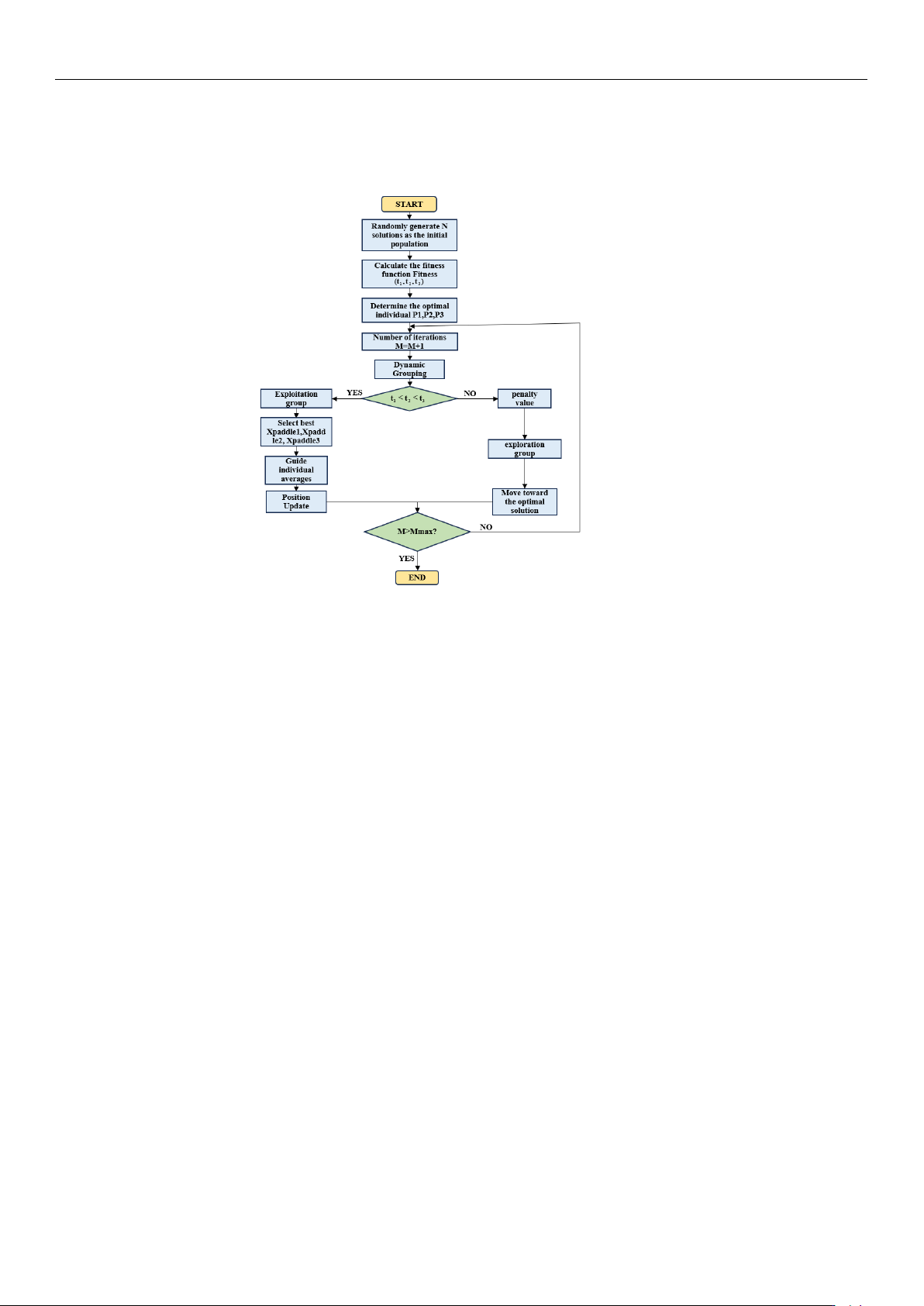
If the maximum number of iterations is reached, it is considered that the final solution
has been achieved, and the iteration stops, exporting the current optimal solution. And its
logical sequence diagram is shown in Figure 3.
Figure 3. Logical Flowchart of the Graylag Goose Optimization Algorithm.
4. Algorithm Testing and Analysis
To verify the performance of the multi-objective GGO function in different workspaces,
five metaheuristic optimization algorithms—Particle Swarm Optimization (PSO) [
14
], Gray
Wolf Optimizer (GWO) [
18
], Whale Optimization Algorithm (WOA) [
26
], Non-dominated
Sorting Genetic Algorithm II (NSGAII) [
10
], and Dung Beetle Optimization (DBO) [
23
]—
were added on the MATLAB 2022B platform for comparison with the multi-objective
GGO function. Two unimodal functions, four multimodal functions, and two composite
functions from the CEC2013 benchmark test set were selected as objective functions, as
shown in Table 4. The performance of the multi-objective GGO algorithm was evaluated
by comparing the results of the test set runs.
In Table 4, a subset of benchmark functions from the CEC2013 test suite is selected to
evaluate the optimization performance of the proposed algorithm. Specifically, functions
F4 and F5 are representative unimodal functions used to assess exploitation capability and
convergence accuracy, whereas F9, F14, F15, F16, F21, and F23 are multimodal or composite
functions designed to evaluate global search ability and robustness against local optima.
These functions cover different landscape characteristics, including high dimensional-
ity, strong nonlinearity, and multiple local minima, which are consistent with the complexity
of multi-objective trajectory optimization problems in robotic systems.
Based on the original Gray Goose Optimization (GGO) algorithm, this study further
develops an improved multi-objective variant to better address the dual-objective vibration
suppression trajectory optimization problem.
https://doi.org/10.3390/s26030829