s26030829.pdf - 第9页
Sensors 2026 , 26 , 829 9 of 21 T able 4. CEC Function T est Results. Function PSO NSGAII GWO WOA DBO MOGGO F4 Mean 1.83 × 10 8 9.87 × 10 6 1.30 × 10 7 4.23 × 10 7 3.02 × 10 8 6.62 × 10 4 Std 6.78 × 10 8 9.83 × 10 6 7.06…
Sensors 2026, 26, 829
8 of 21
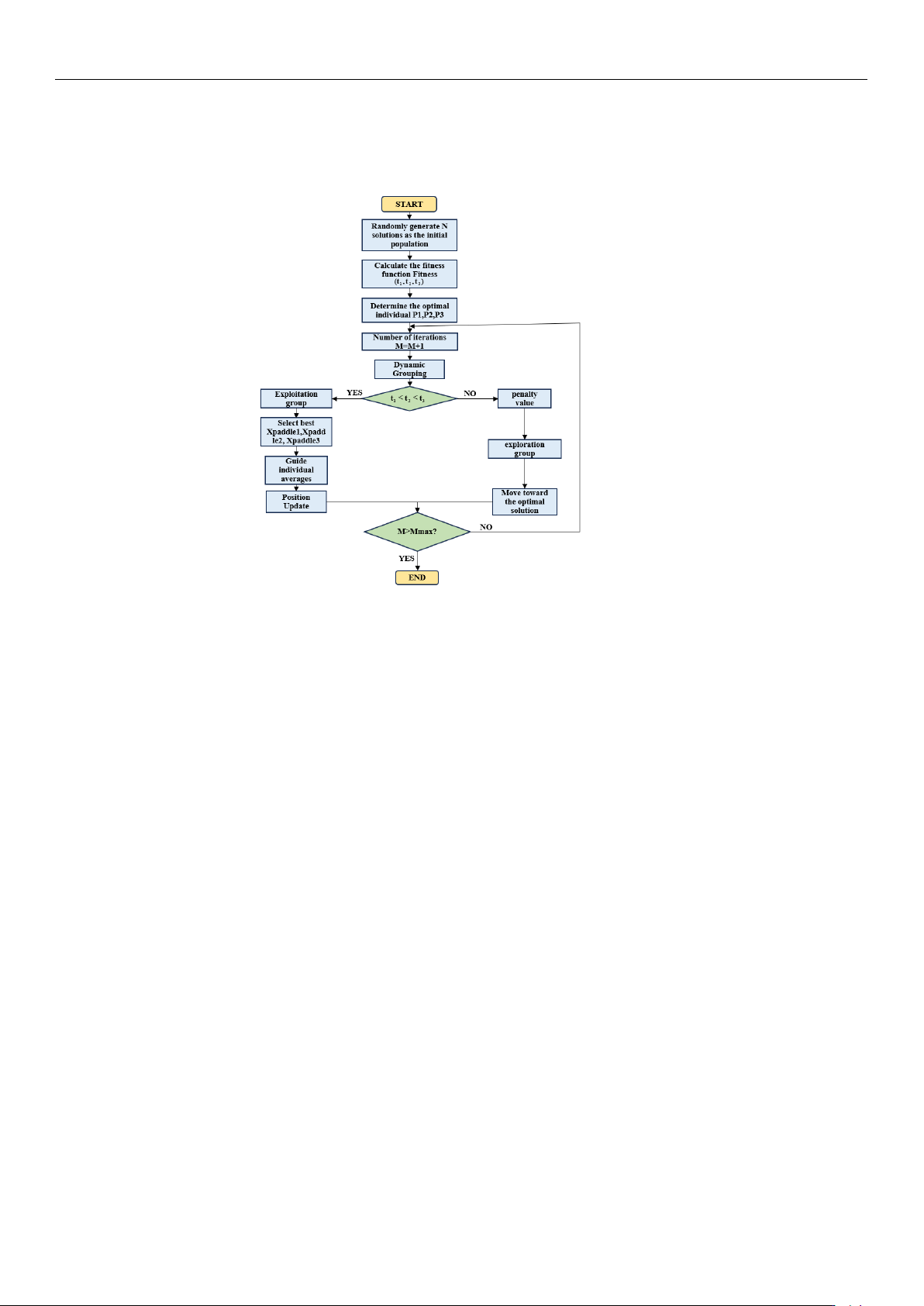
If the maximum number of iterations is reached, it is considered that the final solution
has been achieved, and the iteration stops, exporting the current optimal solution. And its
logical sequence diagram is shown in Figure 3.
Figure 3. Logical Flowchart of the Graylag Goose Optimization Algorithm.
4. Algorithm Testing and Analysis
To verify the performance of the multi-objective GGO function in different workspaces,
five metaheuristic optimization algorithms—Particle Swarm Optimization (PSO) [
14
], Gray
Wolf Optimizer (GWO) [
18
], Whale Optimization Algorithm (WOA) [
26
], Non-dominated
Sorting Genetic Algorithm II (NSGAII) [
10
], and Dung Beetle Optimization (DBO) [
23
]—
were added on the MATLAB 2022B platform for comparison with the multi-objective
GGO function. Two unimodal functions, four multimodal functions, and two composite
functions from the CEC2013 benchmark test set were selected as objective functions, as
shown in Table 4. The performance of the multi-objective GGO algorithm was evaluated
by comparing the results of the test set runs.
In Table 4, a subset of benchmark functions from the CEC2013 test suite is selected to
evaluate the optimization performance of the proposed algorithm. Specifically, functions
F4 and F5 are representative unimodal functions used to assess exploitation capability and
convergence accuracy, whereas F9, F14, F15, F16, F21, and F23 are multimodal or composite
functions designed to evaluate global search ability and robustness against local optima.
These functions cover different landscape characteristics, including high dimensional-
ity, strong nonlinearity, and multiple local minima, which are consistent with the complexity
of multi-objective trajectory optimization problems in robotic systems.
Based on the original Gray Goose Optimization (GGO) algorithm, this study further
develops an improved multi-objective variant to better address the dual-objective vibration
suppression trajectory optimization problem.
https://doi.org/10.3390/s26030829

Sensors 2026, 26, 829
9 of 21
Table 4. CEC Function Test Results.
Function PSO NSGAII GWO WOA DBO MOGGO
F4
Mean
1.83 × 10
8
9.87 × 10
6
1.30 × 10
7
4.23 × 10
7
3.02 × 10
8
6.62 × 10
4
Std
6.78 × 10
8
9.83 × 10
6
7.06 × 10
7
9.44 × 10
7
2.10 × 10
8
3.91 × 10
4
F5
Mean
3.78 × 10
7
1.62 × 10
6
3.37 × 10
6
7.36 × 10
5
1.06 × 10
5
8.5 × 10
3
Std
5.25 × 10
7
7.19 × 10
6
4.56 × 10
6
6.15 × 10
6
2.12 × 10
6
9.47 × 10
3
F9
Mean −557.91 −557.61 −556.16 −556.8 −557.27 −558.48
Std 2.6599 1.8035 2.2561 1.8668 1.8109 3.6466
F14
Mean
1.97 × 10
4
1.11 × 10
3
9.82 × 10
3
9.93 × 10
3
7.41 × 10
3
7.95 × 10
3
Std
1.25 × 10
4
4.59 × 10
3
3.28 × 10
3
3.16 × 10
3
4.12 × 10
3
871.7893
F15
Mean
2.05 × 10
4
1.24 × 10
4
9.4 × 10
3
8.76 × 10
3
9.21 × 10
3
7.35 × 10
3
Std
1.13 × 10
4
4.50 × 10
3
2.52 × 10
3
3.12 × 10
3
2.26 × 10
3
1.08 × 10
3
F16
Mean 204.0242 203.6665 203.8356 204.1670 203.9555 203.9054
Std 0.6995 0.3577 0.3197 0.3353 0.4455 1.3284
F21
Mean
7.54 × 10
5
1.38 × 10
5
4.06 × 10
4
5.70 × 10
5
8.94 × 10
4
2.98 × 10
3
Std
7.43 × 10
5
3.44 × 10
5
2.18 × 10
5
2.52 × 10
5
2.76 × 10
5
249.0022
F23
Mean
2.14 × 10
4
1.24 × 10
4
1.09 × 10
4
1.09 × 10
4
1.09 × 10
4
9.63 × 10
3
Std
1.26 × 10
4
4.13 × 10
3
2.91 × 10
3
2.37 × 10
3
1.96 × 10
3
819.0361
It should be noted that the proposed Multi-Objective Gray Goose Optimization
(MOGGO) algorithm is an improved version of the original GGO algorithm. In this study, a
Logistic chaotic map is introduced to enhance the diversity of the initial population, while a
Gaussian (normal) disturbance mechanism is incorporated during the optimization process
to improve global exploration ability and avoid premature convergence. In addition, the
original single-objective GGO framework is extended to handle multi-objective optimiza-
tion, making it suitable for solving the dual-objective vibration suppression trajectory
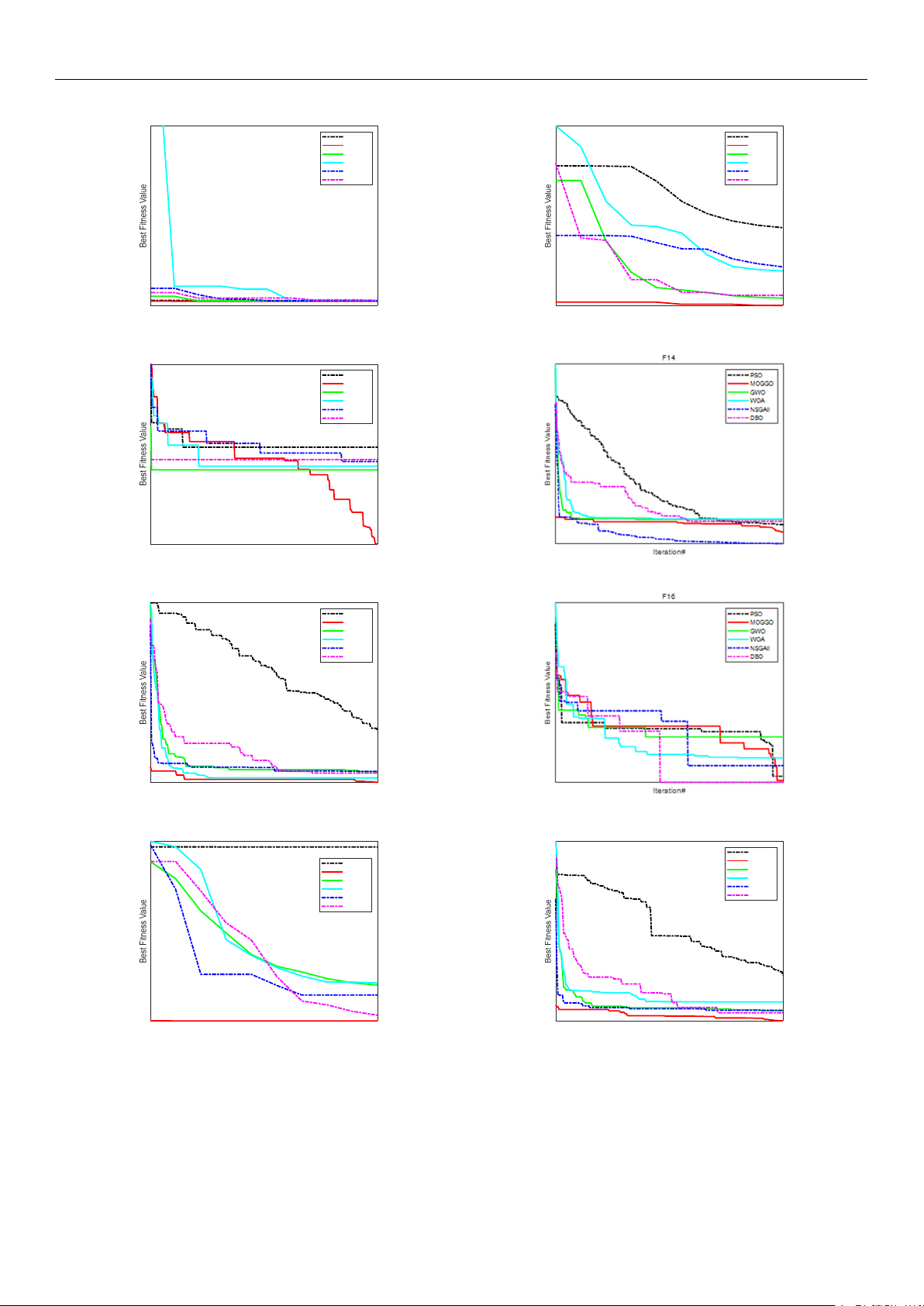
planning problem. The results of the CEC2013 test set are shown in Figure 4. The results
indicate that MOGGO performs the best overall on the CEC2013 test functions, significantly
outperforming the comparison algorithms in terms of convergence speed, solution accuracy,
and stability.
As shown in Figure 4a–h, the convergence behaviors of different algorithms are
compared on benchmark functions F4, F5, F9, F14, F15, F16, F21, and F23. Overall, MOGGO
demonstrates faster convergence speed and better solution accuracy across most test
functions. In unimodal functions, the MOGGO rapidly reaches the optimal region, while in
multimodal and complex functions, it maintains stable convergence and effectively avoids
premature stagnation. In contrast, PSO, WOA, GWO, and NSGA-II generally exhibit
slower convergence or are more prone to local optima. These results indicate that MOGGO
achieves a better balance between global exploration and local exploitation.
(1) Set the forearm to rotate 120
◦
, with the motor’s starting acceleration at 20 deg/s
2
.
On the MATLAB platform, set the population size and number of iterations, define the
main loop function of the algorithm and the displacement equation, and establish it as a
fitness function according to the strict constraint t
1
< t
2
< t
3
. The fitness function can be
expressed as:
F = ω
1
t
3
+ ω
2
E
vib
+ ε (19)
Among them,
1
and
2
are the target weight values, and e is the penalty value. In Equa-
tion (19), w1 and w2 denote the weighting coefficients for motion time and residual vibration
energy, respectively, satisfying w
1
+ w
2
= 1. These parameters allow flexible trade-offs be-
tween efficiency and vibration suppression according to different operational requirements.
https://doi.org/10.3390/s26030829
Sensors 2026, 26, 829
10 of 21
(a) (b)
(c) (d)
(e) (f)
(g) (h)
Iteration#
F4
PSO
MOGGO
GWO
WOA
NSGAII
DBO
Iteration#
F5
PSO
MOGGO
GWO
WOA
NSGAII
DBO
Iteration#
F9
PSO
MOGGO
GWO
WOA
NSGAII
DBO
Iteration#
F15
PSO
MOGGO
GWO
WOA
NSGAII
DBO
Iteration#
F21
PSO
MOGGO
GWO
WOA
NSGAII
DBO
Iteration#
F23
PSO
MOGGO
GWO
WOA
NSGAII
DBO
Figure 4. Convergence Curves for a Subset of the CEC2013 Test Functions.
It is triggered when an individual does not satisfy the condition t
1
< t
2
< t
3
, and is
randomly assigned a larger value to make the individual enter the exploration group to
perform a deep search.
https://doi.org/10.3390/s26030829