46230812.pdf - 第27页
Page 25 TECHNICAL PUBLICATIONS DH Positioning System Assembly , P/T T46230812 Rev . D This Document Supports Assembly 46230812 Adjustment Procedure: Depending on the machine configuration, covers and/or assembly componen…
Page 24
TECHNICAL PUBLICATIONS
T46230812 Rev. D DH Positioning System Assembly, P/T
This Document Supports Assembly 46230812
Rotary Disk Alignment
Purpose:
The rotary disk alignment procedure aligns the rotary disk to the X axis
table.
Several associated assemblies rely on one another. If one assembly is
adjusted, the rest are affected. It may be necessary to alternate between one
step of the procedure and another several times until the rotary disk is
aligned.
Read the entire rotary disk alignment procedure before attempting the
adjustment.
Rotary disk alignment is correct when, with the rotary disk locked in the
FRONT position, the dowel pins can be inserted and removed by hand
through the rotary disk and into the X axis table.
Due to the tolerance build up, interference may be felt when inserting and
removing the pins. This is normal and in no way means the table is not
properly aligned. If the pins can not be inserted into the holes with force,
the disk is not properly aligned.
After the rotary disk is aligned, the two locator pin assemblies drop into
their corresponding locator holes. The additional pressure exerted by
the lock assembly may cause the rotary disk to shift. This shift prevents
the insertion or extraction of the guide pins and additional adjustment of
the lock assembly is required.
If the locator pins slide into the holes after the lock and drive
assemblies are in position, alignment is correct. Proceed to the X-Y
axes encoder adjustments.
Machines with Board Handling System have two low profile guide
wheels which require a special wrench and procedures. These
differences are noted as applies in the following procedure.
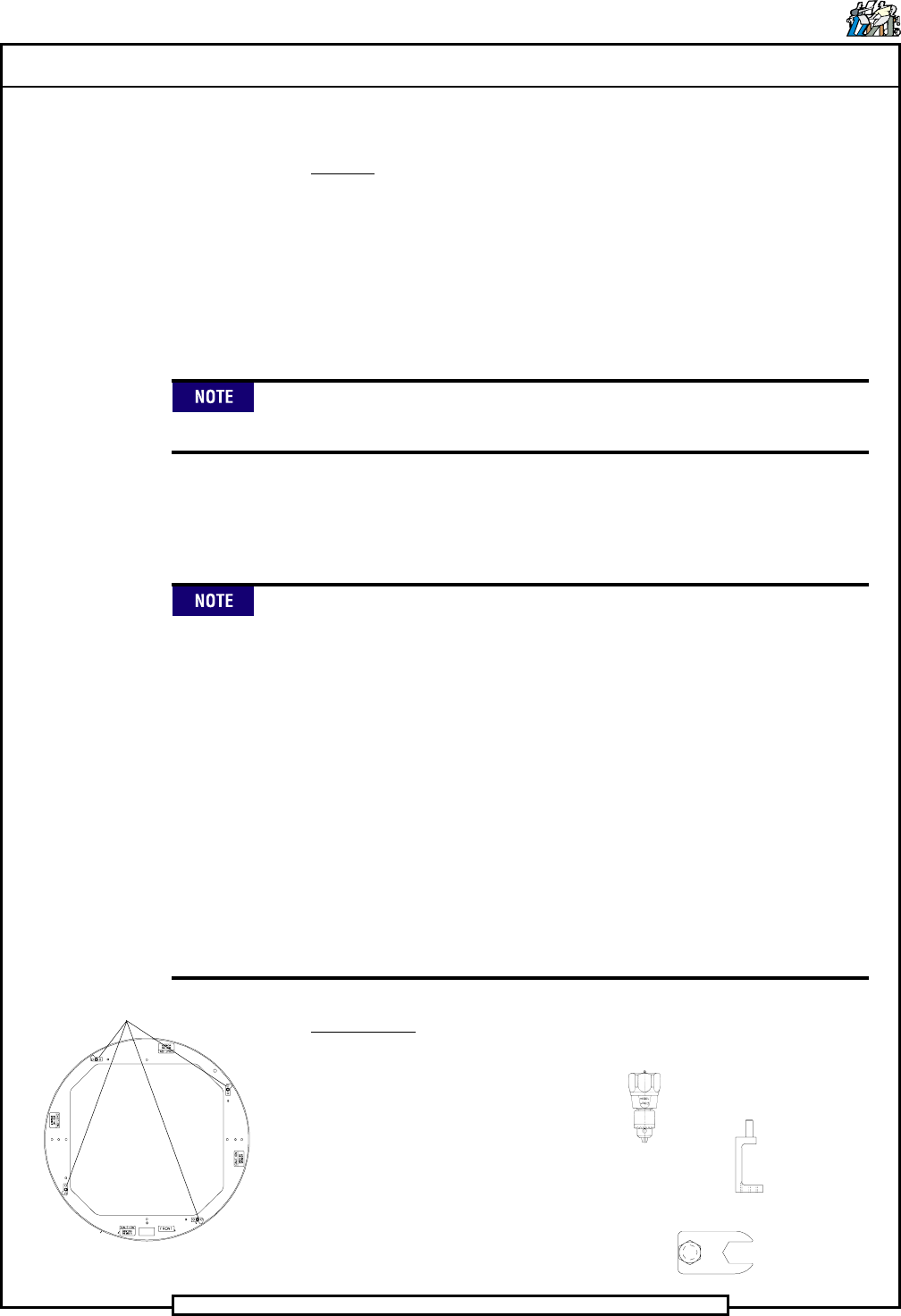
Special Tools:
Torque Wrench (in./lbs.)
Torque Gage (in./oz.) (46808001)
(Waters Mfg. model 651C-30)
Torque Adapter (45081601) (High profile guide wheels)
Dowel pins (1/4 x 2) (80010109) with collars (18333000)
Wrench (46758401) (Low profile guide wheels)
Rotary Disk Assembly
STOP BLOCKS
Page 25
TECHNICAL PUBLICATIONS
DH Positioning System Assembly, P/T T46230812 Rev. D
This Document Supports Assembly 46230812
Adjustment Procedure:
Depending on the machine configuration, covers and/or assembly
components will have to be removed to allow access to the guide
wheels and drive assembly.
1. Remove the four stop blocks from the rotary disk
2. Remove the two socket head cap screws from the stop plate on the
drive assembly.
3. Remove the stop plate from the drive assembly to remove the drive
wheel pressure on the rotary disk.
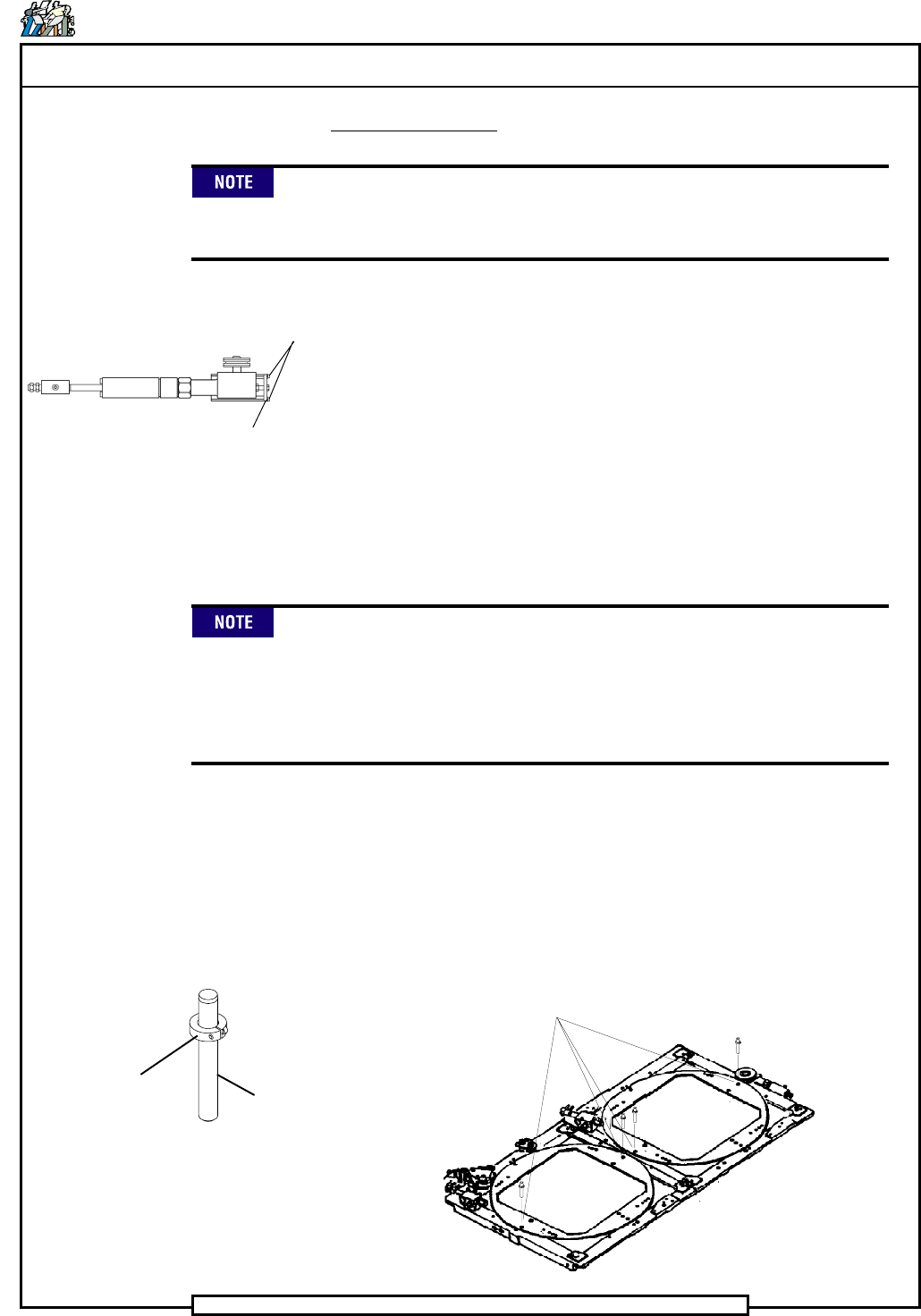
4. Assemble the locator pin assemblies using dowel pins and collar
clamps.
5. Insert the locator pin assemblies through the locator holes in the rotary
table and into the locator holes in the X axis table as shown.
Due to the tolerance build up, interference may be felt when inserting and
removing the pins. This is normal and in no way means the table is not
square. If the pins can not be inserted into the holes, the disk is not
square. Some resistance may be encountered when fitting the pins into
the holes, but the resistance should never require the assistance of a
tool to remove the pins from the X axis frame.
6. If the pins can be inserted into the locator holes, proceed to step 20 to
adjust the lock assembly. If the pins can not be inserted into the locator
holes, proceed as follows.
7. Loosen the button head cap screw securing the locking bracket at each
of the four guide wheel assemblies.
Rotary Disk Drive Assembly
SOCKET HEAD
CAP SCREWS
STOP
PLATE
Locator Pin Assembly
DOWEL PIN
COLLAR
CLAMP
LOCATOR
HOLES
Page 26
TECHNICAL PUBLICATIONS
T46230812 Rev. D DH Positioning System Assembly, P/T
This Document Supports Assembly 46230812
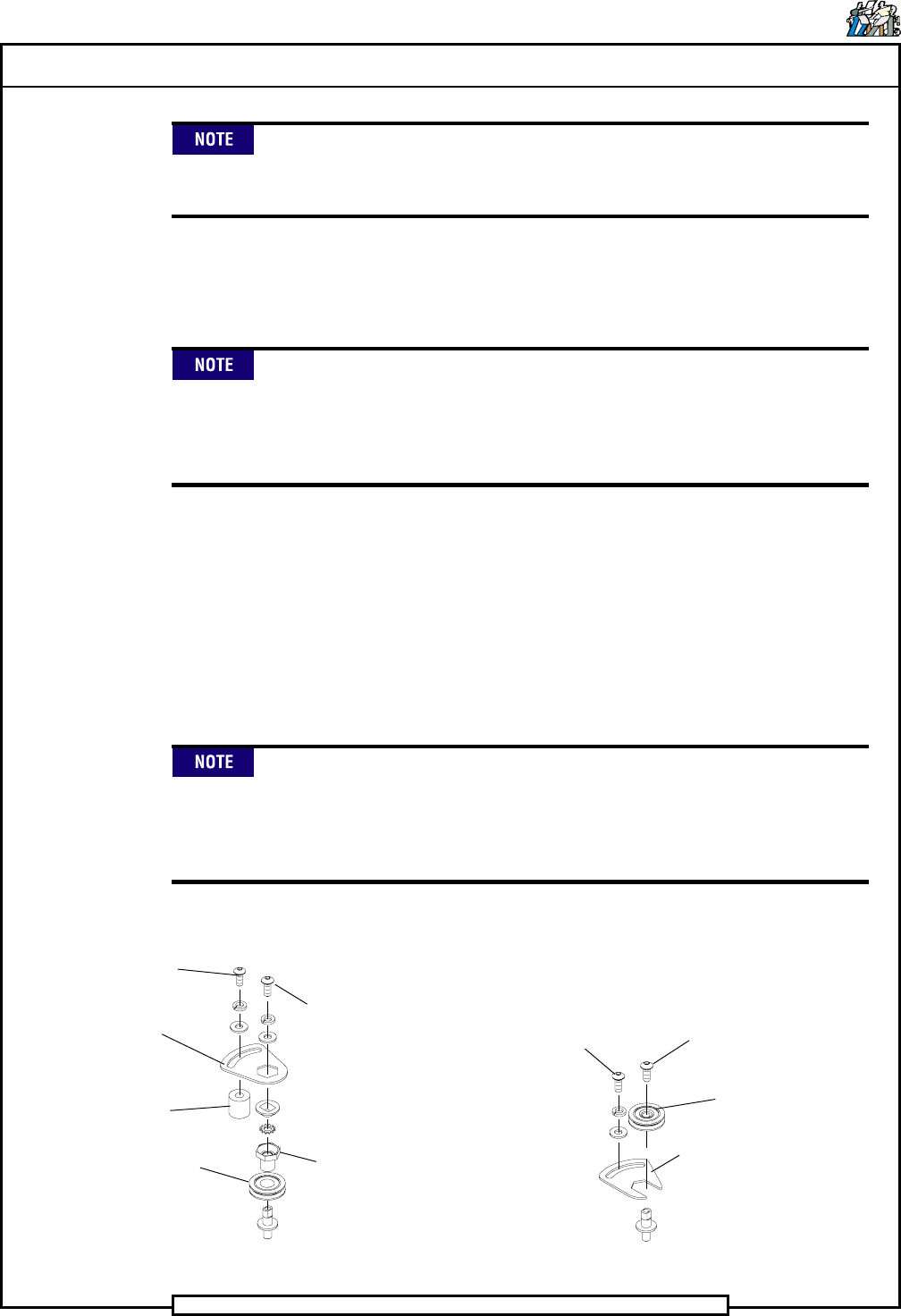
Machines with Board Handling System have two styles of rotary disk
guide wheels. Two are high profile as used on machines without board
handling and two are low profile. Refer to the illustration below.
8. At each of the four guide wheel assemblies, loosen the button head cap
screw that secures the guide wheel bushing adapter and/or guide wheel
with bushing enough to allow them to turn.
The guide wheel bushing adapter/guide wheel with bushing is an
eccentric. Turning them in a counterclockwise direction increases the
amount of resistance between the rotary disk and the guide wheel.
Turning them in a clockwise direction decreases the amount of
resistance between the guide wheel and the rotary disk.
9. Using the locking bracket, rotate each guide wheel bushing adapter
and/or guide wheel with bushing in a clockwise direction, to release
pressure on the rotary disk.
10. Manually position the rotary disk so the FRONT label on the rotary
disk is located at the front of the machine.
11. Align the two .25 inch (6,4mm) locating holes in the rotary disk with
the two .25 inch (6,4mm) locating holes in the top of the X axis frame.
The rotary disk is centered between the four guide wheels by applying
equal pressure from all four guide wheels. When adjusting the guide
wheels, adjust in diagonal pairs. Adjust one diagonal pair of guide
wheels, then adjust the other diagonal pair of guide wheels in the same
manner.
GUIDE WHEEL
BUSHING
ADAPTER
GUIDE
WHEEL
LOCKING
BRACKET
SPACER
HIGH PROFILE
BUTTON HEAD
CAP SCREW
LOW PROFILE
BUTTON HEAD
CAP SCREW
LOCKING
BRACKET
GUIDE WHEEL
WITH BUSHING
BUTTON HEAD
CAP SCREW
BUTTON HEAD
CAP SCREW