i3070series6_Site_Preparation+11-12.3.pdf.pdf - 第36页
6-4 Site Preparation 6 Power Requirem ents Power Drop • A dedicated power dr op must be pr ovided for the system due to its high curr ent r equir ements. • Copper wir e must be us ed for the power dr op. • An electrician…
Power Requirements 6
Site Preparation 6-3
Power Requirements
• Mains Disconnect
• Power Drop
• Basic Power Quality Survey
• Connecting Power to the PDU
Mains Disconnect
A mains disconnect — providing over-current and short-circuit protection — must
be provided for the system. The mains disconnect should be in the form of a
multi-pole circuit breaker.
The mains disconnect must:
• Comply with UL 489/CSA C22.2 No.5 standard; rated current 20 A or below.
• Open all line conductors and neutral conductors where local code applies, but
not the protective earth conductor.
• Be marked “System Mains Disconnect” or the equivalent in your local language
• Be marked with a “|” for the “On” position or “O” for the “Off” position.
• Be capable of being locked in the “Off” position, but not in the “On” position.
• Be installed within 3 meters of the system, where it can be easily reached by
the system operator without requiring the system to be moved to access the
disconnect.
• Be rated for a minimum of 10,000 amps interrupting capacity (AIC) if used on a
200–240 volt circuit, or 14,000 AIC if used on a higher voltage circuit.
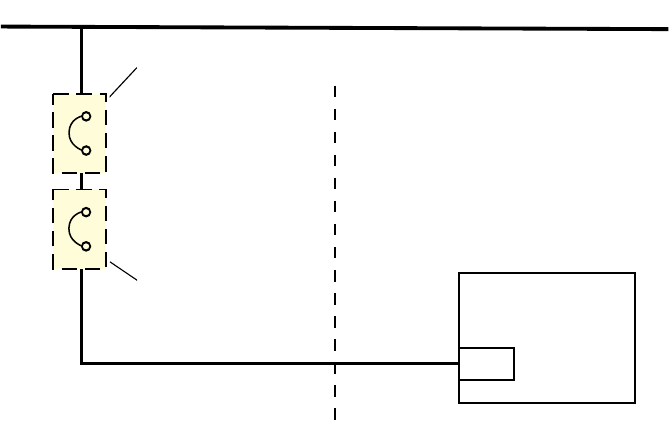
Figure 6-1 Wiring diagram
20 A / 3-Ph breaker
or three 20 A fuses
System
PDU
Installation site
Existing breaker from Series 5 installation
30 A / 3-Ph breaker
or three 30 A fuses
New breaker for Series 6
Keysight
equipment
AC Voltage Source
6-4 Site Preparation
6 Power Requirements
Power Drop
• A dedicated power drop must be provided for the system due to its high current
requirements.
• Copper wire must be used for the power drop.
• An electrician must determine the wire size for the power drop. The wires must
be sized to ensure that the voltage at the system does not drop below
90 percent of nominal (see Calculating the Minimum Voltage below).
Calculating the Minimum Voltage
The voltage at the system must be at least 90 percent of nominal. To calculate the
minimum rms voltage multiply the rms voltage by 0.9. To calculate the minimum
peak voltage, multiply the rms voltage by 0.9 and then 1.414. For example:
208 volts rms * 0.9 * 1.414 = 265 volts peak
Power Requirements 6
Site Preparation 6-5
Sizing the Input Wires and Circuit Breakers
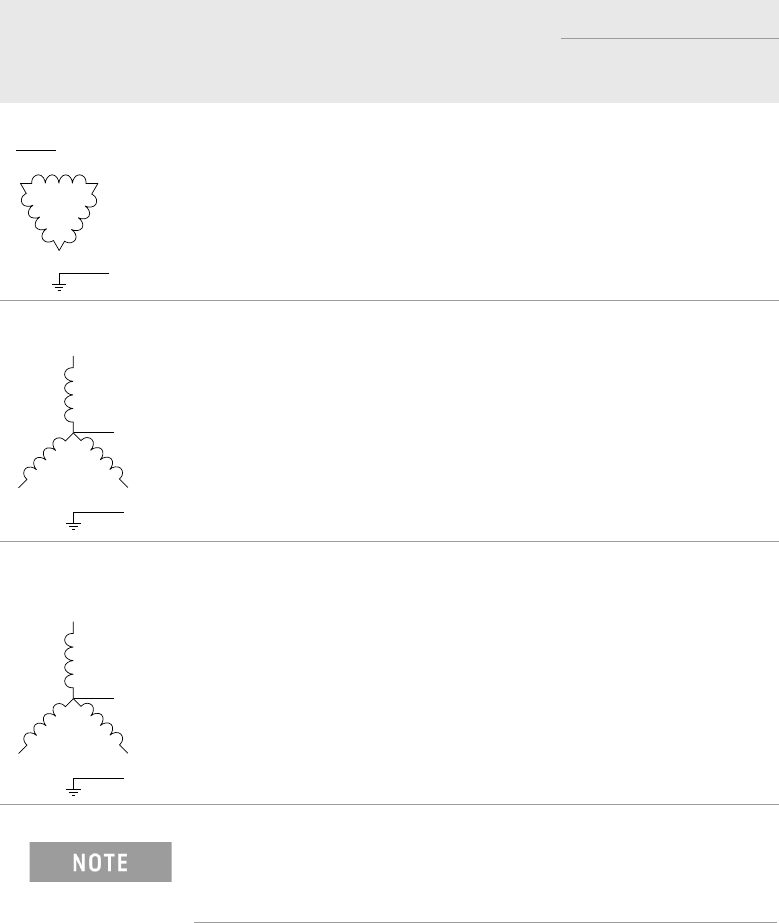
Table 6-1 shows the full-load amps (FLA) for each system type.
Table 6-1 Power requirements
PDU
Power
Option
Frequency Voltage
line-to-neut /
line-to-line
Full-Load Amps (FLA) for:
E9905G E9903G/
E9902G
200–240V 3-Phase Delta 3PD 50/60 Hz 200
220
230
240
18
18
18
18
24
24
24
24
208–220V 3-Phase Wye 3PY 50/60 Hz 208
220
18
18
24
24
380–415V 3-Phase Wye
with Neutral
3PN 50/60 Hz 220 / 380
230 / 400
240 / 415
10
10
10
16
16
16
Neutral is not used by the systems for power options 3PD and
3PY. Neutral is shown in the diagrams because Neutral is
cabled into the PDU.
L1
L3
L2
G
N (optional)
L1
L3
L2
G
N (optional)
L1
L3
L2
G
N