i3070series6_Site_Preparation+11-12.3.pdf.pdf - 第47页
Compressed Air and Vacuum Requirements 7 Site Preparation 7-3 Compressed Air Requirements The i3070 uses compr essed air to pr essuri ze air cylinders that actuate fixtur e pull-down towers. Pull-down towers ar e used to…
7-2 Site Preparation
7 Compressed Air and Vacuum Requirements
Introduction
Both compressed (or pressurized) air and vacuum are used in the testhead.
Compressed air is used primarily to secure the test fixture to the testhead. Vacuum
is used primarily to actuate the test fixture: that is, to make contact between the
board under test and the probes in the fixture. Compressed air is sometimes also
used for air-assisted, solenoid-actuated valves used to switch the vacuum, and for
air-actuated test fixtures.
The site preparation requirements for compressed air and vacuum are different
depending on the type of testhead you are preparing the site for. This chapter
describes those requirements.
For more about compressed air and vacuum principles and terminology, see the
short Compressed Air and Vacuum Primer on page 7-6.
Compressed Air and Vacuum Requirements 7
Site Preparation 7-3
Compressed Air Requirements
The i3070 uses compressed air to pressurize air cylinders that actuate fixture
pull-down towers. Pull-down towers are used to pull and hold a fixture down onto
the testhead, enabling contact between the pins on the fixture and the
spring-loaded interface pins in the testhead.
Connecting Air to the Testhead
Install compressed air lines using rigid line to a point near the testhead. An air cutoff
valve is recommended for situations when the air line must be disconnected.
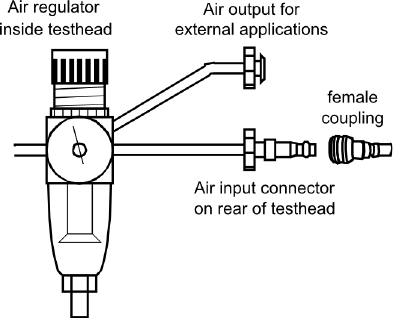
When the system is installed, connect the air to the testhead with a flexible line that
has a Hansen Series 3000 Push-tite 1/4-inch female coupling or equivalent. The
testhead air input connector is shown in Figure 7-1.
Figure 7-1 Compressed air connection to the testhead

7-4 Site Preparation
7 Compressed Air and Vacuum Requirements
Compressed Air Specifications
Table 7-1 shows the compressed air specifications for the systems.
Air Quality
The compressed air must be oil-free and must meet the humidity specifications in
Table 7-1. We recommend that the air be filtered to remove contaminants such as
oil and aerosols. The filter should filter 0.3-micron particles.
Table 7-1 Compressed air specifications for the system
Description Measurement
Maximum Pressure for Testhead Only 1035 kPa (150 psi)
Minimum Pressure for Testhead Only 480 kPa (70 psi)
Minimum Flow Rate for Testhead Only 0.66 l/s at STP (1.4 SCFM)
Relative Humidity allowed 70% for compressed air (150 psi) at 25°C
50% for compressed air (150 psi) at 40°C
Dew point must be not more than 5°C